
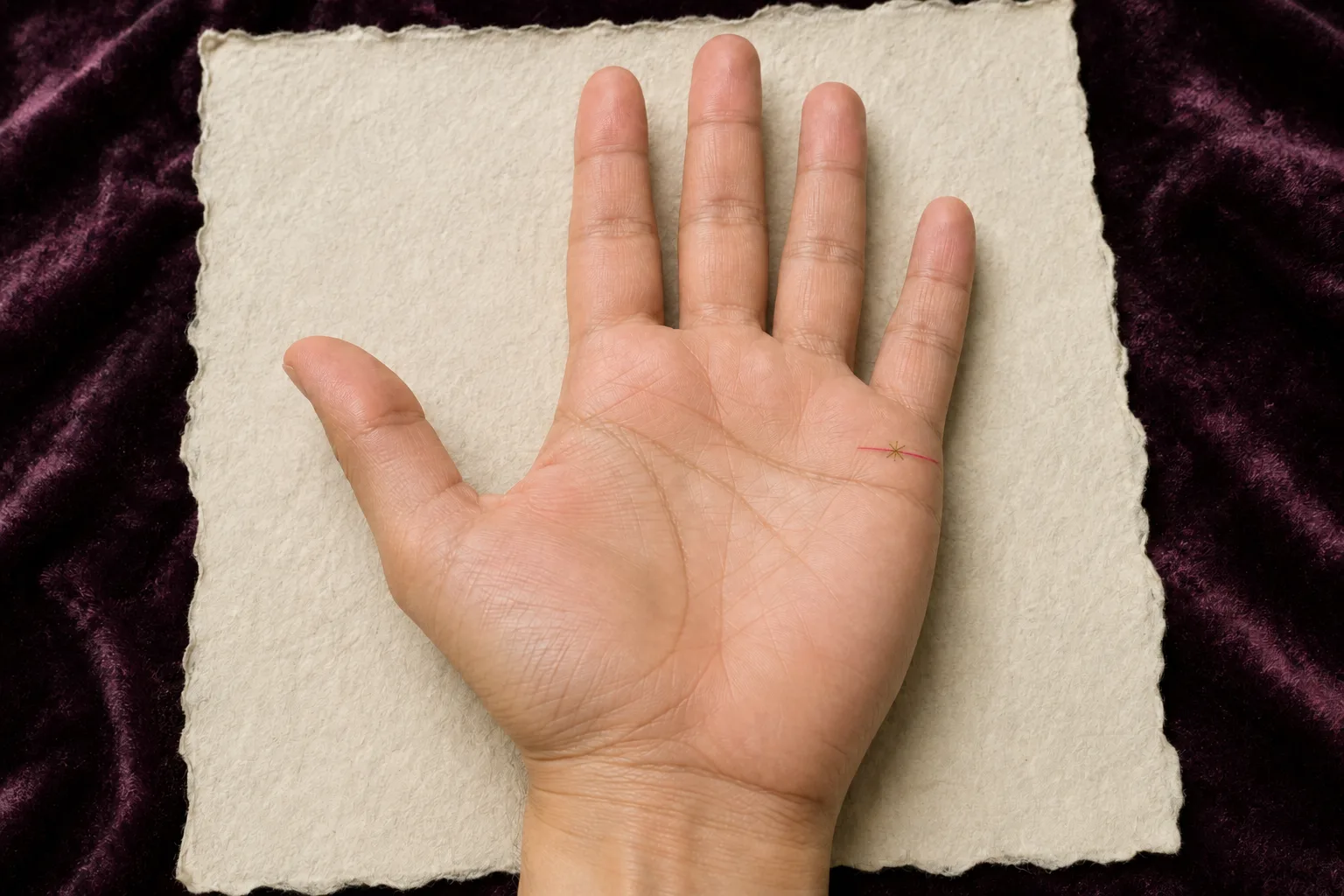
A star on the marriage line is made by at least three short strokes converging through one shared center that touches a verified relationship-line parent. Traditional palmistry associates it with a sudden, intense, or highly consequential relationship chapter. It does not prove partner loss, death, divorce, betrayal, infidelity, scandal, or a bad marriage. First verify the star, the correct edge zone, the parent line, every ray, start-middle-end position, continuation, Heart, Venus, Head, Fate, real behavior, timing limits, and both palms.
A relationship-line star becomes personal only after the correct Mercury-edge zone, one true edge-origin parent, at least three short strokes, one shared center, exact contact, ray origins, start-middle-end position, height, clarity before and after, cross, fork, grille, child-line, multiple-line, island, break and edge-fold tests, Heart, Venus, Head, Fate, Mercury, Sun, timing, real behavior, and both palms are compared. A whole-hand reading can show how love, trust, communication, commitment, responsibility, visibility, and change work together.
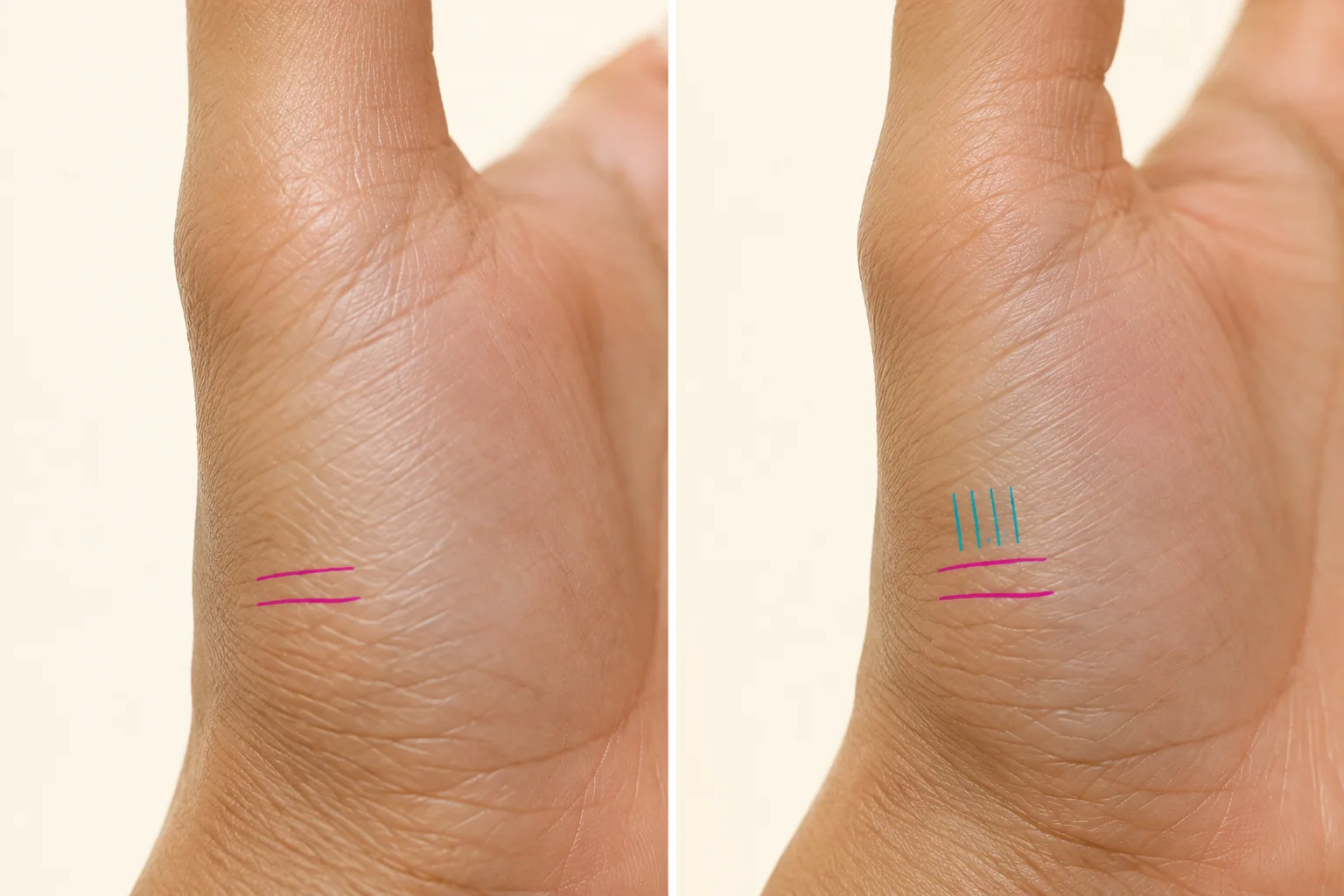
The so-called marriage lines are short horizontal creases on the outer edge below the little finger and above the Heart line. Relationship line or union line is often a clearer name because these creases do not count legal marriages. A star is one local marking on one line. It should never be turned into a complete relationship prediction by itself.
How to identify a true star on a marriage line
Use the complete marriage-line guide to find the narrow Mercury-edge zone. Photograph the side edge as well as the open palm; a front-only image can hide where each tiny crease starts.
- Locate the correct zone between the Heart line and little-finger base.
- Trace one relationship-line parent from the outer edge inward.
- Find at least three short strokes crossing at nearly one point.
- Confirm one shared center with six or more radiating arms.
- Place the center on the parent, not merely near it on Mercury.
- Trace every ray to exclude branches, child lines, and ordinary folds.
- Record start, middle, or end position along the true parent.
- Compare the line before and after for clarity, break, island, fork, or chain.
- Add Heart, Venus, Head, Fate, and behavior as relationship context.
- Compare both palms with matching front and edge photographs.
This is the ten-part marriage-line-star method: zone, parent, three strokes, shared center, contact, ray origins, position, continuation, support, and both palms. Two intersecting strokes make a cross, not a star. Several intersections without one center form a grille or ordinary texture.
Star, cross, fork, grille, child line, island, or edge fold?
| Formation | What to trace | Why it differs |
|---|---|---|
| Star on relationship line | At least three short strokes share one center touching the parent | Six or more rays converge at one point |
| Cross | Exactly two strokes intersect | Four arms rather than six or more |
| Fork or branch cluster | Two or more arms grow from one junction on the parent | They divide outward rather than cross through one center |
| Grille | Several lines create multiple separate intersections or cells | No single shared center |
| Child line | One fine vertical stroke rises from or cuts the edge line | One stroke cannot create a star |
| Island | The parent splits, encloses space, and reunites | A closed oval rather than radiating rays |
| Edge fold | A broad crease changes with finger flexion | Ordinary joint movement, not a fine marking |
The general star-mark guide owns the shared-centre shape and mount meanings. The relationship-line island guide owns one enclosed loop, and the fork guide owns one parent splitting into endpoint arms.
What a star on the marriage line traditionally means
Traditional readers use a star to intensify the subject of the line it touches. On a relationship line, it can frame a sudden beginning, defining encounter, rapid commitment, dramatic revelation, concentrated pressure, abrupt change in circumstances, or a relationship chapter that becomes unusually important. The star describes intensity and suddenness more readily than it describes a favorable or difficult outcome.
The parent line and continuation supply direction. A deep clear line that continues after the star tells a different story from one that breaks, fades, chains, or forks at the same point. A separate star on the Mercury mount may emphasize communication, applied skill, or commerce rather than a specific bond. If the line reaches toward Apollo, visible or public relationship themes may become relevant, but the route must actually be traced.
The star cannot prove what a partner feels or intends. It cannot establish infidelity, abuse, divorce, scandal, accident, illness, or death. Use real conduct, conversations, agreements, records, medical evidence, and safety information for those questions. Palmistry can organize reflection around where intensity entered the relationship pattern and what happened afterward.
| Common fear | What the mark establishes | Useful question |
|---|---|---|
| “My partner will die” | A crease cannot predict a person's death or health | What real evidence or care is relevant now? |
| “It guarantees divorce” | The star only concentrates one point on one line | Does the relationship line continue clearly? |
| “It proves cheating” | A hand mark cannot reveal another person's conduct | What do honesty, consistency, and boundaries show? |
| “My relationship will become a scandal” | The star does not predict public events | Is there any genuine Apollo connection or public context? |
| “I will have a bad marriage” | One mark cannot define the whole bond | How do Heart, Venus, Head, behavior, and both hands combine? |
What start, middle, or end position changes
Trace the relationship line from the outer edge inward. Position describes where the traditional intensity sits within the line's symbolic story. It does not supply a universal event or exact age.
| Star position | Traditional focus | What to verify |
|---|---|---|
| At the outer start | Sudden meeting, rapid beginning, early intensity, or unusual circumstances | The star center is on the true edge origin |
| Near the middle | A defining event, revelation, pressure, or transition within the bond | Clarity and condition on both sides |
| At the inner end | A decisive outcome, changed direction, or intensified later chapter | Endpoint, downward or upward movement, and nearby mounts |
| Beside the line | Mercury-mount intensity may influence the relationship theme | Whether the shared center actually touches the parent |
| At a fork junction | Sudden intensity coincides with diverging directions | Which rays belong to the fork and which create the star |
| Where a long line reaches Apollo | Visibility, recognition, reputation, or a public partnership theme | A genuine route into the Apollo area |
What the relationship line after the star changes
Continue tracing inward from the outer edge and compare the line immediately before and after the shared center. A star can look dramatic while the parent remains coherent.
- Clear continuation: sudden intensity is followed by an ongoing, coherent bond or relationship theme.
- Deeper continuation: commitment, clarity, or significance may consolidate afterward.
- Fainter continuation: the bond may become quieter, less defined, or still uncertain.
- Break after the star: sudden intensity combines with a real interruption or separation of the crease.
- Island after it: a defining point is followed by a bounded period of divided attention.
- Fork after it: the relationship theme divides into two directions or responses.
- Upward branch: growth, aspiration, or increasing engagement may follow.
- Downward branch: emotional strain, thought, or competing priorities may draw attention away.
What Heart, Venus, Head, Fate, and Mercury add
The complete love and relationship guide shows why one tiny edge mark is never enough. Heart adds emotional expression, trust, ideals, and boundaries. Venus adds affection, attachment, warmth, and home. Head adds communication and judgment. Fate adds responsibility and life structure. Mercury adds conversation, negotiation, and practical exchange.
| Supporting feature | Traditional contribution | Real-world check |
|---|---|---|
| Clear Heart line | Coherent emotional expression supports the bond through intensity | Communication, trust, and boundaries |
| Balanced Venus | Warmth and attachment support connection | Affection, home, generosity, and personal space |
| Clear Head line | Judgment and dialogue help process sudden change | Listening, decisions, and conflict repair |
| Clear Fate line | Work and responsibility frame the relationship chapter | Schedules, duties, relocation, and shared plans |
| Balanced Mercury | Communication and negotiation can give intensity a useful channel | Honesty, agreements, and follow-through |
| Clear Sun line | Visibility or fulfillment may connect with partnership | Public roles, shared work, audience, and satisfaction |
Can a marriage-line star predict when something happens?
No universal scale can turn the relationship-line star into an exact date. Readers may compare the star's position from edge to inner endpoint and its height between Heart and the little-finger base, but different schools reverse or vary these scales. The line may also be only a few millimeters long.
- Confirm the true parent and shared-centre star.
- Record start, middle, or end position without forcing an age.
- Compare height only as a broad relative clue.
- Add Heart, Fate, influence lines, and known relationship milestones.
- Compare both palms and report a broad chapter.
The marriage timing guide explains the wider method. The star cannot date a meeting, engagement, breakup, marriage, betrayal, illness, or partner loss.
What the star means in one palm or both
State which hand is active for writing and compare the same relationship-line zone in matched front and edge photographs. A common modern convention treats the less-active hand as background and the active hand as current development.
- Similar star in both palms: the intense relationship theme appears strongly repeated.
- Star mainly in the active hand: current choices or relationship conditions may shape it.
- Star mainly in the less-active hand: an earlier expectation or pattern may be handled differently now.
- Clearer active continuation: present connection or boundaries may be more coherent after the turning point.
- Different lines or positions: treat them as distinct bonds or chapters until other features connect them.
Five worked examples
1. Star at the start with a clear continuation
Three short strokes converge on the outer origin, and the relationship line continues deep and unbroken. Traditional synthesis suggests a sudden or unusually intense beginning followed by a coherent bond.
2. Apparent star made by one child line and a fork
One vertical stroke crosses a parent that divides at its end, but the rays do not share one center. Read the child-line and fork geometries separately rather than calling them a star.
3. Mid-line star with balanced Heart and Venus
The star is clear, Heart is coherent, and Venus is full but not overmarked. A defining relationship event may be intense while warmth, expression, and attachment provide support.
4. Star followed by an island
The shared-center star is followed by one closed split and reunion. Traditional reading separates a sudden turning point from the bounded divided phase that comes afterward.
5. Active-hand star with clearer continuation
The star appears mainly in the active palm, where the parent deepens after it. Current circumstances may have created a defining chapter followed by greater clarity or commitment.
Photo checklist for a relationship-line star
- Capture both the full palm and the little-finger edge.
- Keep Heart, the complete relationship-line zone, and Mercury visible.
- Use bright indirect light plus one side-lit macro view.
- Trace one true edge-origin parent before marking the star.
- Confirm at least three short strokes and one shared center.
- Trace every ray to exclude forks, child lines, grilles, and folds.
- Record start, middle, or end position and continuation.
- Separate crosses, islands, breaks, chains, and multiple lines.
- Keep one unmarked original and annotate only a duplicate.
- Photograph both palms at the same distance and exposure.
Frequently asked questions
Does a star on the marriage line mean my partner will die?
No. Palm lines cannot predict death, accidents, or illness in you or another person.
Does it guarantee divorce or separation?
No. Traditional palmistry frames sudden intensity or a defining relationship chapter. Continuation, supporting features, real behavior, and both palms create the fuller reading.
Does it prove infidelity?
No. A crease cannot reveal another person's conduct. Use evidence, communication, consistency, and boundaries.
Is a cross the same as a star?
No. A cross has two strokes and four arms. A star needs at least three strokes converging through one center and six or more rays.
What if the relationship line stays clear after the star?
A clear continuation traditionally suggests the bond or relationship theme remains coherent after the intense turning point.
What if the star sits near but not on the line?
Read it first as an independent Mercury-mount star. The shared center must touch the relationship-line parent for this line-specific method.
Can the star show an exact marriage age?
No. Position can support only a broad relative chapter when calibrated with other features and known milestones.
Can the star change?
Fine-line visibility varies with light, skin condition, finger position, pressure, and camera angle. Compare matched dated photographs before deciding its geometry changed.
The complete answer
A star on the marriage line is made by at least three short strokes converging at one shared center that touches a verified relationship-line parent in the Mercury-edge zone. Traditional palmistry associates it with sudden intensity, a defining encounter, concentrated pressure, rapid commitment, revelation, or a major relationship turning point, not guaranteed partner loss, death, divorce, infidelity, scandal, or a bad marriage. Verify the zone, parent, three strokes, shared center, exact contact, ray origins, start-middle-end position, and continuation against a cross, fork, grille, child line, multiple relationship lines, island, break, and ordinary edge fold. Then add Heart, Venus, Head, Fate, Mercury, Sun, real behavior, timing limits, and both palms. A Full Palm Reading maps all important features across both hands and combines them into a holistic reading focused on your questions about love, trust, communication, commitment, change, timing, and what becomes clearer afterward.
A Full Palm Reading
Ask how your relationship-line star fits your complete love pattern
Your reading maps the correct Mercury-edge zone, one true edge-origin parent, at least three short strokes, one shared center, exact contact, ray origins, start-middle-end position, height, clarity before and after, cross, fork, grille, child-line, multiple-line, island, break and edge-fold tests, Heart, Venus, Head, Fate, Mercury, Sun, timing, real behavior, and both palms, then adds every other important line, mount, finger, marking, shape, and texture into one holistic reading focused on your questions.
Your Full Palm Reading maps all the important features—hand shape, skin texture, thumb, fingers, mounts, major and minor lines, markings, and the differences between both palms—and brings them together in a holistic reading focused on your questions.