
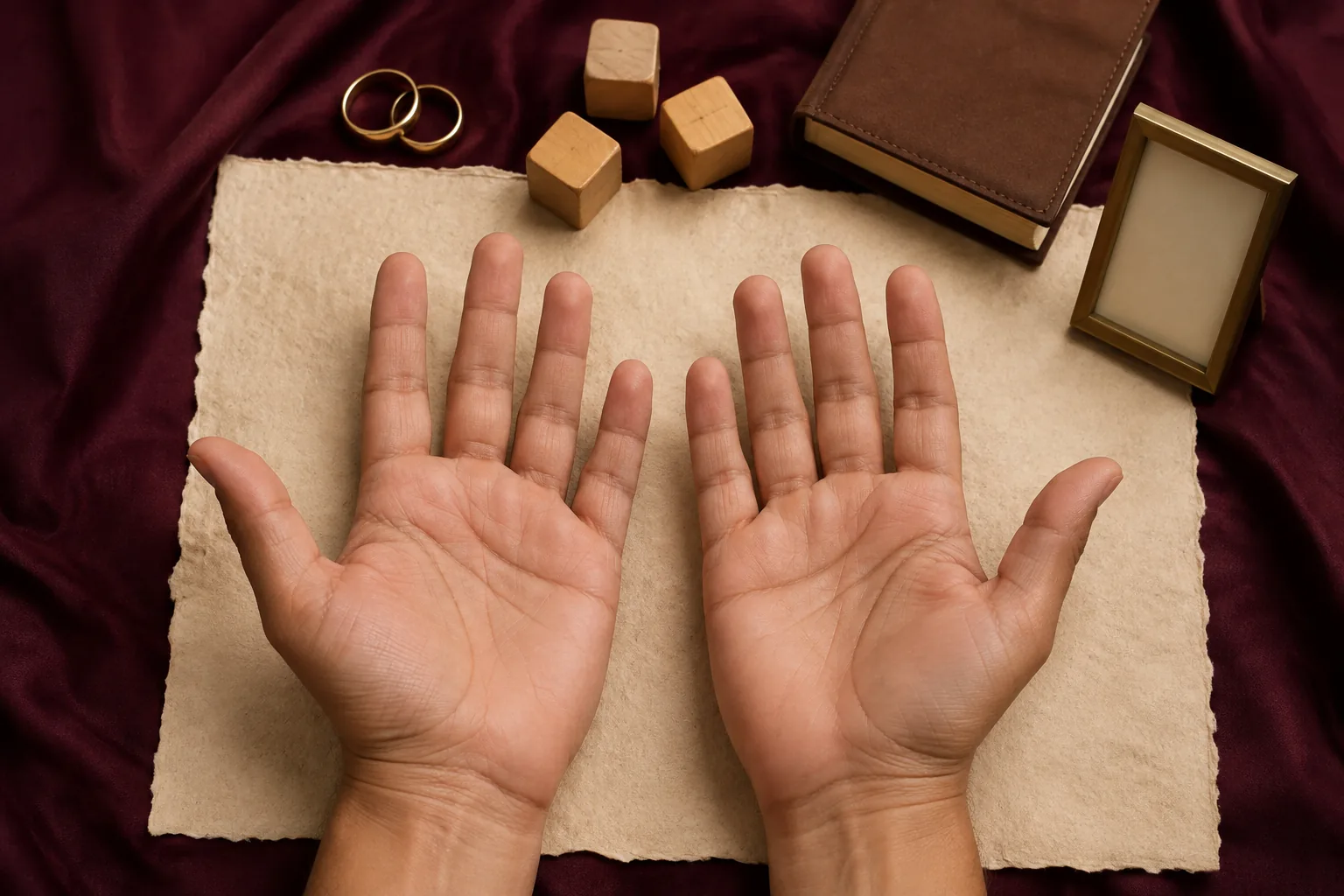
In a marriage and children palm reading, palmists first identify the clearest horizontal relationship line on the outer edge below the little finger, then examine any fine vertical children lines rising from or immediately above it. A clear connection between the two is traditionally read as partnership and caregiving becoming part of the same family chapter. The relationship line supplies the bond and broad stage; the vertical marks add children, stepchildren, mentoring, or other nurturing roles. Their count cannot reliably predict how many children a person will have.
The edge marks show only part of the family picture. A whole-hand reading can connect relationship and children lines with emotional style, family influence, communication, shared responsibility, timing, and the changes that partnership or caregiving creates across both palms.
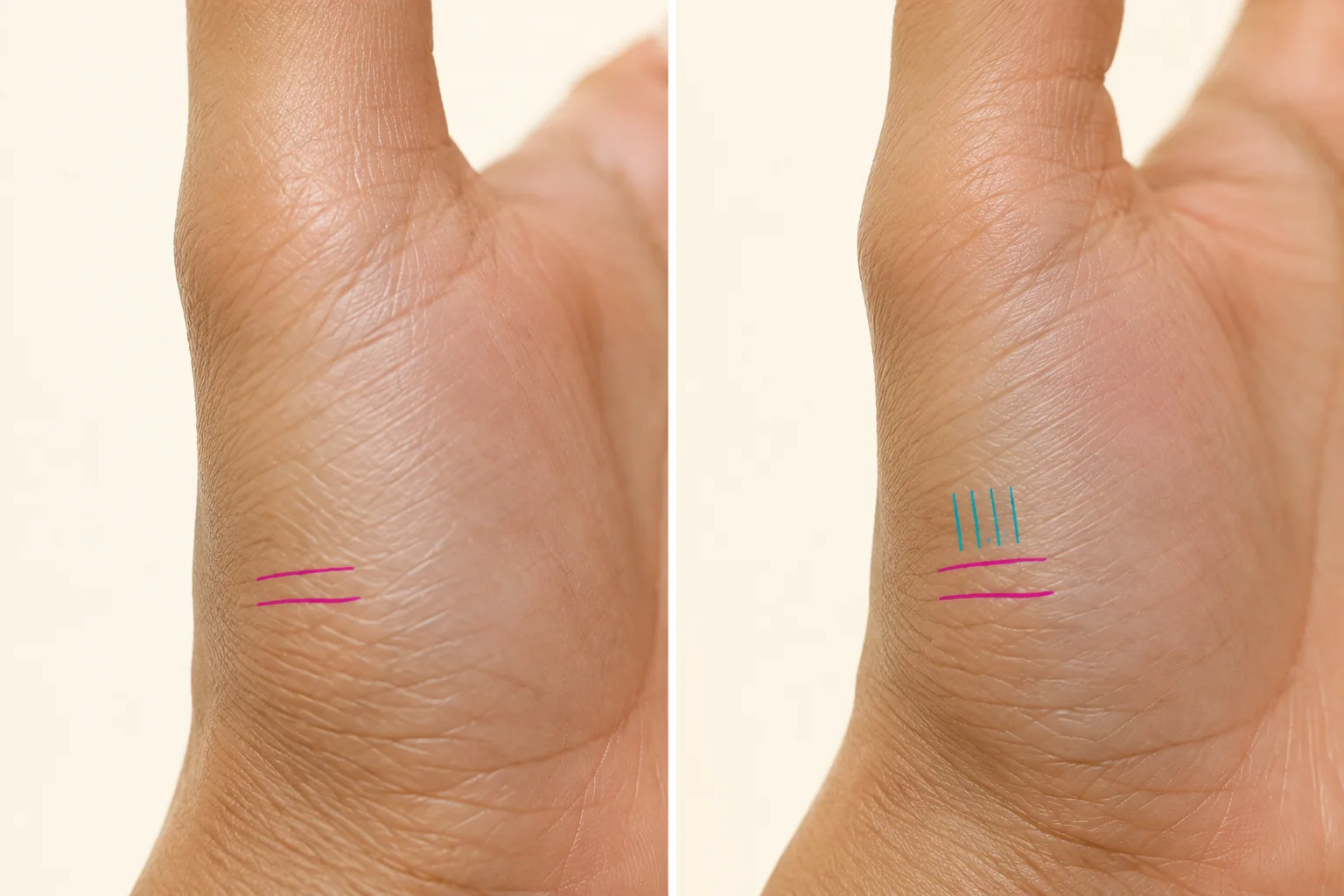
The complete reading also uses the heart line for emotional style, Venus for warmth and family attachment, the little finger for communication, Jupiter for shared values and commitment, the fate line for changes in direction, and both hands for how the pattern develops. This matters because the tiny edge marks are easy to confuse with skin folds, branches, or Mercury-mount striations.
Marriage and children palmistry map
| Feature | Traditional family question | What to observe |
|---|---|---|
| Relationship line | Which partnership or bond carries the family chapter? | Depth, length, position, direction, forks, breaks |
| Children lines | How strongly are children, caregiving, or mentoring emphasized? | Vertical direction, clarity, connection to a relationship line |
| Heart line | How are affection, protection, and emotional needs expressed? | Depth, curve, ending, branches, continuity |
| Venus mount | How central are home, attachment, closeness, and extended family? | Fullness, firmness, fine influences, relation to the life line |
| Little finger | How are needs, boundaries, and care responsibilities discussed? | Relative length, setting, straightness, flexibility |
| Jupiter area | What ideals, guidance, or formal structure shape the family? | Balanced development and clear upward support lines |
| Fate line | How does partnership or family change life direction? | Influence junctions, strengthening, shifts, breaks, branches |
Give the greatest weight to features that are clear, independent, and repeated. A single tiny vertical mark should not outweigh a strong relationship line, the main emotional pattern, or the differences between the two palms.
Where are marriage and children lines on the palm?
Both sit in the narrow zone on the outer edge below the little finger and above the heart line, but they run in different directions.
- Relax the hand and turn the little-finger edge about 45 degrees toward the camera.
- Locate the heart line entering the palm from below.
- Locate the crease at the base of the little finger above.
- Within that zone, find the clearest horizontal relationship line entering from the outer edge.
- Now look for fine vertical marks rising from or immediately above that line.
- Trace every mark from start to finish before classifying it.
- Repeat the same observation on the other hand.
| Line type | Direction | Usual visual scale | Common confusion |
|---|---|---|---|
| Relationship line | Horizontal, from outer edge inward | Longer and usually deeper | Finger-base crease or a short surface fold |
| Children line | Vertical, rising above or from relationship line | Shorter and finer | Mercury striation, crossing bar, or skin texture |
| Relationship branch | Diagonal, sharing one parent line | Varies with the parent line | A separate children line |
| Crossing bar | Often vertical but cuts fully through the relationship line | May be deeper than a children mark | A family or child indicator |
| Mercury striation | Vertical below the little finger | May extend farther across the mount | A children line when it does not connect with the relationship zone |
Use the detailed relationship-line map and children-line guide when either set of marks is unclear.
How relationship and children lines are read together
Start with the quality of the horizontal line, then add the vertical marks. A steady parent line gives the family marks a more coherent partnership context. A broken, forked, or faint parent line changes the question toward how caregiving and relationship transitions interact.
| Combined pattern | Traditional interpretation | What to check next |
|---|---|---|
| Clear vertical line rises from a deep relationship line | A strongly emphasized child or caregiving bond within that partnership chapter | Heart line, Venus, and the same zone on the other hand |
| Several fine vertical lines above one clear relationship line | Several young people, nurturing roles, or family responsibilities | Rank depth rather than turning the count into births |
| Vertical line touches but does not cut the relationship line | Family and partnership themes meet without obvious disruption | Direction and clarity of both lines |
| Deep vertical line cuts fully through the relationship line | A responsibility or outside condition may complicate the bond | Whether the horizontal line recovers after the crossing |
| Vertical marks appear above a later second relationship line | Children, stepchildren, or caregiving become prominent in a later partnership | Verify that the later horizontal line is independent |
| Children marks remain clear after a fork or break | Caregiving bonds continue through a changed relationship structure | Which branch or continuation carries the marks |
| No clear vertical marks | No emphasized minor-line pattern in this zone | Read Venus, heart, family influences, and lived priorities |
Do children lines that cross a marriage line mean problems?
First distinguish a children line from a crossing bar. A fine vertical mark that rises from or gently touches the relationship line is read as a connection between caregiving and partnership. A deeper line that cuts fully across and continues below it is treated more like an outside influence or obstacle. Follow the relationship line after the crossing: continuity, weakening, or recovery changes the reading.
What if children lines appear above a second marriage line?
Palmists may explore stepchildren, a blended family, a child born or adopted in a later partnership, or a new mentoring role. The vertical marks do not identify biological connection. First confirm that the later relationship line begins independently at the outer edge rather than being a fork or shifted continuation. The second-marriage framework explains that test.
Can palmistry tell how many children you will have?
Traditional systems often count clear vertical marks, but the result is not dependable. Several reasons make a literal count weak: the area carries natural surface creases, the marks change visibility with hand position and light, traditions disagree about the exact zone, and caregiving can include biological children, adopted or stepchildren, younger relatives, students, mentees, and significant creative work.
| What is visible | Traditional reading | Better combined interpretation |
|---|---|---|
| One deep vertical line | One strongly marked child influence | One caregiving bond or role carries particular weight |
| Two clear lines of similar strength | Two important child influences | Two young-person or mentoring bonds are emphasized |
| One deep line plus several faint lines | One central influence and several lesser ones | One role is defining while other caregiving connections remain secondary |
| Many fine striations | Large family or many child influences | Check for general Mercury texture before counting anything |
| No visible vertical lines | No strong minor-line emphasis | No conclusion about children, family capacity, or future events |
Can the lines show a son or daughter?
Some older methods assign deeper or wider lines to sons and finer lines to daughters. Crease depth can vary with pressure, texture, moisture, angle, and lighting, so it does not provide a reliable sex distinction. Read clarity and relationship context without assigning a child's sex.
How marriage and children timing is compared
Timing uses two directions. The vertical position of the relationship line within the edge zone supplies a broad partnership chapter. Along that line, marks nearer the outer beginning are read earlier within the bond and marks farther inward later. This creates sequence rather than an exact year.
| Timing observation | Traditional order | How to use it |
|---|---|---|
| Relationship line nearer the heart line | Earlier partnership chapter | Keep the estimate broad and compare fate-line timing |
| Relationship line in the middle of the zone | Middle partnership chapter | Calibrate with known relationship or family events |
| Relationship line nearer the little-finger base | Later partnership chapter | Do not convert height alone into an exact marriage age |
| Vertical mark near the relationship line's outer start | Earlier within that relationship story | May emphasize caregiving near the opening phase |
| Vertical mark farther inward along the line | Later within that relationship story | May emphasize caregiving after the bond has developed |
| Marks occur around a fork, gap, or overlap | Family themes coincide with a relationship transition | Follow which branch or continuation stays clear |
Compare this sequence with an influence joining the fate line or a clear change in direction. The marriage-timing guide shows how palmists use the head- and heart-line crossings as broad reference points.
How the whole hand adds family context
Venus and the life-line curve
The Mount of Venus is the padded thumb mound inside the life line. A broad, firm Venus area traditionally adds warmth, attachment, physical affection, home, and extended-family involvement. Many fine influence lines can show numerous close ties or responsibilities. A narrower Venus area may show a more selective or private family style.
Heart line and emotional care
A clear curved heart line adds expressive warmth. A straighter line can show care through steadiness, action, or practical support. Upward branches add hope and connection; a fork can show the ability to hold two emotional perspectives. Breaks or downward branches need context rather than being assigned to a child or partner automatically.
Little finger and family communication
The little finger traditionally describes communication, negotiation, and the ability to name intimate needs. Its setting matters as much as length. A low-set little finger can make it look short and may suggest communication that develops through experience. In a family reading, ask how care, boundaries, schedules, and responsibility are discussed.
Jupiter, thumb, and shared decisions
Jupiter beneath the index finger adds standards, guidance, responsibility, and formal commitment. The thumb adds firmness, judgment, and adaptability. A family pattern works differently when one person needs fixed structure and another adapts continuously, even if their edge lines look similar.
Fate line and changes after partnership
An influence joining fate may show another person or family responsibility changing life direction. If fate strengthens afterward, the partnership or family chapter can support clearer structure. If it shifts, work, home, or priorities may be reorganized. If it weakens, the reading should explore divided demands or a period of adjustment.
Which hand shows marriage and children?
Compare both palms. In the common active-hand method, the less-active hand shows the underlying relationship and family pattern, while the active hand shows how it has developed through lived choices. The active hand carries more weight for the path being built, but repetition across both hands creates the strongest theme.
- Same clear relationship and vertical marks on both hands: partnership and caregiving repeat strongly.
- Faint vertical marks on the less-active hand, clearer on the active hand: family or mentoring roles have become more defined.
- Clear marks on the less-active hand, fewer on the active hand: expectations and lived priorities may differ.
- Marks attach to different relationship lines: the hands may emphasize different chapters or potential routes.
- Forked relationship line on one hand, joined line on the other: family roles may continue while partnership direction becomes more integrated.
Use the two-hand comparison method instead of assigning one hand to women and another to men.
Six worked examples
Example 1: one partnership and a strong caregiving theme
One deep relationship line stays even. A single clear vertical mark rises from it, Venus is firm, and the heart line is warm and unbroken. The combined reading emphasizes one defining bond with a central child, mentoring, or caregiving role.
Example 2: several family responsibilities
One clear relationship line carries one deep vertical mark and several fine marks. Venus contains many influence lines, while the little finger is long and straight. One caregiving role may be central, with additional younger-person or family responsibilities managed through communication.
Example 3: blended family in a later partnership
A lower relationship line fades. A higher independent line is deep and carries two clear vertical marks. Fate gains a new influence in the later zone. Palmists may explore stepchildren, a later child, or caregiving that becomes prominent through the second partnership.
Example 4: family responsibility during relationship strain
A deep vertical line crosses a relationship line near a small fork. The main horizontal line continues afterward, and the heart line remains clear. Care responsibilities may test the couple's direction without erasing emotional continuity.
Example 5: caregiving continues through separation
The relationship line has a gap with overlapping fragments. A vertical mark connects to the continuation, and Venus remains strongly lined. This can describe a caregiving bond remaining important through separation, co-parenting, or a changed family structure.
Example 6: edge texture mistaken for a family forecast
Many tiny lines appear only when the little finger bends, and none stays visible in a relaxed side view. No vertical mark can be traced to a clear relationship line. The edge does not support a literal family count; use the heart, Venus, little finger, and lived question instead.
Photo checklist for marriage and children lines
- Photograph both full palms from fingertips through wrists.
- Add a sharp 45-degree image of the edge below each little finger.
- Keep both hands relaxed and use the same camera distance.
- Use bright indirect light plus one gentle side-lit view.
- Include the heart-line endpoint and little-finger base as boundaries.
- Capture the Venus area, life line, and complete fate line.
- Do not draw over, smooth, sharpen, or increase contrast around fine marks.
- State hand dominance and whether the question concerns partnership, children, stepchildren, caregiving, or timing.
Questions that make a family reading useful
- Which horizontal relationship line carries the clearest vertical marks?
- Do the vertical marks rise from, touch, or cut through the relationship line?
- Are they genuine children lines, Mercury striations, branches, or skin folds?
- Does the relationship line stay clear after family responsibility becomes prominent?
- Do Venus, the heart line, and the little finger repeat warmth, caregiving, and communication?
- Does fate strengthen, shift, or weaken after a partnership or family influence joins?
- Do the two palms show the same family sequence?
- Could the marks reflect stepchildren, younger relatives, students, or mentoring?
- What matters most now: commitment, family timing, blended-family roles, communication, responsibility, or shared direction?
Build the complete marriage and family picture
Verify the relationship line, identify the vertical children-line zone, add the whole-hand love pattern, and locate Venus through the palm-mount map before combining the family signs.
The complete answer
A marriage and children palm reading begins with the strongest horizontal relationship line, then examines the fine vertical marks that rise from or above it. Their connection, clarity, order, and the condition of the parent line show how partnership and caregiving themes interact; they do not supply a dependable child count. Venus, the heart line, little finger, Jupiter, fate-line influences, timing zones, and both palms add warmth, communication, family involvement, structure, and changes in direction. A Full Palm Reading maps all these important features across both hands and combines them into a holistic reading focused on the person's questions about commitment, children, blended family, caregiving, timing, and shared family direction.
A Full Palm Reading
Ask how partnership and family roles connect across your complete hand
Your reading verifies the horizontal relationship line and vertical children marks, then adds the heart and fate lines, Venus, Jupiter, little finger, thumb, timing zones, and both palms to explore commitment, children, stepchildren, caregiving, communication, and shared family direction.
Your Full Palm Reading maps all the important features—hand shape, skin texture, thumb, fingers, mounts, major and minor lines, markings, and the differences between both palms—and brings them together in a holistic reading focused on your questions.