
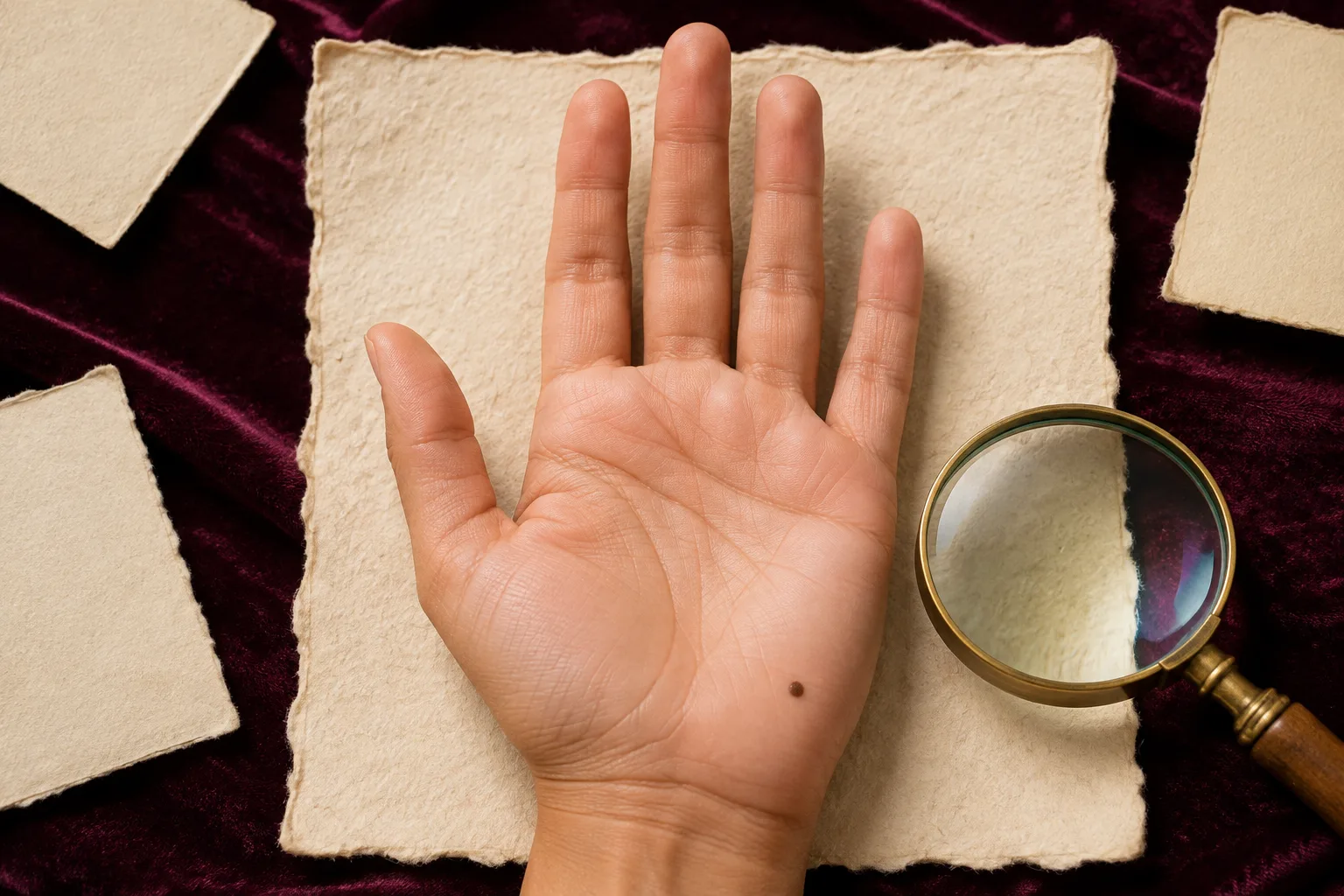
In palmistry, a mole on the palm is interpreted through its exact position: the nearest mount supplies the life theme, and a nearby major line shows where that theme may intersect thought, emotion, vitality, work, recognition, or relationships. A mole on Jupiter is traditionally connected with ambition and leadership; on Apollo with visibility and creative expression; on Mercury with communication and commerce; on Venus with affection and family ties; and on Moon with imagination, travel, distance, or changing environments.
A mole's traditional location becomes useful only after its center, nearest mount, line proximity, surrounding creases, and the other hand are compared. A whole-hand reading can connect that symbolic location with work, relationships, family, visibility, communication, travel, purpose, or direction while keeping skin assessment separate.
A mole is physically a pigmented skin mark rather than a crease symbol, so “on the life line” usually means the spot lies directly over or very close to the crease. Do not interpret its shape as a circle, dot, island, or star made from lines. Record the skin mark, map its center, trace the nearby line separately, and compare the rest of both hands before building a traditional reading.
Separate the skin mark from the symbolic location
Palmistry can attach a traditional theme to where a mole appears, but it cannot identify or assess the skin mark itself. For the reading, use position only. For the skin, notice whether it is new or changing and use current dermatology guidance rather than a palmistry meaning.
Six checks before reading a mole on the palm
| Check | What to establish | Why it matters |
|---|---|---|
| Mark type | Color belongs to the skin rather than a crease shadow | Line symbols use structure, not pigment |
| Exact center | Place the middle of the spot on one mount, plain, or boundary | The center decides the primary location |
| Nearest line | Trace any major or minor line beneath or beside it | Proximity adds a second life subject |
| Line relationship | Note whether the crease passes under, touches, or stays separate | “On” and “near” are different combinations |
| Hand | Record active or less-active palm | The two hands are compared rather than assigned by gender |
| Photo reliability | Use color, scale, full-palm context, and more than one light angle | A crop can distort shade and location |
- Look at the mark in ordinary daylight before taking a photograph.
- Confirm that the visible feature is color rather than a crease, shadow, stain, or pressure mark.
- Photograph the full palm so the fingers, wrist, and mounts establish orientation.
- Place the center relative to the nearest finger and major line.
- Trace that line's complete route without treating the mole as a line break.
- Compare the same area on the other hand and state hand dominance.
Mole, dot, circle or line marking?
| Visible feature | Made from | Use this reading method |
|---|---|---|
| Mole or pigmented spot | Skin color | Map the center by mount and line proximity |
| Crease dot | Very short or punctate line indentation | Read as a local line mark |
| Circle | Closed curved crease around an empty center | Verify boundary, closure, contents, and parent line |
| Island | One line dividing and rejoining | Read the parent line and enclosed phase |
| Cross or star | Two or more crease strokes sharing a center | Count strokes and locate the intersection |
| Stain | Surface color from ink, dye, soil, or another material | Clean and recheck before mapping |
| Scar | Changed skin texture after injury or healing | Describe separately from natural palm lines |
The circle guide covers a true closed crease. The marks-and-symbols guide covers dots, islands, crosses, stars, bars, triangles, squares, and forks. Keeping pigment and crease geometry separate prevents one small spot from receiving several contradictory meanings.
How to map the mole's exact location
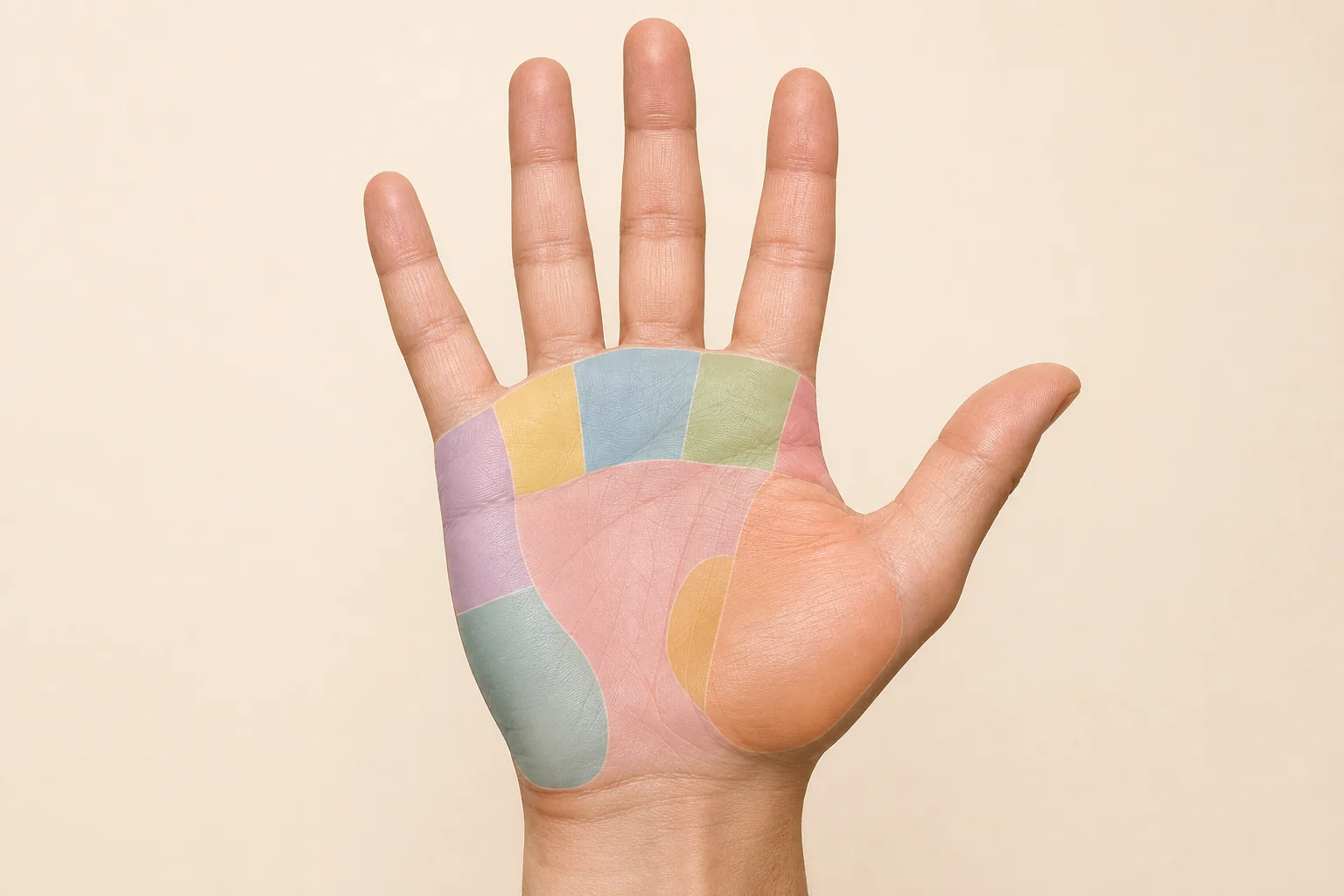
Use the center of the visible spot. A mole can overlap two regions, but one location usually contains more of it. Start with the finger above it, then use the nearest major creases as boundaries. The heart line separates the upper mounts from much of the middle palm; the life line curves around Venus; the lower outer palm belongs to Moon; and the central plain lies between the major routes.
| Location question | How to answer it | Common mistake |
|---|---|---|
| Which mount? | Find the finger above or the thumb/outer-palm region beside it | Using the nearest crease instead of the spot's center |
| Which line? | Trace the complete crease that passes under or nearest the mark | Naming a short random crease as a major line |
| On or near? | Zoom in to see whether pigment overlaps the crease | Assuming contact from a distant photo |
| Upper or lower area? | Use the heart, head, life, and wrist creases as landmarks | Rotating a cropped image mentally |
| Palm or edge? | Take a separate side view of the percussion | Flattening relationship-line and Moon zones together |
Open the mounts of the palm guide while mapping. A location should be repeatable from the photograph: “centered on lower Moon, below the head-line ending” is specific enough to check; “on the right side of my palm” changes with which hand is shown.
Traditional mole meanings by palm mount
In symbolic palmistry, a mole tends to concentrate, complicate, conceal, or intensify the subject of its location. The surrounding mount decides the subject and the rest of the hand shows how it is expressed. These are interpretive traditions rather than established personality measures or predictions.
| Mole location | Where to look | Traditional theme | Features to compare |
|---|---|---|---|
| Jupiter | Below index finger | Ambition, leadership, teaching, status, or commitment becomes a sensitive focus | Index finger, thumb, fate and heart branches |
| Saturn | Below middle finger | Responsibility, caution, study, solitude, or long-term duty becomes concentrated | Middle finger, fate line, hand texture |
| Apollo / Sun | Below ring finger | Visibility, reputation, creativity, recognition, or satisfaction carries added attention | Ring finger, Sun line, head and fate lines |
| Mercury | Below little finger | Communication, trade, negotiation, research, or specialist skill needs careful expression | Little finger, head and Mercury lines |
| Venus | Thumb mound inside life line | Affection, family, attachment, attraction, or personal energy becomes intense or private | Life and heart lines, thumb, influence lines |
| Moon | Lower outer palm | Imagination, travel, distance, public contact, dreams, or emotional atmosphere becomes pronounced | Head line, travel lines, fate origin |
| Upper Mars | Outer middle palm | Resistance, negotiation, boundaries, or conflict becomes a recurring focus | Head and heart lines, Mars support |
| Lower Mars | Inner palm above Venus | Courage, reaction, assertion, or pressure needs controlled direction | Life line, thumb, head line |
| Plain of Mars | Central palm | Competing duties, practical pressure, or a central life problem draws attention | Fate, life, head, heart, and support lines |
Mole on the Jupiter mount
Jupiter concerns aspiration, authority, ideals, teaching, and commitment. A mole here is traditionally read as a sensitive point around ambition or influence. A strong index finger, balanced mount, open firm thumb, and upward fate branch can direct it toward responsible leadership or teaching. A heavily grilled mount and rigid thumb can show the same ambition becoming overcontrolled or difficult to share.
Mole on the Saturn mount
On Saturn, the emphasis moves to duty, seriousness, specialization, patience, and consequences. The mole can concentrate attention on responsibility or a long-term task. A clear fate line and firm middle finger support disciplined development; breaks, bars, and a weak continuation show why the obligation may feel restrictive or uncertain.
Mole on the Apollo mount
Apollo covers creative expression, public response, reputation, and satisfaction in one's work. Traditional readings often treat a mole here more cautiously than a crease circle: it can make visibility, approval, or reputation a sensitive subject. A clear Sun line, balanced ring finger, and steady fate line show whether the attention is supported by consistent work.
Mole on the Mercury mount
Mercury concerns language, exchange, analysis, trade, teaching, and applied knowledge. A mole here can symbolize privacy, complexity, or extra care around communication and agreements. Compare the little finger's position, head line, Mercury line, and thumb. Avoid turning a traditional mark into a judgment about honesty or character.
Mole on the Venus mount
Venus represents affection, family ties, attachment, sociability, pleasure, and personal energy. A mole can make one bond, family influence, or emotional need especially prominent. Trace nearby influence lines and the life line, then add the heart line and thumb to see whether the pattern favors warmth, strong loyalty, selective boundaries, or divided obligations.
Mole on the Moon mount
Moon is linked with imagination, intuition, travel, distant places, public contact, and sensitivity to atmosphere. A mole here concentrates one of those themes. A sloping head line, life-line branch toward Moon, or fate line beginning there can connect it with creative thinking, relocation, outside influence, or work involving wider audiences.
What a mole near the life, head, heart, fate or Sun line means
A mole does not break a line physically merely because it overlaps the crease. Map two layers: the mount gives the setting, and the nearest line gives the life function. Then trace the line's real depth and continuation beneath or around the pigment.
| Line proximity | Traditional subject | Questions to ask |
|---|---|---|
| Life line | Routine, vitality, family setting, home, and changes of environment | Which Venus or Mars area contains it, and does the crease continue clearly? |
| Head line | Thinking style, concentration, learning, planning, and decisions | Is the line straight, sloping, forked, strong, or interrupted independently? |
| Heart line | Emotional expression, relationship ideals, and boundaries | Which mount lies above it, and where does the line end? |
| Fate line | Work, responsibility, direction, structure, and turning points | What happens below and above the spot? |
| Sun line | Recognition, creative identity, satisfaction, and public response | Does the line remain clear, branch, stop, or begin nearby? |
| Mercury line | Communication, work systems, analysis, and specialist practice | How do the head line and little finger support it? |
| Relationship line | A significant bond, commitment chapter, or relationship change | Is the spot truly on the edge line, and what does the heart line add? |
Mole on or near the life line
Traditional interpretation connects the spot with a sensitive phase involving routine, family, home, personal energy, or environment. It does not predict lifespan or establish a health condition. Identify whether the center falls on Venus or Mars, then trace the life line's continuity, branches, islands, and parallel support as separate crease features.
Mole on or near the head line
The focus shifts to learning, decisions, concentration, imagination, and communication. A straight head line places more weight on practical systems; a downward slope adds imagination or inward processing; a fork combines modes. The mole does not itself prove confusion, injury, or a cognitive problem.
Mole on or near the heart line
A heart-line mole is traditionally read through affection, emotional standards, expression, and relationship choices. The mount above it tells whether Jupiter's ideals, Saturn's restraint, Apollo's visibility, or Mercury's communication dominates the setting. Add Venus, relationship lines, and thumb flexibility before drawing a conclusion.
Mole on or near the fate line
A central spot over the fate line can make work, duty, structure, or direction a concentrated subject. The line below shows the foundation; the line above shows continuation. If a branch, break, or shifted upper segment occurs at the same level, the major life-change method helps separate the crease transition from the mole's location symbolism.
Mole on or near the Sun line
The traditional focus is recognition, reputation, creative work, or satisfaction. A clear Sun line passing the spot may show consistent expression despite sensitivity about visibility. A line beginning above it can indicate a later-developed outlet; bars or breaks should be read independently rather than blamed on the skin mark.
Mole in the center, on the palm edge or near the wrist
| Broader position | Traditional emphasis | Required context |
|---|---|---|
| Center of palm | Practical pressure, competing responsibilities, or one dominant concern | Fate, head, life, heart, and Plain of Mars |
| Upper palm below fingers | Ambition, responsibility, visibility, or communication | Exact finger mount and heart-line boundary |
| Thumb side | Family, affection, personal will, or immediate courage | Venus versus Lower Mars and life line |
| Outer edge | Communication, relationships, resilience, imagination, travel, or distance | Upper Mercury, Upper Mars, or lower Moon zone |
| Near wrist | Foundation, home base, movement, or early direction | Wrist creases, life-line ending, fate-line origin |
| Finger or thumb | Will, role, skill, or expression associated with that digit | Phalanx and finger-reading context |
“Center of the palm” is not one precise place. A spot may sit on the Plain of Mars, over the fate line, between fate and life, or below the head line toward Moon. Each position combines different subjects. A full-palm photograph prevents an edge crop from turning a specific location into a vague central mark.
Do mole color, size or shape change the palmistry meaning?
Some traditional systems assign different symbolic weights to dark, light, red, raised, flat, large, or small marks. Those categories vary too much to use as a universal rule, and a photograph can alter color through white balance, exposure, and screen settings. For a useful palmistry reading, give most weight to exact location, nearest line, surrounding crease pattern, and both hands.
| Appearance detail | Traditional use | Photo limitation |
|---|---|---|
| Darker or more visible | Often treated as stronger symbolic emphasis | Exposure can deepen or flatten color |
| Small and sharply located | Read as a specific local theme | Scale is unknown without a reference |
| Large across a boundary | May combine two mount or line subjects | Close-up can hide the boundary |
| Flat or raised | Not a reliable palmistry distinction | A two-dimensional image cannot establish texture |
| Round or irregular | Does not turn pigment into a crease circle | Image compression can change edges |
| New or changing | Pause symbolic interpretation | Use a clinician for physical assessment |
Never infer whether a mole is harmless from a palm photograph or from a symbolic meaning. A favorable traditional placement is not a physical assessment, and an unfavorable symbolic placement is not a medical warning.
Mole on the active hand versus the less-active hand
Use hand dominance rather than “male right hand, female left hand” rules. In palmistry, the less-active hand is often read as background pattern or earlier potential and the active hand as present expression and developed choices. A mole may exist on only one hand because it is a physical skin feature; the symbolic comparison comes from the surrounding hand pattern, not from assuming a matching spot must appear.
| Two-hand pattern | Traditional reading approach | Next comparison |
|---|---|---|
| Mole on active hand only | Connect the location with present expression and choices | Find the corresponding crease and mount on the other hand |
| Mole on less-active hand only | Connect the location with background or earlier pattern | Look for an active-hand route expressing the same theme |
| Marks in matching locations | The same subject may be emphasized across both patterns | Compare color only descriptively and lines symbolically |
| Different locations on each hand | Map each position independently before combining | Which theme repeats through lines or mounts? |
| Same mole, different nearby line quality | The location remains while current expression differs | Trace line continuation and branches |
| Only photos appear different | No symbolic difference is established | Retake matched full-palm and close-up images |
The which-hand guide explains active and less-active comparison. For a mole, compare the same region even when the other palm has no spot: mount development, line routes, branches, and markings can still repeat or modify the subject.
Six worked mole-on-palm examples
1. Mole on Jupiter beside an upward fate branch
A small flat spot is centered below the index finger. It does not touch the heart line, and an upward fate branch enters balanced Jupiter. The index finger is proportionate and the thumb is firm and open. The traditional synthesis emphasizes ambition, teaching, leadership, or commitment as a sensitive but actively supported focus.
2. Mole on Apollo near a clear Sun line
The spot sits beside rather than over the Sun line. The line remains clear from the head-line level to Apollo, with a strong central fate line. The mole concentrates attention on visibility or reputation, while the crease pattern supports steady creative expression. It is not interpreted as a circle or a break in the Sun line.
3. Mole on Moon with a life-line travel branch
A small spot lies on lower Moon. A branch leaves the lower life line toward the same area, and the fate line begins from Moon. The traditional reading links imagination, distant environments, travel, relocation, public contact, or outside influence with life direction rather than treating the mole in isolation.
4. Mole over the fate line at a shift
A central mole overlaps the fate line below the head-line landmark. The crease itself shifts slightly and grows stronger above the level, while a Sun line begins nearby. The symbolic location highlights a work or responsibility transition; the actual shift and continuation supply the direction and broad timing.
5. Mole near the heart line under Mercury
The spot is centered just above the heart line below the little finger. The heart line rises clearly, Mercury is balanced, and the thumb is flexible. The pattern connects emotional expression and communication, suggesting that clarity, trust, agreements, or speaking directly may be central to relationship questions.
6. Dark photo spot that disappears in daylight
A close-up shows a round dark mark in the central palm, but a daylight image reveals it as the shadow of a deep crease beside dry skin. Because there is no persistent pigmented spot, no mole location is read. The actual fate, head, and Mars features remain available for interpretation.
A concise skin-change check for a mole on the palm
The American Academy of Dermatology recommends checking moles and pigmented spots for the ABCDE signs: Asymmetry, an irregular Border, varying Color, Diameter that may be larger than about 6 mm although melanoma can be smaller, and Evolving size, shape, or color. It also advises attention to a spot that grows, bleeds, itches, or does not heal. These are reasons to have a clinician examine the mark, not a way to diagnose it yourself. See the AAD's ABCDE guide and guidance for darker skin tones, which specifically includes checking the palms and soles.
| Notice | Useful next step | What palmistry cannot do |
|---|---|---|
| Long-standing, unchanged spot | Keep your usual awareness and photos if helpful | Confirm what the mark is |
| New spot or visible evolution | Arrange a professional skin assessment | Explain the physical change symbolically |
| Asymmetry, irregular edge, or several colors | Show the mark to a qualified clinician | Rule a condition in or out from a photo |
| Bleeding, itching, pain, or failure to heal | Seek clinical advice rather than waiting on a reading | Replace examination or dermoscopy |
| Unclear image | Use daylight photos for tracking and an in-person check for concern | Recover accurate color or texture from compression |
This check applies regardless of whether the traditional palmistry location sounds favorable, difficult, or neutral. The symbolic reading and the physical assessment answer different questions.
Photo checklist for a mole-on-palm reading
- Take one full image of each palm from fingertips through wrists.
- Keep both hands relaxed, flat, and parallel to the camera.
- Add a sharp close-up that shows the spot and enough surrounding palm to locate it.
- Use neutral daylight or even indoor light without colored bulbs.
- Include a ruler beside, not over, the mark if physical size matters.
- Keep images in color and disable smoothing, portrait mode, filters, and sharpening.
- Do not circle, trace, recolor, or cover the mark with an annotation.
- State which hand is active and the life question connected with the location.
What photos can show for palmistry
A full-palm photograph can show the mark's approximate mount, line proximity, surrounding crease pattern, and two-hand difference. A close-up can show whether pigment overlaps a crease and whether a supposed circle is actually color. It cannot reliably establish texture, depth, cause, diagnosis, or change without comparable earlier images.
Common mistakes when reading a palm mole
- Using a crease-circle meaning for a pigmented spot.
- Mapping the edge of the mole instead of its center.
- Calling a mole “on” a line when a close-up shows clear separation.
- Treating the pigment as if it physically breaks the crease.
- Ignoring the mount that supplies the surrounding subject.
- Applying a rigid right-hand or left-hand rule based on gender.
- Interpreting camera exposure as meaningful color intensity.
- Assuming a favorable symbolic location establishes that a mark is harmless.
- Trying to diagnose a new or changing spot from a palm photo.
- Letting one small skin mark outweigh the complete two-hand pattern.
Questions that make a mole reading useful
- Is the visible feature pigment rather than a crease, ridge, shadow, stain, or scar?
- Where is the exact center relative to the fingers, mounts, and major lines?
- Does a crease pass beneath the mole, touch its edge, or remain separate?
- Which mount supplies the primary life theme?
- What does the nearest major or minor line add?
- How does that line continue beyond the location?
- Which finger, thumb, mount, or second line repeats the same subject?
- Does the corresponding area on the other hand strengthen or redirect the pattern?
- Is the mark new or changing in a way that belongs to a separate skin check?
- What question about work, relationships, family, visibility, communication, travel, purpose, or direction should the symbolic location answer?
Read the mole's location inside the complete hand
Map the center by mount and line proximity, then add the actual crease route, continuation, fingers, thumb, hand shape, texture, other markings, and both palms. This connects the traditional location symbolism with the life question you are asking while keeping physical skin assessment separate.
The complete answer
A mole on the palm is a pigmented skin mark, not a crease symbol. Traditional palmistry reads its center through the nearest mount: Jupiter for ambition and commitment, Saturn for responsibility, Apollo for visibility, Mercury for communication, Venus for affection and family, Moon for imagination and wider environments, and Mars for pressure and boundaries. Proximity to the life, head, heart, fate, Sun, Mercury, or relationship line adds that line's subject, but the pigment does not itself break the crease. Compare both hands through active and less-active use rather than gender rules, and treat camera color and shape cautiously. If a spot is new, changing, irregular, multicolored, bleeding, itching, painful, or not healing, use clinical assessment for the skin question. A Full Palm Reading maps the mole's symbolic location and all other important features across both hands and combines them into a holistic reading focused on your questions about work, relationships, family, visibility, communication, travel, timing, purpose, and direction.
A Full Palm Reading
Ask what your mole's location means across the complete hand
Your reading maps the mark's center by mount and line proximity, then adds the actual crease route, continuation, nearby markings, fingers, thumb, hand shape, texture, major and minor lines, and both palms into one holistic reading focused on your questions about work, relationships, family, visibility, communication, travel, purpose, and direction.
Your Full Palm Reading maps all the important features—hand shape, skin texture, thumb, fingers, mounts, major and minor lines, markings, and the differences between both palms—and brings them together in a holistic reading focused on your questions.