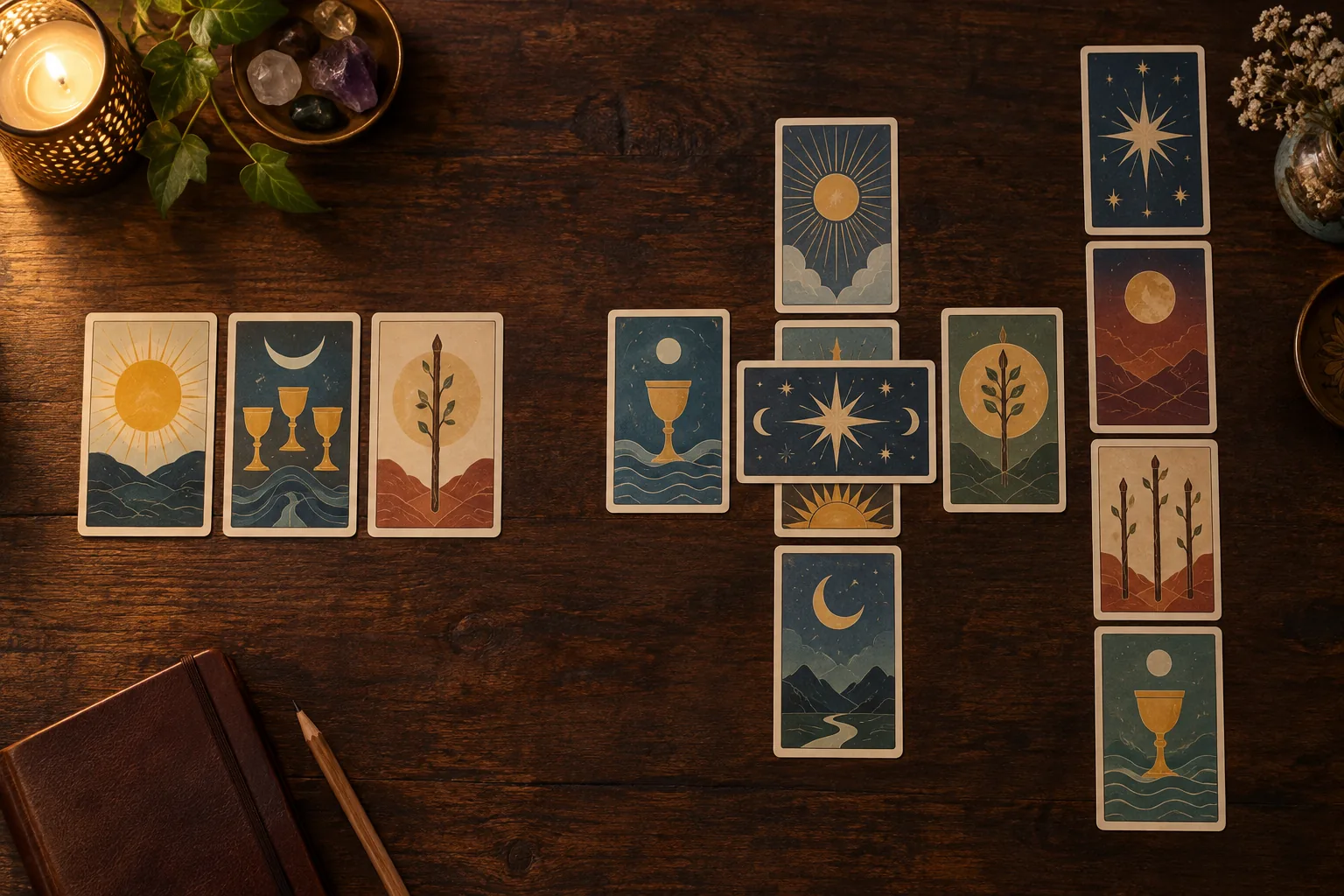
Use three cards when you have one question and want a clear, short reading you can finish in ten minutes. Use the Celtic Cross when the situation has a history, other people in it and pulls in more than one direction, and you have time to sit with ten cards. More cards give you more angles on the same question. They do not make the answer more accurate, and tarot is a tool for reflection, not a proven way to predict events. The evidence is laid out in does tarot work?.
You have a question and a deck, and every guide says to use the Celtic Cross. Ten cards feels like a lot. You want to know whether three would do.
If you are new to tarot, start with three. Many readers never move past it, and plenty who learned the Celtic Cross first say it overwhelmed them.
The two spreads side by side
| Three-card spread | Celtic Cross | |
|---|---|---|
| Cards | 3 | 10 (11 in the original, with a chosen card in the middle) |
| Time for a careful read | 10 to 15 minutes | 30 to 60 minutes |
| Best for | One focused question, a daily check-in, journaling | A tangled situation with a past, other people and mixed feelings |
| What you get | A short story with a beginning, middle and end | A map: the core issue, the obstacle, the background, your attitude, your surroundings and your hopes or fears |
| Main risk | Reading too much into three cards | Losing the thread, or picking the two cards you like and ignoring eight |
| Good for beginners? | Yes | Better after you know most cards without a book |
What Waite actually wrote about the Celtic Cross
The Celtic Cross most people learn comes from A. E. Waite's 1910 book The Pictorial Key to the Tarot, where it is called "An Ancient Celtic Method of Divination". Three things in the original surprise people today.
It was meant for a definite question. Waite calls it "the most suitable for obtaining an answer to a definite question." Modern advice often says the reverse, that the Celtic Cross is for big open situations and three cards for simple ones. Both views can work. What Waite cared about was that the question was clear before the cards came out.
It started with an eleventh card. Before dealing, the reader picked a court card to stand for the person asking, called the Significator, and laid it in the centre. Waite chose it by age and colouring. Wands were for "very fair people", Pentacles for very dark hair and eyes, and the ages are odd to modern eyes: "A Knight should be chosen as the Significator if the subject of inquiry is a man of forty years old and upward", and a King for "any male who is under that age". Most modern readers skip the Significator or let you pick any card that feels like you.
It had a do-over rule. If the tenth card was unclear, Waite suggested laying the whole spread again with that tenth card as the new centre. He also said the method "has the special advantage of being free from all complications", which is generous for a spread with ten positions.
So the "ancient" in the name is Waite's word. There is no older Celtic source for the layout, and books after him have moved positions around and renamed them.
The ten positions, in Waite's words and in plain English
| # | Waite's phrase | What he meant | The question it asks you |
|---|---|---|---|
| 1 | This covers him | The general atmosphere around the matter | What is the mood of this whole situation? |
| 2 | This crosses him | The obstacle | What is in the way? |
| 3 | This crowns him | The aim, or the best that can be reached for now | What am I hoping for here? |
| 4 | This is beneath him | The foundation, what has already happened | What is this built on? |
| 5 | This is behind him | An influence just passing | What is fading out? |
| 6 | This is before him | An influence arriving soon | What is starting to show up? |
| 7 | Himself | Your position or attitude | How am I standing in this? |
| 8 | His house | Your surroundings, friends, work, family | Who and what around me is shaping it? |
| 9 | His hopes or fears | What you want or dread | What am I hoping, or afraid, will happen? |
| 10 | What will come | Where it is heading if things go on as they are | Where does this lead if nothing changes? |
Two notes on that table. Waite put cards 5 and 6 on either side of the cross depending on which way the Significator's figure faced, so diagrams online disagree about left and right. And many modern books swap the meanings of 3 and 4 or call 3 "the conscious mind" and 4 "the unconscious". None of these versions is the true one. Pick one diagram and keep it.
Card 9 is worth slowing down on. Waite put hopes and fears in the same position, and readers often find the card there could be read either way. That is useful. Ask yourself which one it is for you, and the answer usually tells you more than the card does.
The three-card spread has many versions
There is no single three-card spread. The positions are whatever you agree before you shuffle. Common ones:
- Past, present, future. Our guide to the past, present, future reading explains each position.
- Situation, obstacle, advice. Good for practical problems at work or home.
- What is present, what is beneath it, what to explore next. The self-reflection spread in our guide to using tarot for self-reflection.
- Option A, option B, what you need to know. For a choice between two paths.
That flexibility is the three-card spread's real strength. You can shape it to the question. The Celtic Cross makes you fit the question to its ten fixed slots.
Four questions to pick your spread
Answer these before you shuffle. Each "yes" points toward the Celtic Cross.
- Does the situation involve at least one other person whose choices matter? Position 8 (your surroundings) has something to work with.
- Has it been going on for months, with a history you want to see? Positions 4 and 5 look backward.
- Do you feel two ways about it? Position 9 holds hopes and fears together.
- Do you have 45 minutes and a notebook? If not, a rushed Celtic Cross is worse than a careful three-card read.
Zero or one "yes": three cards. Two: either, and three cards is still the calmer choice. Three or four: try the Celtic Cross. If your question can be answered with yes or no, neither spread suits it well. See can tarot answer yes-or-no questions? for how to reword it.
One question, laid out both ways
Here is an invented example to show the difference. The cards are made up to illustrate the method. The question is: "What should I understand about moving to another city for work?"
Three cards (situation, obstacle, advice):
- Situation: Eight of Pentacles. Steady effort, learning the craft.
- Obstacle: Five of Cups. Grief over what gets left behind.
- Advice: Page of Wands. Treat it as an experiment, not a forever decision.
Read together: the job itself appeals, the sticking point is loss, and the advice is to lower the stakes. Ten minutes, one clear line to write in a journal.
Celtic Cross (Waite's order):
| # | Position | Invented card | One-line reading |
|---|---|---|---|
| 1 | Covers | Eight of Pentacles | The move is really about growing at work |
| 2 | Crosses | Five of Cups | Sadness about leaving is the block |
| 3 | Crowns | The Star | The hope is a fresh start |
| 4 | Beneath | Four of Pentacles | Years of playing it safe |
| 5 | Behind | Three of Swords | An old hurt that is fading |
| 6 | Before | Two of Wands | A decision is coming up soon |
| 7 | Yourself | Knight of Cups | Romantic about the idea |
| 8 | House | Six of Pentacles | Family or friends with opinions, maybe money involved |
| 9 | Hopes or fears | The Moon | Not knowing what the new place is really like |
| 10 | What will come | Page of Wands | An exploratory start, not a final answer |
The Celtic Cross added three things the short spread did not show: the long habit of playing safe (card 4), the people around the decision (card 8), and the specific fear of the unknown (card 9). It also took most of an hour and produced two cards, the Star and the Moon, that can be read as pulling in opposite directions. Whether that tension is useful or just confusing depends on the person. Some people find it exactly what they needed. Others end up more anxious than when they started.
Both spreads ended on the same practical note. That happens often, because both are only as good as the question and the honesty of the reading.
More cards, more combinations, not more certainty
With a 78-card deck there are 456,456 ways to deal three cards in order. For ten cards in order the number is about 4.6 quintillion, a 4 followed by 18 digits. That is our own arithmetic, and it explains why a Celtic Cross feels so rich. There are far more stories the cards can tell.
It does not mean the bigger spread knows more. Each extra card is another prompt to think about. If ten prompts help you see your situation from more sides, the Celtic Cross is worth it. If they bury the one thing you needed to notice, three cards will serve you better.
Mistakes that make either spread worse
- Redrawing until you like the answer. Decide before you shuffle that the first layout stands.
- Reading ten separate fortunes. The positions are meant to talk to each other. Look for the card that explains the obstacle.
- Asking about someone else's private thoughts. "What is he thinking?" turns any spread into guessing. "What should I understand about how I feel about him?" gives the cards something to work with.
- Using the Celtic Cross for a tiny question. "Should I go to the party?" does not need a background, a foundation and a house.
- Forgetting to write it down. A reading you can reread next month teaches you more than one you half remember. A psychic journal helps.
If someone else is reading for you
You do not have to ask for a particular spread. A good reader picks the layout that fits what you bring. What helps most is a clear question and a little context: who is involved, how long it has been going on, and what you have already tried. Three focused questions often cover more ground than one vague question spread across ten cards.
If you would like a written perspective, Maria can write a personal reading built on up to three questions you send, delivered by email. It is offered for entertainment and personal reflection. If you are stuck on wording, these questions to ask a psychic are a starting point.
Common questions
Is the Celtic Cross more accurate than a three-card spread?
No. More cards give more angles on a question, not more accuracy. There is no good evidence that any tarot spread predicts events, so choose the one that helps you think most clearly.
Should beginners learn the Celtic Cross?
It is usually easier to start with three cards and add the Celtic Cross once you know most card meanings without a book. Ten positions plus 78 meanings is a lot to hold at once.
What does the tenth card in the Celtic Cross mean?
Waite called it "what will come", the point the situation reaches if things carry on as they are. It is a direction, not a fixed outcome. If it is unclear, Waite's own suggestion was to lay the spread again with that card in the centre.
Do I need a Significator card?
No. Waite used one, chosen by age and colouring. Most modern readers leave it out or let you pick any card that represents you. The reading works the same way without it.
Can I use a three-card spread for a big question?
Yes, if you can narrow it to one clear question. "What should I understand about this move?" works. "Tell me everything about my next five years" works badly with any spread.
Why do Celtic Cross diagrams online look different?
Waite placed cards 5 and 6 depending on which way the Significator faced, and later books renamed and reordered several positions. Choose one version and use it the same way every time.
Three questions instead of ten cards
If your situation feels too tangled for any spread, Maria can write a personal reading around up to three of your questions. It arrives by email within 24 hours, so you can read it slowly.
- Her perspective on the question at the centre of it.
- Her reading of the people and pressures around it.
- Possible next steps to weigh, in a format you can keep.
Maria’s approach: a USA-based psychic and tarot reader, Maria combines intuition and tarot to read the connection behind your questions. Her focus is on what comes through about the feelings, the blockage, and the path ahead—including where the picture feels mixed.
What you receive from Maria
A personal written reading shaped around up to three questions and the details you share, delivered by email within 24 hours. You provide your questions and relevant details with your order. This is a reading you can keep and return to, not a live call you need to schedule.
Send Maria your three questions →
View the reading details and current price before ordering. You can review our refund policy and privacy policy at any time.
Sources
- Waite, A. E. (1910). The Pictorial Key to the Tarot, Section 7, An Ancient Celtic Method of Divination. Public domain text at sacred-texts.com.
- Reddit threads (community discussion, not evidence): r/tarot on good spreads for beginners, r/tarot spread recommendations for a beginner and r/tarot on the perfect beginner's spread.
- Card combinations: our own arithmetic (78 x 77 x 76 for three cards in order, 78 x 77 x ... x 69 for ten).
- The example reading is invented to illustrate the two spreads.
A personal reading by Maria
Bring the question, not the spread
Add the context that matters and read Maria's perspective in your own time. The decisions stay yours.
Your Full Psychic Reading is built around up to three questions and the context you share. Receive your written guidance by email within 24 hours.