
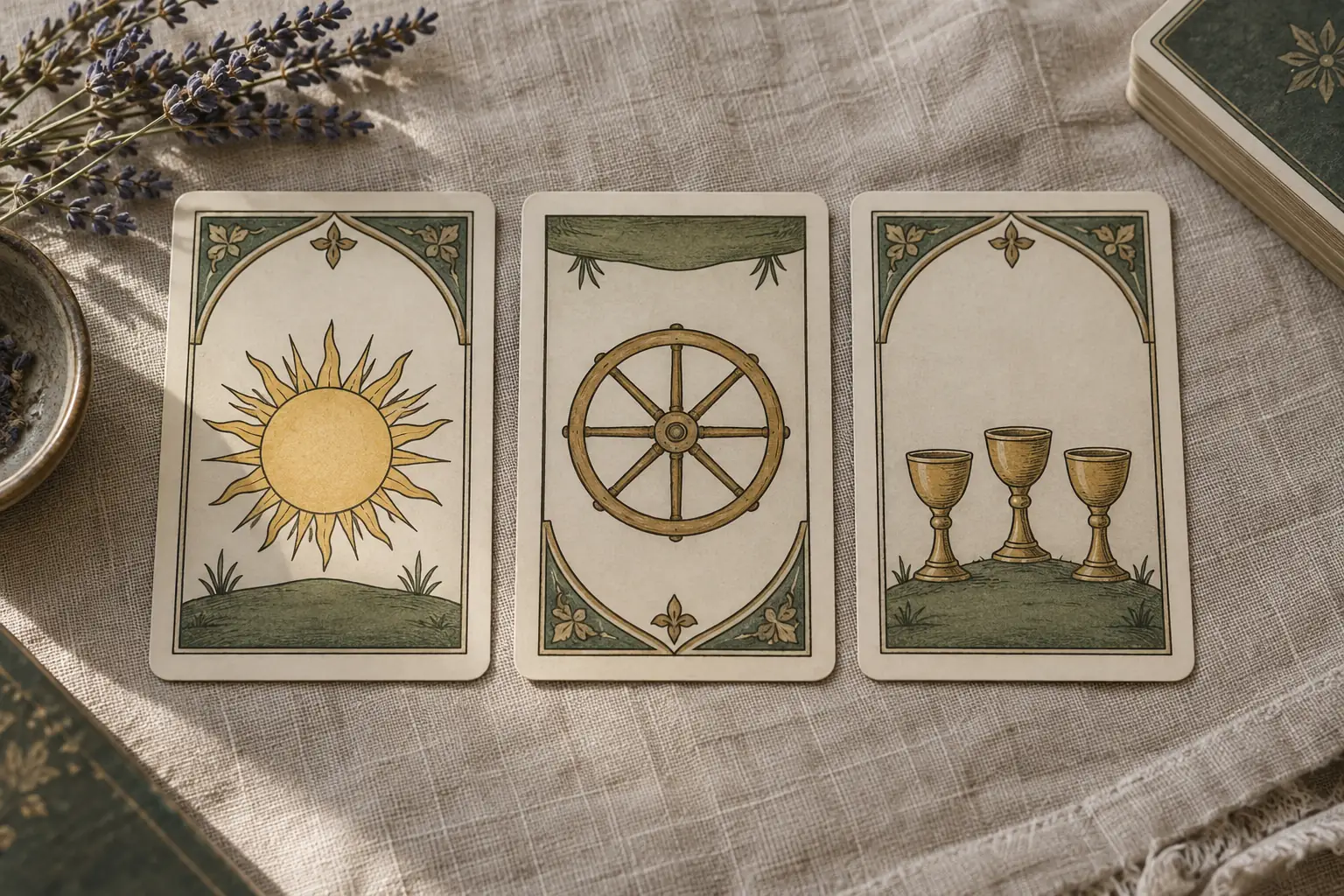
Reading reversed tarot cards is optional. Many readers turn every card upright and never look back. Others treat an upside-down card as a change in tone. Neither way is the correct one, because the tradition itself never agreed. If you are still learning the 78 upright meanings, or you read tarot mainly to calm your thoughts, skip reversals for now. If you want more shades and will stick to one method, try them. Either way, decide before you shuffle, not after a card lands.
A card came out upside down and the guidebook gave you a second, gloomier meaning. You want to know if you even have to read it that way.
A reversed card is not a bad omen. Tarot is a tool for reflection, and there is no good evidence that it predicts events. Our post on whether tarot works goes into that.
Where reversals come from
Upside-down meanings are older than most modern decks. The French card reader Etteilla published a fortune-telling method in 1770 for an ordinary 32-card pack. It gave each card one meaning upright and another reversed. His later tarot work tabulated every meaning a card could carry in both positions.
A. E. Waite kept the habit. The Pictorial Key to the Tarot (1910), written to go with the Rider-Waite-Smith deck that many beginners learn on, gives a reversed line for every card. Then, at the end of his list of the major cards, Waite says what he thinks of these fortune-telling meanings. He calls them "at once artificial and arbitrary, as it seems to me, in the highest degree."
Keep that in mind when someone tells you a reversed card has one fixed meaning.
What Waite's reversed meanings actually say
A common belief is that reversed simply means the opposite. Waite's own lists do not work that way.
| Card | Waite's upright meaning (short) | Waite's reversed meaning | What kind of change |
|---|---|---|---|
| The World | Assured success, voyage, change of place | "Inertia, fixity, stagnation, permanence" | An opposite |
| The Sun | Material happiness, contentment | "The same in a lesser sense" | A weaker version |
| The Tower | Misery, ruin, unforeseen catastrophe | The same "in a lesser degree", also oppression | A weaker version |
| Wheel of Fortune | Destiny, fortune, success, luck | "Increase, abundance, superfluity" | More, not less |
| Death | End, mortality, destruction | "Inertia, sleep, lethargy, petrifaction" | A different idea |
| Three of Cups | Plenty, merriment, happy issue | "Expedition, dispatch, achievement, end" | A different, cheerful idea |
The meanings come from the major cards section and the Three of Cups page of the 1910 text. So in the most-used source, a reversal can flip a card, soften it, push it further, or send it somewhere new. Modern books mostly pick one of those and apply it to every card. That is a later tidying up, and it is a reader's choice.
Four ways readers handle an upside-down card
| Method | What the reversal means | Suits you if | Watch out for |
|---|---|---|---|
| Turn it upright | Nothing. Every card is read the upright way | You are learning, or you want a short, calm reading | Nothing lost. Position and neighbouring cards give plenty of nuance |
| Opposite | The upright meaning flipped | You like clear contrasts | It doubles the scary cards. A reversed Sun reads as gloom |
| Weaker or blocked | The same theme, held back or slowed | You want the card to stay recognisable | Everything starts to sound like "delay" |
| Inward | The theme is happening inside you, not around you | You use tarot for journaling and self-reflection | It can turn every question back on you, even when the issue is outside |
Pick one row and use it for a month. Switching methods in the middle of a reading is how people end up choosing whichever meaning they like best.
Should you read them? A two-minute check
Answer these four honestly.
- Can you say the upright meaning of most cards without a book? If not, wait. Reversals double what you have to hold in your head.
- Do you read to settle your mind or to dig for detail? For settling, upright-only is kinder. For detail, reversals give you one more layer.
- Will you keep one method for your next 30 readings? If yes, try reversals and log which method you used each time. If you would switch, skip them.
- Do you redraw when a card looks bad? If you do, reversals will tempt you more. Fix that habit first.
Two or more answers pointing to "wait" means skip reversals for now. You can add them any time, and some readers on r/tarot and r/SecularTarot say they never did and never missed them.
How often reversals turn up
A new deck comes with every card the same way up. Riffle and overhand shuffles keep it that way. You only get reversals if you turn some cards, for example by splitting the deck and rotating one half before you shuffle it back in.
Once the deck is fully mixed, each card has about an even chance of landing either way. By that arithmetic, about 7 in 8 three-card readings will show at least one reversed card. In a ten-card spread, all ten come up upright about once in a thousand readings. A reversal is the shuffle doing its job. It is not a message about you.
One card, read five ways
Take an invented example. Someone asks, "What should I understand about my new job?" and draws the Three of Cups, reversed. Upright, it is the card of friends raising a glass.
- Turned upright: friendship and small celebrations at work.
- Opposite: feeling left out of the group.
- Weaker or blocked: the friendships are forming, just slowly.
- Inward: you are pleased with yourself in private but have not marked the change.
- Waite's own line: "expedition, dispatch, achievement, end", a task finished quickly.
Five sensible readings, and some of them disagree. The method changed the answer more than the card did. If you read reversals, write down the method next to the card so you can see later what you were actually doing. Our guide to tarot for self-reflection has a simple spread to practise on.
Common questions
Are reversed tarot cards bad?
No. In Waite's 1910 book some reversed cards are milder than upright, some point somewhere new, and a few are cheerful, such as the Wheel of Fortune's "increase, abundance". A reversed card is a different shade of the same card, not a warning.
Should beginners read reversed cards?
It is usually easier to learn the upright meanings first. Add reversals later with one consistent method, or skip them for good. Many experienced readers never use them.
Does a reversed card mean no in a yes-or-no reading?
Only if you agreed that rule before you drew. Some readers use it and many do not. Our guide to yes-or-no tarot questions explains why open questions work better.
Is a reversed Death card worse than an upright one?
Not in the old sources. Waite gives "inertia, sleep, lethargy" and "hope destroyed" for Death reversed. Those are words about feeling stuck, not about dying. Our guide to the Tower, Death and the Devil covers the upright meanings.
How do I shuffle so cards come out reversed?
Split the deck, turn one half around, and shuffle the halves together. Repeat once or twice. If you never turn any cards, you will never draw a reversal, and that is a fine way to read.
Sources
- Waite, A. E. (1910). The Pictorial Key to the Tarot, Section 3, the greater arcana and their divinatory meanings and Three of Cups. Public domain text at sacred-texts.com.
- Wikipedia, Etteilla, citing Decker, Depaulis and Dummett, A Wicked Pack of Cards (1996), and Dummett, The Game of Tarot (1980).
- Reddit threads (community discussion, not evidence): r/tarot on why beginners are told to skip reversals and r/SecularTarot on reading reversals as a beginner.
- Odds of reversals: our own arithmetic, assuming each card's orientation is a fair coin after shuffling.