
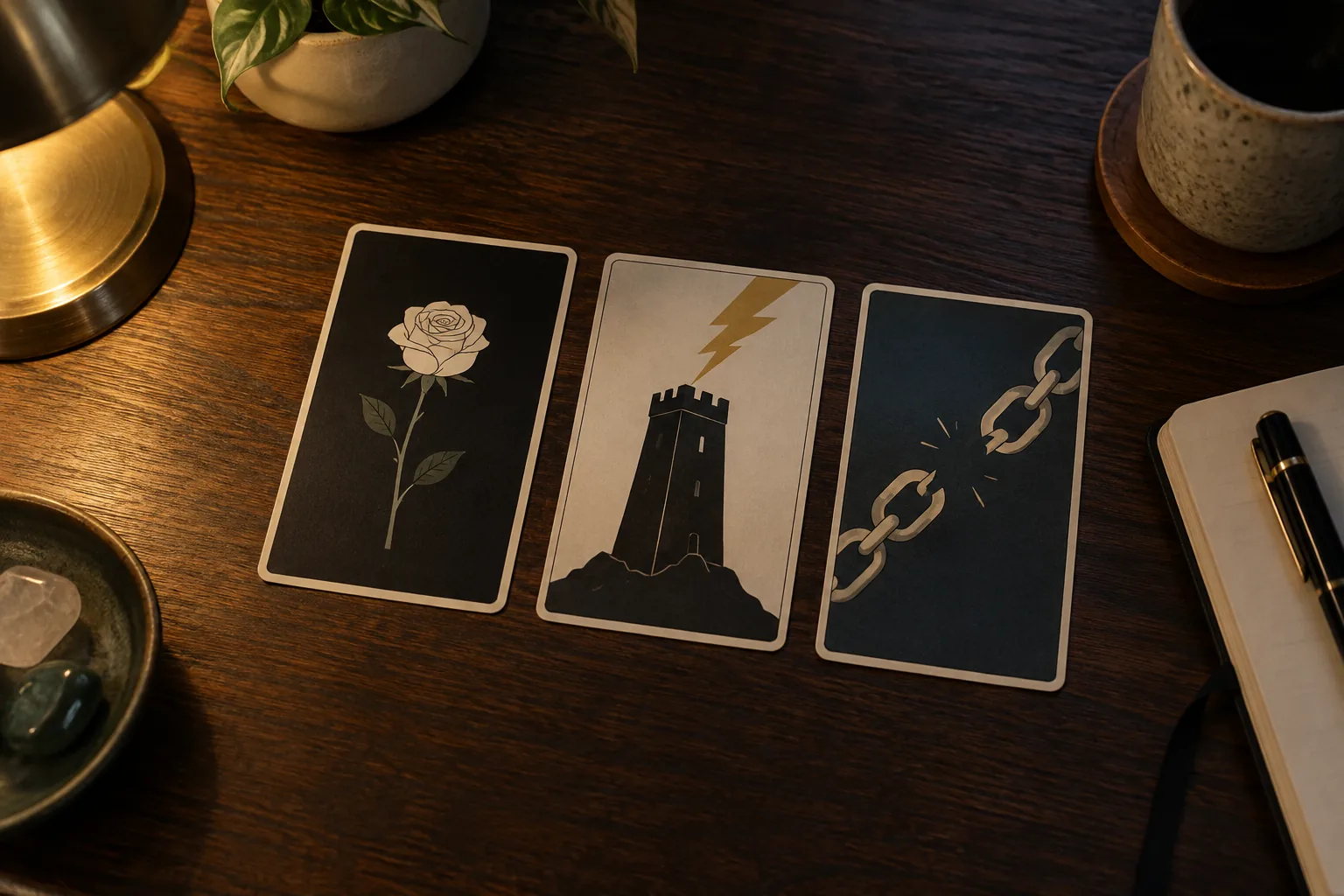
Pulling the Death card, the Tower or the Devil does not mean that you or someone you love will die, lose everything or fall under a curse. In tarot tradition these three cards name hard themes. Death is an ending. The Tower is the sudden fall of something that was never sound. The Devil is a habit, bond or appetite with a grip on you. The old guidebooks describe them in grim words, and this guide quotes those words so you can see where the fear began. Then it covers what each card asks of you, how often you should expect to see one, and what to do in the day after you draw one.
The card is face up in front of you, and your stomach dropped before your mind caught up. You want to know how worried to be.
One honest note first. Tarot has not been shown to predict events. Our guide on whether tarot works sets out a fair test you can run on yourself. Read what follows as a guide to symbols and tradition. It is not a forecast.
Why these three cards frighten people
Most people meet tarot through one deck, the Rider-Waite-Smith, first published in 1909 with pictures by Pamela Colman Smith. Films and social media borrow its images. In that deck the three cards look like this.
- Death (card XIII): a skeleton in black armor rides a white horse and carries a black banner with a white rose. A king lies fallen. A bishop with joined hands, a young woman and a child stand in its path. A sun rises between two towers in the distance.
- The Devil (card XV): a horned figure with bat wings squats on a pedestal and holds a torch. A naked man and woman, both with tails, stand chained to it.
- The Tower (card XVI): lightning strikes a tall tower topped with a crown. Flames burst out. Two people fall through the air, with small flames shaped like the Hebrew letter yod falling around them.
The pictures are half of it. The other half is what the original guidebook said.
What the 1910 guidebook actually said
The deck was made to the instructions of Arthur Edward Waite, and Waite wrote its companion book, The Pictorial Key to the Tarot. His list of fortune-telling meanings is blunt. These are his words, now in the public domain.
| Card | Waite's list of meanings (upright) | Waite's own comment on the picture |
|---|---|---|
| Death | "End, mortality, destruction, corruption" | The card speaks of "change, transformation and passage from lower to higher" |
| The Devil | "Ravage, violence, vehemence, extraordinary efforts, force, fatality", then "that which is predestined but is not for this reason evil" | The horned figure "is not to be their master for ever" |
| The Tower | "Misery, distress, indigence, adversity, calamity, disgrace, deception, ruin", and "a card in particular of unforeseen catastrophe" | The falling building is "a House of Falsehood" |
So the fear has real roots. The tradition did attach hard words to these cards. Even Waite's grim list never ties them to a date, a person or a fixed event, though. His commentary also points toward the readings most tarot writers use today. Later authors, Eden Gray among them, describe a literal death as an uncommon reading of the Death card.
How often you will draw one
A standard tarot deck has 78 cards. If it is well shuffled, these three turn up often, by chance alone.
| How you draw | Chance that at least one of the three appears |
|---|---|
| One card | 3.8%, about 1 in 26 |
| A three-card spread | 11.2%, about 1 in 9 |
| A ten-card Celtic Cross | 34.1%, about 1 in 3 |
| One card a day for 30 days, reshuffled each day | 69% |
| One card a day for a year | About 14 appearances expected |
These are plain probabilities for a shuffled 78-card deck, with each card used once per spread. The person and the question do not change them. If you read tarot for a while, you will meet all three, many times. A card turning up is the deck behaving normally.
What does change is how a card lands. Three posts on Reddit's r/tarot show the same pattern. One person felt ill one night, joked that the first card would be Death, and drew it. They spent the night scared. By morning they felt fine, and the cause had been an upset stomach. Another wrote about pulling cards on days of health anxiety and said the Death card hits hardest then. A nervous flyer drew Death in the week of a flight, after dreaming about a crash. In each case the fear came first and the card gave it a face. That is worth knowing about yourself before you shuffle on a bad day.
Death (XIII): something has run its course
Most tarot writers today read Death as an ending, a transition or the close of a chapter. A role, a habit, a living arrangement or one version of a relationship cannot carry on in its old shape. Some decks drop the name. In the Tarot of Marseille and the 15th-century Visconti-Sforza cards it often has no title and is called the card with no name. A few modern decks call it Rebirth.
| Death | |
|---|---|
| Usual modern reading | An ending, a transition, a chapter closing |
| What it does not tell you | That anyone will die, or when |
| In a love question | A pattern or phase in the relationship coming to an end, which may or may not be the relationship itself |
| In a work question | A role, project or way of working finishing |
| A question to write down | What has already ended that I have not admitted yet? |
An ending you wanted can still hurt. It is fine to read the card as permission to be sad about one.
The Tower (XVI): a sudden change to something shaky
The Tower is the card of a shock. News changes the picture, a plan fails at its weak point, or a belief stops holding. Older decks show different scenes. Some Belgian decks and the 17th-century cards of Jacques Viéville call it La Foudre, the lightning, and show a tree being struck. The Rider-Waite-Smith version follows the burning tower of the Tarot of Marseille. Some early painted decks, such as the Visconti-Sforza, have no Tower at all.
| The Tower | |
|---|---|
| Usual modern reading | A shock, a revelation, the collapse of something built on a weak base |
| What it does not tell you | That an accident or disaster is coming, or on which day |
| In a love question | A truth comes out, or an assumption about the relationship breaks |
| In a work question | A plan meets its flaw, a restructure, a sudden decision made above you |
| A question to write down | What have I been propping up, and what do I know now that I did not want to know? |
Waite read the falling building as a house built on falsehood. That is a comment on the structure. It says nothing about whether the people inside deserved to fall. If something hard has already happened to you, the card is no verdict on you. Where the worry is money, housing, health or safety, take it to someone who can check the facts.
The Devil (XV): a grip you can loosen
The Devil is usually read as attachment, temptation, compulsion or a bargain you keep making with yourself. Money, approval, a substance, a person or a fear starts making your choices. The Rider-Waite-Smith figure borrows from Eliphas Lévi's 1855 drawing of Baphomet, which is where the horns, wings and torch come from. Many modern readers say the chains look loose enough to lift off. Waite wrote that the figure on the pedestal "is not to be their master for ever".
| The Devil | |
|---|---|
| Usual modern reading | Attachment, compulsion, temptation, a pattern that narrows your choices |
| What it does not tell you | That you are evil, possessed or cursed, or that someone in your life is a bad person |
| In a love question | A pull you keep going back to, such as jealousy, dependence or a dynamic that runs on need |
| In a work question | A job kept for money or status at a cost you have stopped counting |
| A question to write down | What do I keep choosing that I would not choose with a clear head? |
Some grips are not loose. Coercive control, debt and addiction can narrow real choices, and they need real help. In the US, the National Domestic Violence Hotline answers at 1-800-799-7233 and thehotline.org. The 988 Suicide and Crisis Lifeline takes calls and texts on 988, including for alcohol or drug concerns.
Other cards people fear
Three Minor Arcana cards and one more trump cause the next-most worry. Waite's notes are revealing here too.
| Card | What the picture shows | What Waite wrote | How many readers use it today |
|---|---|---|---|
| Ten of Swords | A figure lying flat, pierced by ten swords | "Pain, affliction, tears, sadness, desolation", adding that it "is not especially a card of violent death" | A painful ending, or the low point before things turn |
| Three of Swords | A heart pierced by three swords, with cloud and rain behind | "Removal, absence, delay, division, rupture" | Heartbreak, grief, a hard truth |
| Nine of Swords | A woman sitting up on her bed in grief, with nine swords above her | "Despair", along with death, failure and disappointment | Worry, sleepless nights, fear running ahead of the facts |
| The Moon (XVIII) | A dog and a wolf howling at the moon, a crayfish climbing out of the water, a path between two towers | "Hidden enemies, danger, calumny, darkness, terror, deception" | Confusion, an unclear picture, fear in the dark |
Notice that Waite listed "death" under the Nine of Swords, a card few people worry about. His meanings were a fortune-teller's word lists, and every list held something grim. Reversed cards, drawn upside down, add another layer that readers disagree about. This guide sticks to upright meanings.
What to do in the 24 hours after you draw one
- Leave the deck alone. Redrawing until a kinder card comes up turns the deck into a slot machine. The first card tends to stay with you anyway.
- Write three lines. The question exactly as you asked it, the card, and how you felt before you shuffled. Our guide to keeping a psychic journal shows how to review entries like this later.
- Name the real worry in one plain sentence. "I'm scared the test result will be bad." "I think he's going to leave."
- Send that worry to the right place. Use the table below.
- Ask the card's question once. Take the question from that card's table above, write a short answer, and stop.
- Reread it the next morning. If the fear has faded, the card did its job as a prompt. If it has grown, take a week off tarot.
| The worry | Where it belongs |
|---|---|
| Your health, or someone else's | A doctor, nurse line or pharmacist |
| Money, a contract or the law | A qualified adviser, or the organization involved |
| Your safety at home | The hotline above, or 911 in an emergency |
| A relationship | A direct conversation, or a counselor |
| A general sense of dread | Sleep, then reread your three lines tomorrow |
If you notice that you reach for the cards mostly on anxious days and they leave you more anxious, pause the habit for a while. Our guide on what to do after a psychic reading has more on sorting reflection from prediction.
The red flag: a reader who offers to fix the card
Some readers use these cards to sell something. The pitch goes like this. The Death or Tower card shows a curse, a dark attachment or a danger to your family, and only a paid cleansing, candle ritual or spell will lift it. AARP's guide to psychic scams lists this pattern among its warning signs, including a psychic who says something bad will happen to you or your loved ones if you do not pay for help.
No card needs a payment to undo it. If you hear that pitch, end the reading. Our checklist for choosing a psychic reader safely covers the other warning signs, and our guide to auditing an email psychic reading shows how to spot template wording.
Common questions about scary tarot cards
Does the Death card mean someone is going to die?
No. Tarot writers today read the Death card as an ending or a transition. It does not name a person, a cause or a date, and tarot has not been shown to predict events.
Is the Tower card always bad?
It is a hard card. It usually stands for a shock or a sudden change to something that was not stable. Many readers also see relief in it, because a shaky situation becomes clear and can be rebuilt on firmer ground.
What does the Devil card mean in a love reading?
It usually points to a pull you keep going back to, such as jealousy, dependence or a pattern that runs on need. It is a prompt to look at the dynamic. It does not prove that your partner is a bad person.
Which tarot card is the scariest?
Most lists of scary cards start with Death, because of its name and its skeleton. The Tower and the Devil usually come next. None of them predicts a disaster.
What should I do if I keep pulling the same scary card?
Check the odds first. If you draw often, repeats happen by chance. If the same card keeps catching you, write down what it brings to mind each time and look for the common thread. If the repeats make you anxious, take a break from drawing.
Should I stop reading tarot if the cards scare me?
A break is a good idea if tarot leaves you more anxious than before. You can also switch to a deck with gentler art, or use the cards only for reflection questions about yourself.
Sources
- A. E. Waite, The Pictorial Key to the Tarot (1910), divinatory meanings of the Greater Arcana, and his commentary on Death, the Devil, the Tower, the Moon, the Ten of Swords, the Nine of Swords and the Three of Swords. Internet Sacred Text Archive.
- Wikipedia: Death (tarot card), The Tower (tarot card), The Devil (tarot card). Used for deck history and naming.
- AARP, "Psychic Scams" (2022).
- Reddit r/tarot threads linked above (user posts, quoted as examples only).
- Probabilities: our own calculation for a shuffled 78-card deck.