Samhain (say SOW-in or SAH-win) is the Gaelic festival that marked the end of the harvest and the start of winter. In 2026 it runs from sunset on Saturday, October 31, to sunset on Sunday, November 1. Many Halloween customs grew from it. A lot of what gets said about Samhain online is younger than it sounds, though. Below are the dates, six common claims checked against the sources, how Samhain differs from Halloween and its neighbors, and the fortune-telling games people actually played on the night.
You have seen "the veil is thin" all over your feed this month, and you would like to know what Samhain actually was before you light a candle for it.
When is Samhain in 2026?
There are three defensible dates this year, and a different one south of the equator.
| Which Samhain | 2026 date and time | Why this date |
|---|---|---|
| Traditional | Sunset Saturday, October 31, to sunset Sunday, November 1 | The Gaelic day began at sunset, so the festival of November 1 started the evening before |
| Astronomical midpoint | Saturday, November 7, at 09:52 UTC (4:52 a.m. Eastern) | The Sun reaches 15 degrees of Scorpio, halfway between the September equinox and the December solstice. Some modern pagans mark this moment |
| Nearest new moon | Monday, November 9, at 07:02 UTC (2:02 a.m. Eastern) | Some groups that follow the moon keep the festival at the dark of the moon |
| Southern Hemisphere | Sunset April 30 to sunset May 1 | Many pagans there shift the festivals by six months to match their own seasons |
Three other things shape the week. Clocks go back in the UK on Sunday, October 25, and in the US on Sunday, November 1, the morning after Halloween. Evenings get dark an hour earlier just as the festival arrives. The Moon is past full on October 31, waning toward its third quarter on November 1, after the Hunter's Moon of October 26. And if you follow astrology, Mercury is retrograde from October 24 to November 13. Our Mercury retrograde in Scorpio guide covers that.
Six claims about Samhain, checked
Samhain appears in Irish literature from about the 9th century. Most detailed descriptions of how people kept it come much later, from the early modern period and from folklore collected in the 19th and 20th centuries. That gap is where many confident claims come from. Here is how six of them hold up.
| The claim | What the sources say | Verdict |
|---|---|---|
| "Samhain means summer's end." | That is the traditional translation. Some linguists propose a different root meaning "assembly" or "coming together". The word is also the Irish and Scottish Gaelic name for November. | Traditional, but debated |
| "It was the Celtic New Year." | The idea was made popular by two scholars, Sir John Rhŷs and Sir James Frazer, around 1900. The historian Ronald Hutton judged the evidence flimsy in his 1996 history of the ritual year, and he traced where the idea came from in a 2024 article in the journal Folklore. | Disputed |
| "It was the ancient festival of the dead." | In later Irish folk custom, Halloween was called "ghost night" or "spirit night", and the souls of the dead were expected to return to the family home. Hutton argues that ancient European feasts of the dead, where they existed, fell between March and May. In his account the big November feasts for the dead grew up in the medieval church. | True of later folk custom. Unproven for ancient times |
| "The veil between the worlds is thin." | Medieval Irish tales describe the fairy mounds as open at Samhain. Later folklore has people avoiding fairy forts that night and carrying a black-handled knife or a steel needle for protection. "The veil is thinnest" is how modern Wiccan writing puts it. | Old belief, modern wording |
| "Halloween is just Samhain with a Christian coat of paint." | Halloween is All Hallows' Eve, the night before All Saints' Day on November 1. All Souls' Day on November 2 was established in the 11th century. Some scholars stress Samhain's influence on Halloween. Others argue it has been exaggerated and that the church feasts shaped Samhain too. | Too simple |
| "The eight-festival Wheel of the Year is ancient." | The individual festivals are old. The wheel as one system was put together in the mid-20th century by Gerald Gardner, the founder of modern Wicca, and Ross Nichols, who founded the Order of Bards, Ovates and Druids. | Modern |
Modern pagans have built a living festival out of these pieces, and folklorists study that festival too. Knowing which piece is which lets you talk about Samhain accurately, whichever way you keep it.
Samhain, Halloween, All Souls' and Día de los Muertos
Four observances cluster around the turn of October and November. They share a mood, but their roots differ.
| Observance | When | Where it comes from | What it marks | Typical customs |
|---|---|---|---|---|
| Samhain | Sunset October 31 to November 1 | Gaelic Ireland, Scotland and the Isle of Man | The start of winter, when cattle came down from summer pasture | Bonfires, guising in masks, feasting, divination games |
| Halloween | October 31 | All Hallows' Eve, carried to North America mainly by Irish and Scottish immigrants in the 19th century | The eve of All Saints' Day | Costumes, trick-or-treating, carved lanterns |
| All Saints' and All Souls' | November 1 and November 2 | The Western Christian church | Honoring the saints, then praying for the dead | Church services, prayers for family members who have died |
| Día de los Muertos | End of October into early November | Mexico's indigenous communities, blended with Catholic feasts | The brief return of dead relatives, and the end of the maize-growing cycle | Flower petals, candles, favorite dishes and offerings at home altars and graves |
Día de los Muertos is a tradition of its own. UNESCO added it to its list of the Intangible Cultural Heritage of Humanity in 2008. Calling it "Mexican Halloween" misses most of what it is.
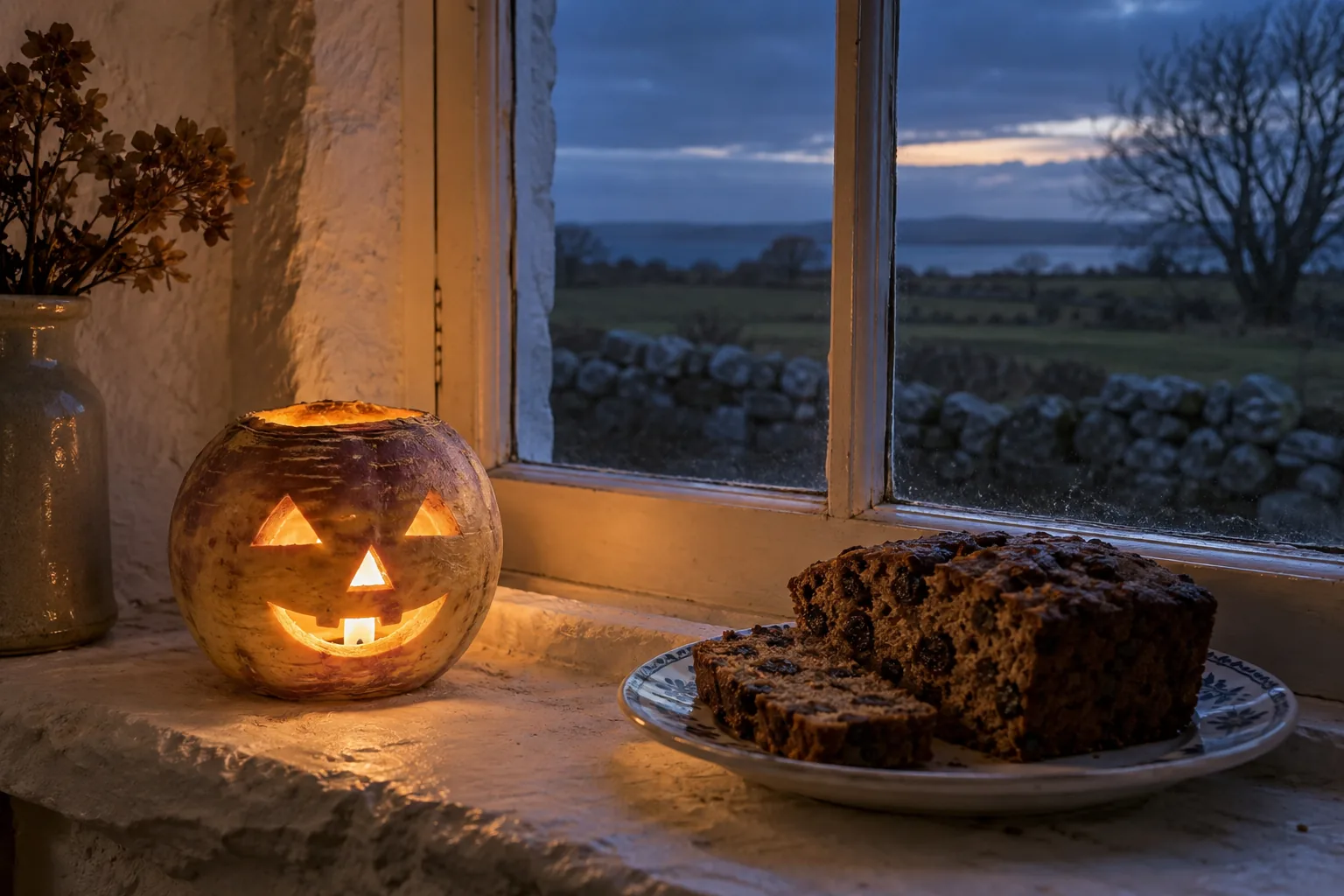
The Halloween lantern has a Samhain story too. In Ireland and the Scottish Highlands people carved turnips into lanterns with frightening faces. The National Museum of Ireland calls the pumpkin "an American development of this idea".
The fortune-telling games of Samhain night
For a site about readings, this is the part we find most interesting. For centuries Samhain and Halloween were the great night for guessing at the future in Ireland and Scotland. Ronald Hutton calls it "the festival of divination par excellence". He writes that in earlier times the question people most often asked was who would live through the winter. Many of the games that folklorists later recorded were about marriage.
| Game | How it worked | What it claimed to tell you |
|---|---|---|
| Barmbrack (báirín breac) | A fruit loaf baked with small objects inside, sliced and shared out | A ring meant you would marry next. A coin meant wealth, a rag poverty, and a thimble or button staying single |
| Pillow dreams | An apple, a cabbage or another object under your pillow, or a salty oatmeal cake eaten in three bites before bed with nothing to drink | A dream of your future spouse, who might offer you water |
| The cabbage pull | Pulling up a cabbage while blindfolded | Its size, shape and roots described your future husband |
| The four bowls | A blindfolded choice between bowls holding water, a ring, clay and food | Emigration, marriage, death or prosperity |
| Apple peel | Peeling an apple in one long strip and tossing it over your shoulder | The shape gave the first letter of your future spouse's name |
| Roasting hazelnuts | Two nuts set by the fire, one for you and one for the person you liked | Nuts that jumped away from the heat meant a bad match. Nuts that roasted quietly meant a good one |
Look at what the games had in common. People played them in company, with food and noise. The results were random by design, a slice of cake or a blindfolded choice. Everyone could laugh at the result and still talk about it seriously for a minute. That is a healthy way to hold any reading, including a modern one. Treat it as something to think and talk with, held lightly. Our guide on whether tarot works makes the same case from the skeptic's side.
A barmbrack game for this Halloween
Here is a version you can play at a table this year. We invented it, so treat it as a party game with no tradition behind it. Bake or buy a fruit loaf. Push a few small, clean, wrapped tokens into the base, and tell everyone about them before they bite. Skip the tokens if young children are eating. Whoever finds a token answers its question out loud.
| Token | The question to answer |
|---|---|
| Ring | Who do you want to be closer to this winter? |
| Coin | What are you saving your money or energy for? |
| Button | What would you like to do on your own next year? |
| Thimble | What small skill do you want to get better at? |
| Scrap of cloth | What could you give away or let go of before the new year? |
Nobody is predicting anything. The token is random, the answer is yours, and the conversation is the point. Hutton describes the old festival as both a time of fun and a way to face the fears of the dark season. A game like this keeps both.
If you are remembering someone
In Irish folk custom, the season's link with winter and dying nature made Samhain a time for remembering people who had died. Candles went in the windows, and in some homes a place was set at the table for the dead. If you lost someone recently, ordinary support matters more than any date. A bereavement service, your doctor or a friend who knew them can carry more than a ritual can.
Some people think about seeing a medium at this time of year. Psychic readings and mediumship make different claims, so read our guide to psychic vs medium vs clairvoyant first. Then use the warning signs in how to choose a psychic reader. Be wary of anyone who says a loved one's spirit is trapped or angry, or needs a paid ritual to rest. AARP notes that scam psychics target people who are grieving.
Questions for Samhain night
Samhain fell at the turn of the farming year, when people took stock before winter. That makes it a good night for a question about what you are carrying forward. Questions about your own next step work better than questions about whether something will happen. Five to start with:
- What am I holding on to from this year that I could put down?
- What did this year teach me that I want to keep?
- Who would I like to spend more time with this winter?
- What would make the dark months easier at work or at home?
- What do I want to start once the days get longer?
If you read tarot, a simple layout fits the night. Draw three cards for what to leave in this year, what to carry into winter, and what to plant for spring. If Death turns up, it fits the night. In tarot tradition it is a card of endings and change. Our list of questions to ask a psychic has more ideas for wording.
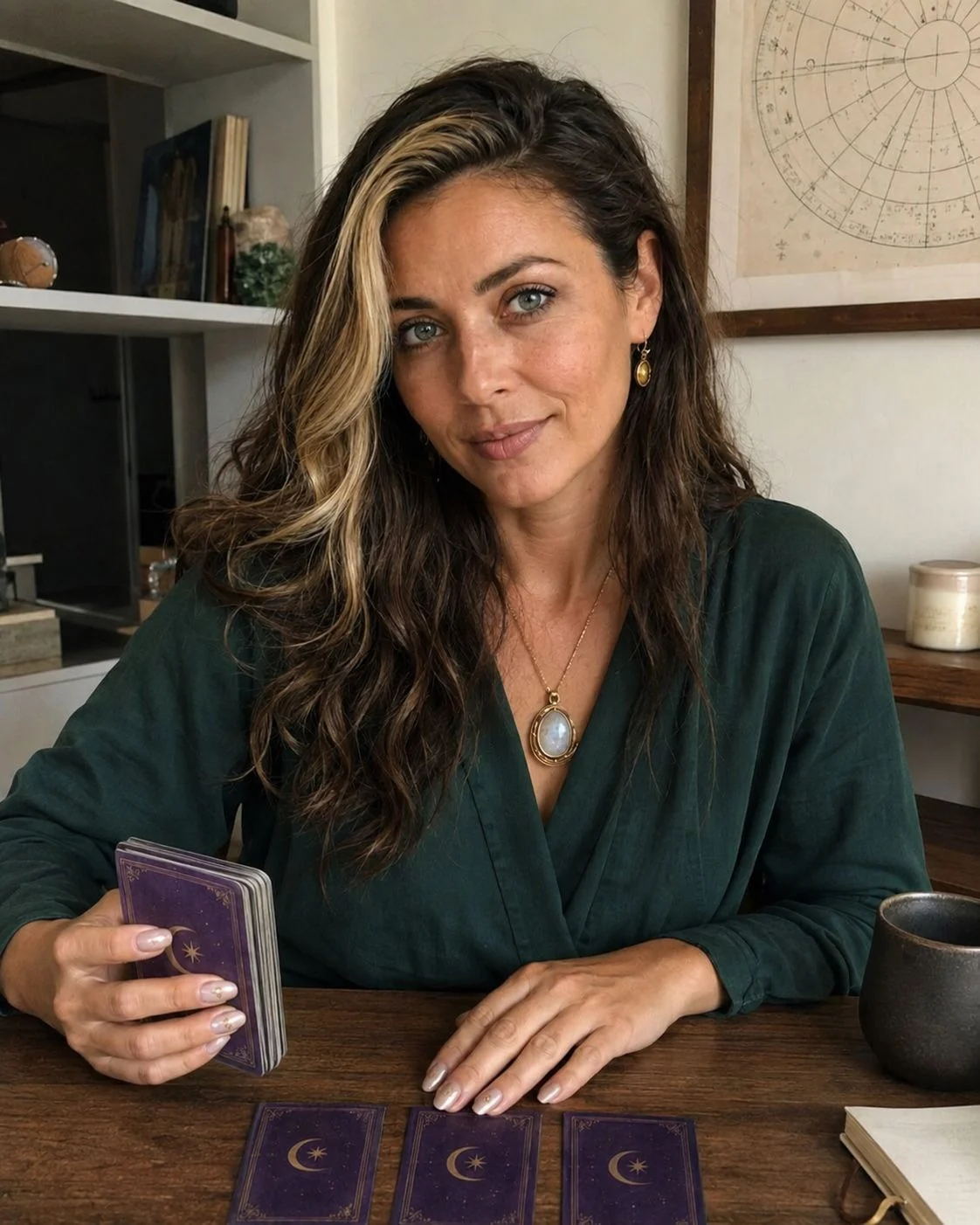
If you want an outside view on one of your questions, Maria writes personal readings by email for Divine Glows. Read one the way people once read a slice of barmbrack. It is something to think about and talk over, with your own judgment in charge. The reading page lists what is included.
Common questions about Samhain
When is Samhain 2026?
Samhain 2026 runs from sunset on Saturday, October 31, to sunset on Sunday, November 1. The astronomical midpoint between the equinox and the solstice falls on November 7, 2026, at 09:52 UTC, and some modern pagans mark that date instead.
How do you pronounce Samhain?
Most English speakers say SOW-in, rhyming with "cow-in", or SAH-win. The Irish name for Samhain night, Oíche Shamhna, is said roughly EE-ha HOW-na.
Is Samhain the same as Halloween?
No. Samhain is the Gaelic festival of the start of winter. Halloween is All Hallows' Eve, the night before the Christian feast of All Saints. They fall on the same night and have shaped each other. Guising and carved lanterns came into Halloween from Gaelic customs.
What does "the veil is thin" mean?
It is a modern way of saying that at Samhain the boundary between the living world and the Otherworld was believed to open, so spirits, fairies and the dead could pass through. Medieval Irish tales and later folklore describe that belief. The phrase itself is common in modern pagan writing.
Is Samhain a pagan holiday?
It began as a seasonal festival of the Gaelic year. Its pre-Christian religious rites were never recorded, so little is known about them. Today many modern pagans, including Wiccans and Celtic Reconstructionists, keep Samhain as a religious festival, and many Irish and Scottish people keep its customs as part of Halloween.
When is Samhain in the Southern Hemisphere?
Many pagans in the Southern Hemisphere celebrate Samhain from sunset on April 30 to sunset on May 1, so that it falls at the start of their own winter. In that version of the calendar, Beltane falls on October 31.
A question for the turn of the year
If Samhain has you taking stock, Maria can write a personal reading around up to three of your questions. It arrives by email, so you can read it slowly and come back to it in the dark months.
- Her view of what you are carrying into winter and why.
- The pattern she senses behind the question you wrote.
- Possible directions to consider, in a format you can keep.
Maria’s approach: a USA-based psychic and tarot reader, Maria combines intuition and tarot to read the connection behind your questions. Her focus is on what comes through about the feelings, the blockage, and the path ahead—including where the picture feels mixed.
What you receive from Maria
A personal written reading shaped around up to three questions and the details you share, delivered by email within 24 hours. You provide your questions and relevant details with your order. This is a reading you can keep and return to, not a live call you need to schedule.
Ask Maria your year-end questions →
View the reading details and current price before ordering. You can review our refund policy and privacy policy at any time.
Sources
- National Museum of Ireland, "Ghost turnips, the púca, fortune-telling and evil abductions" (Clodagh Doyle, Keeper of the National Folklife Collection). Customs, games, lanterns.
- Ronald Hutton, "Halloween? It's more than trick or treat", The Guardian, 2014.
- Ronald Hutton, "The Celtic New Year and Feast of the Dead", Folklore 135(1), 2024. Abstract checked.
- Religion Media Centre, "Factsheet: Samhain" (Jennifer Uzzell, 2020). Wheel of the Year history and modern practice.
- UNESCO, "Indigenous festivity dedicated to the dead" (Mexico, inscribed 2008).
- Wikipedia, Samhain. Pronunciation, etymology debate, the games, Southern Hemisphere dates.
- timeanddate.com: moon phases 2026, UK clock change, US clock change.
- Cross-quarter time: What's Up Sky, Samhain 2026 and the EarthSpirit 2026 almanac.
A personal reading by Maria
Write it down while the year turns
Put the question in your own words, add the context that matters, and read Maria's perspective in your own time. Keep your own judgment in charge.
Your Full Psychic Reading is built around up to three questions and the context you share. Receive your written guidance by email within 24 hours.