
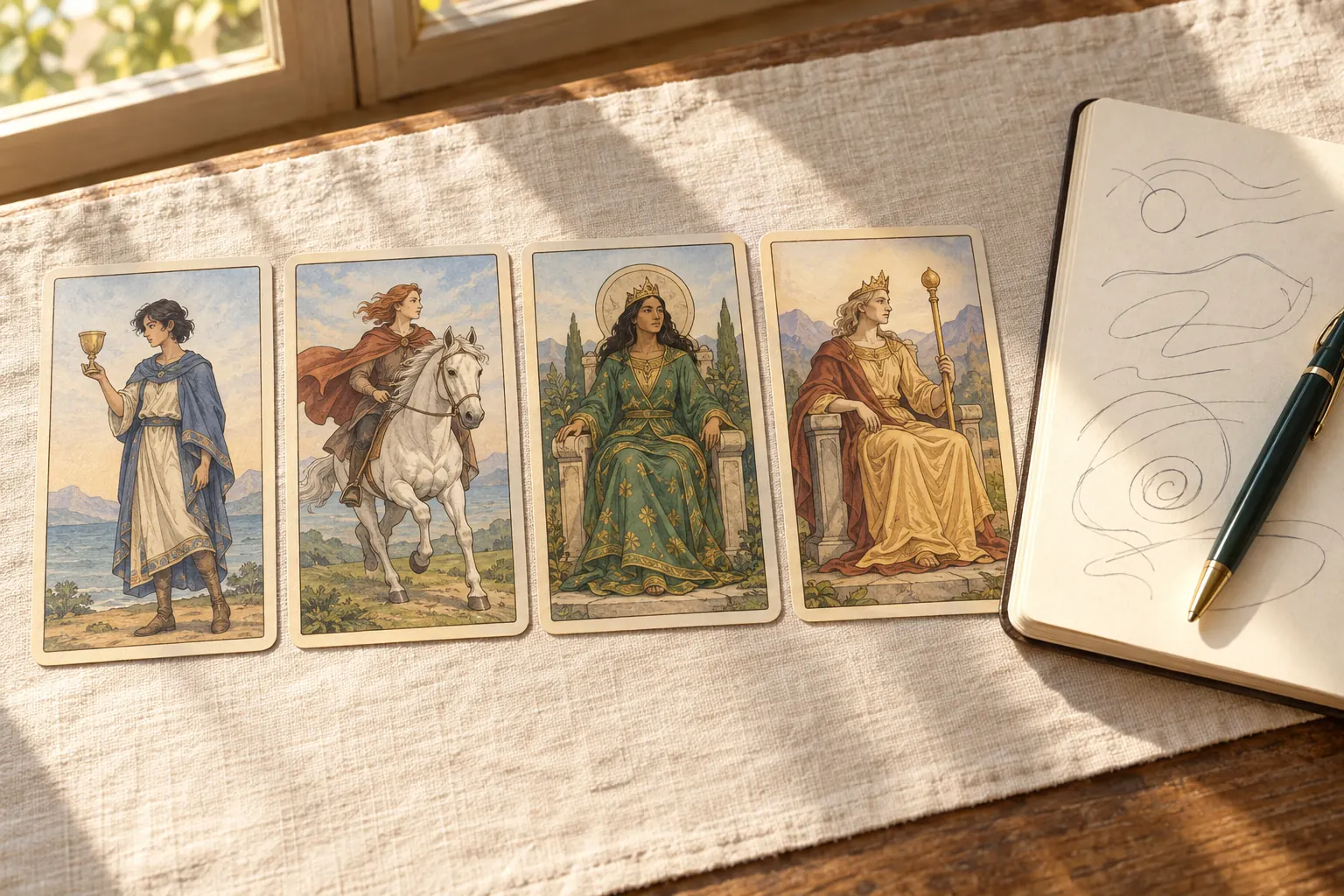
A tarot court card can be read three ways: as a real person in your situation, as a part of you, or as an approach the reading suggests you take. Nothing printed on the card tells you which. The question you asked and the position the card lands in usually decide it, and the number of court cards in the spread is a useful hint. What a court card cannot do is confirm who someone is. If you drew the King of Cups and thought "is that him?", the honest answer is that the card describes a way of acting, and you are the one who knows whether anyone in your life is acting that way.
You drew a King, Queen, Knight or Page and you are not sure whether it means someone in your life, a side of you, or something to try.
This guide gives a rank-by-suit table for all sixteen cards, what Arthur Edward Waite wrote about them in 1910, why different books name the ranks differently, how often court cards turn up in a spread, and a worked example of the "is this card him?" question. No study has found that tarot can forecast events or uncover hidden facts about a person. As tools for reflection, though, the court cards are some of the most useful cards in the deck.
The sixteen court cards at a glance
The rank tells you the stage. The suit tells you the area of life. Each cell below gives the card as a person first, then as an energy or approach.
| Rank | Stage | Wands (drive, work, ideas) | Cups (feelings, love, friendship) | Swords (thoughts, words, conflict) | Pentacles (money, body, home) |
|---|---|---|---|---|---|
| Page | Learning, a first message | Someone keen and new to something. An idea worth testing | A gentle, open beginner. A feeling you have not yet said aloud | A watchful, curious student. A sharp question, checking the facts | A careful learner. Study, or a small practical start |
| Knight | Moving, chasing it | A restless mover. A sudden trip, move or change of plan | Someone who arrives with an offer. An invitation or proposal | A blunt, fast arguer. Charging in, or a fight about words | A slow, dependable worker. Routine, duty, keeping at it |
| Queen | Holding it from the inside | A warm, confident host. Self-belief that draws people in | An empathetic listener. Intuition and care | A clear-eyed person who has lived through loss. Honest boundaries | A generous, grounded provider. Comfort and security at home |
| King | Directing it outward | A bold leader. Setting the direction | A calm adviser. Steady feelings under pressure | An expert or a judge. A decision made on facts | A successful builder. Money and resources handled well |
The suit areas follow modern readers' usual practice. The cells are our own plain summaries, built from Waite's meanings below and from common modern usage. Other books will word them differently, and some will disagree on a cell or two.
What Waite actually wrote in 1910
Waite devised the Rider-Waite-Smith deck with the artist Pamela Colman Smith, and many modern decks follow it. In The Pictorial Key to the Tarot (1910) he says the court cards differ in their pictures, but "the symbolism resides in their rank and in the suit to which they belong". That is the table above in one sentence.
His divinatory meanings are more interesting than most summaries suggest, because they do not treat the court cards as people by default. We went through all sixteen.
| What Waite's meaning does | How many of the 16 | Which cards |
|---|---|---|
| Opens by describing a person | 6 | King, Queen and Page of Wands, King, Queen and Page of Cups |
| Mentions a person only in passing | 3 | Knight of Wands, Knight of Cups, Page of Pentacles |
| Describes only qualities, events or situations | 7 | All four Swords cards, King, Queen and Knight of Pentacles |
A few examples show how mixed the list is. The Knight of Wands begins "Departure, absence, flight, emigration", and only then adds "A dark young man, friendly". The Queen of Swords is "Widowhood, female sadness and embarrassment, absence", a situation and not a woman. The King of Pentacles is "Valor, intelligence, business, mathematical gifts, and success in these paths", with no person at all.
Waite also gave rules for choosing a court card to represent the person asking, by age and by hair and eye colour. The Celtic Cross guide quotes them. Then he added a reserve that most people skip. He wrote that "one who is exceedingly dark may be very energetic, and would be better represented by a Sword card than a Pentacle", and that a very fair person who is "indolent and lethargic" belongs with Cups rather than Wands. Even in 1910, temperament beat appearance.
Why one book's Knight is another book's King
If two guides disagree about which court card is the most senior, they may be using different naming systems. Waite's deck uses King, Queen, Knight and Page, like a medieval court. The Golden Dawn, the London occult order Waite belonged to, used a different set in its manual known as Book T.
| Book T name | How Book T pictures it | The card it matches in a Waite deck |
|---|---|---|
| King | "Figures mounted on steeds", swift and violent | Knight |
| Queen | Seated on thrones, steady and enduring | Queen |
| Prince | "Figures seated in Chariots" | King |
| Princess | Standing figures, "the Knaves of the Tarot Pack" | Page |
So Book T's "King of the Spirits of Fire" is labelled as the Knight of Wands, and its "Prince of the Chariot of Fire" is the King of Wands. Decks that follow the Golden Dawn line, such as the Thoth deck, use Knight, Queen, Prince and Princess. If a book tells you the Knight is the most powerful card in the suit, it is probably using this scheme. Neither system is wrong. Just check which one your book uses before you compare meanings.
Three ways to read one court card
Every court card in a reading can be one of these. Often more than one fits, and that is fine.
- A person. Someone in the situation who is acting the way the card describes. Read what the card shows of how they act toward you, not what they secretly think.
- A part of you. How you are showing up in this situation, or a side of you that is louder than usual right now.
- An approach. A way of acting the reading puts in front of you to try, whether or not you act that way now.
Three clues help you choose.
- The position. A position about another person, such as "them" or "outside influences", points to a person. A position about you points to a part of you. An "advice" or "what to do" position points to an approach.
- The question. If you asked about a specific relationship, the person reading is more likely. If you asked about your own choice or habit, the part-of-you or approach reading is more likely.
- How many court cards there are. Tarot author Marcus Katz suggests a rule of thumb in material from his 2010 book Tarosophy. One court card in a spread is likely a particular person, since that energy takes centre stage. Two or three describe the forces at work in the situation as a whole. Many court cards, especially of mixed suits, usually point to parts of the querent's own personality pulling against each other.
Reversed court cards are usually read as the energy blocked, overdone or turned inward, which leans toward the part-of-you reading. The reversed cards guide covers the four common ways readers handle them.
How often court cards turn up
A full deck has 78 cards and 16 of them are court cards. People often read a court card as a sign that someone is about to enter their life. The arithmetic says court cards are simply common. These figures assume a well-shuffled full deck.
| Spread | Chance of at least one court card | What is typical |
|---|---|---|
| One card | About 21 percent, roughly 1 in 5 | No court card |
| Three cards | About 50 percent, a coin toss | None or one |
| Ten-card Celtic Cross | More than 90 percent | Two, on average. Two or three in about 54 percent of spreads. Four or more in about 1 in 9 |
Two things follow. First, a court card in a three-card spread is not a special event. It happens in about half of all draws. Second, if you use Katz's rule on a Celtic Cross, the "single court card, likely a person" case comes up in only about one spread in four (26 percent). Most of the time you will be reading two or three courts as forces in the situation.
"Is this card him?" A worked example
This is the question people most often bring to a court card, usually in a love reading. Here is how a careful reader might think it through. The person, the question and the cards are invented for this example.
Priya asks, "What is going on between me and Arjun since our argument?" She draws three cards for "me", "him" and "what would help". The cards are the Page of Cups, the King of Swords and the Queen of Cups.
- The King of Swords in the "him" position. The position points to a person, so reading it as Arjun is reasonable. But the card describes how he is acting toward her, not who he is or what he feels. Waite's meaning is about judgment and authority. In plain words: he may be treating the argument as a case to win, all logic and no warmth. Priya can check that against what he has actually said and done. If it does not fit, the card is not "him", and she can set it aside.
- The Page of Cups in the "me" position. A part of her. Waite's Page of Cups includes "reflection, meditation". She may be the one holding back an apology she has not sent.
- The Queen of Cups in "what would help". An approach, not a third person. It suggests listening and naming feelings first. It does not mean another woman is involved.
Notice what the reading did not do. It did not say whether Arjun will come back, whether he still loves her, or whether he is honest. A card cannot know those things. If you find yourself drawing again and again to confirm who a court card is, that is a sign the question needs rewording. The yes-or-no tarot guide has rewrites for exactly this kind of question.
Gender, age and the person in front of you
Waite's meanings describe "a dark woman" or "a fair young man", and older books read Queens as women and Kings as men. Waite himself noted that "certain rare sets" of cards turned the Page into a maid of honour, so even in his time the genders were conventions. Most modern readers read a Queen as anyone, of any gender, who handles that suit from the inside, and a King as anyone who directs it outward. Age works the same way. A sixty-year-old learning to paint can be a Page of Wands.
This matters most in the "is this card him?" moment. If your partner is a woman and you drew a King, the card can still describe her, because the rank describes behaviour, not body or age.
Common mistakes with court cards
- Treating every court card as a new person about to arrive. Courts turn up in about half of all three-card draws.
- Deciding on the person before reading the position. Read the position first.
- Reading gender and age literally. The rank describes how someone handles the suit.
- Drawing again to "confirm" an identity. A second draw gives you a second random card, not a confirmation.
- Ignoring the part-of-you reading because it is less exciting. It is often the one you can do something with.
For what tarot can and cannot honestly do, see does tarot work?
Common questions
Are tarot court cards always people?
No. A court card can describe a person, a part of you, or an approach to take. The position and your question usually decide which. In Waite's own 1910 meanings, seven of the sixteen court cards describe only qualities or events, with no person at all.
Is this court card my partner?
It might describe how your partner is acting, if the card sits in a position about them and the description fits what they actually do. It cannot confirm who someone is or what they feel. If it does not match their behaviour, read it as a part of you or as advice instead.
Can a court card represent me?
Yes. A court card in a position about you, or in a question about your own choices, is often read as a side of you that is active in the situation right now. Many readers find this the most useful reading.
What does it mean if I get several court cards in one spread?
It is common. A ten-card Celtic Cross has two court cards on average. Marcus Katz suggests reading two or three as the forces at work in the situation, and a large number as parts of your own personality pulling in different directions.
Do court cards have fixed genders and ages?
Not in modern practice. Older books read Queens as women and Pages as young people, but most readers now treat the rank as a stage of maturity in that suit, open to anyone.
Why do some decks have Princes and Princesses?
They follow the Golden Dawn's Book T, which names the ranks King, Queen, Prince and Princess. In that scheme the mounted King matches the Knight in a Waite deck, and the Prince in a chariot matches Waite's King.
Sources
- Waite, A. E. (1910), The Pictorial Key to the Tarot, Project Gutenberg. Court card meanings and the Significator reserve were read from the full text.
- Mathers and the Golden Dawn, Book T, The Tarot, "The Sixteen, or Royal, Cards".
- Katz, M. (2010), Court Cards, unpublished material from Tarosophy, Tarot Association.
- Probabilities: hypergeometric counts for a 78-card deck with 16 court cards, computed by Divine Glows.