
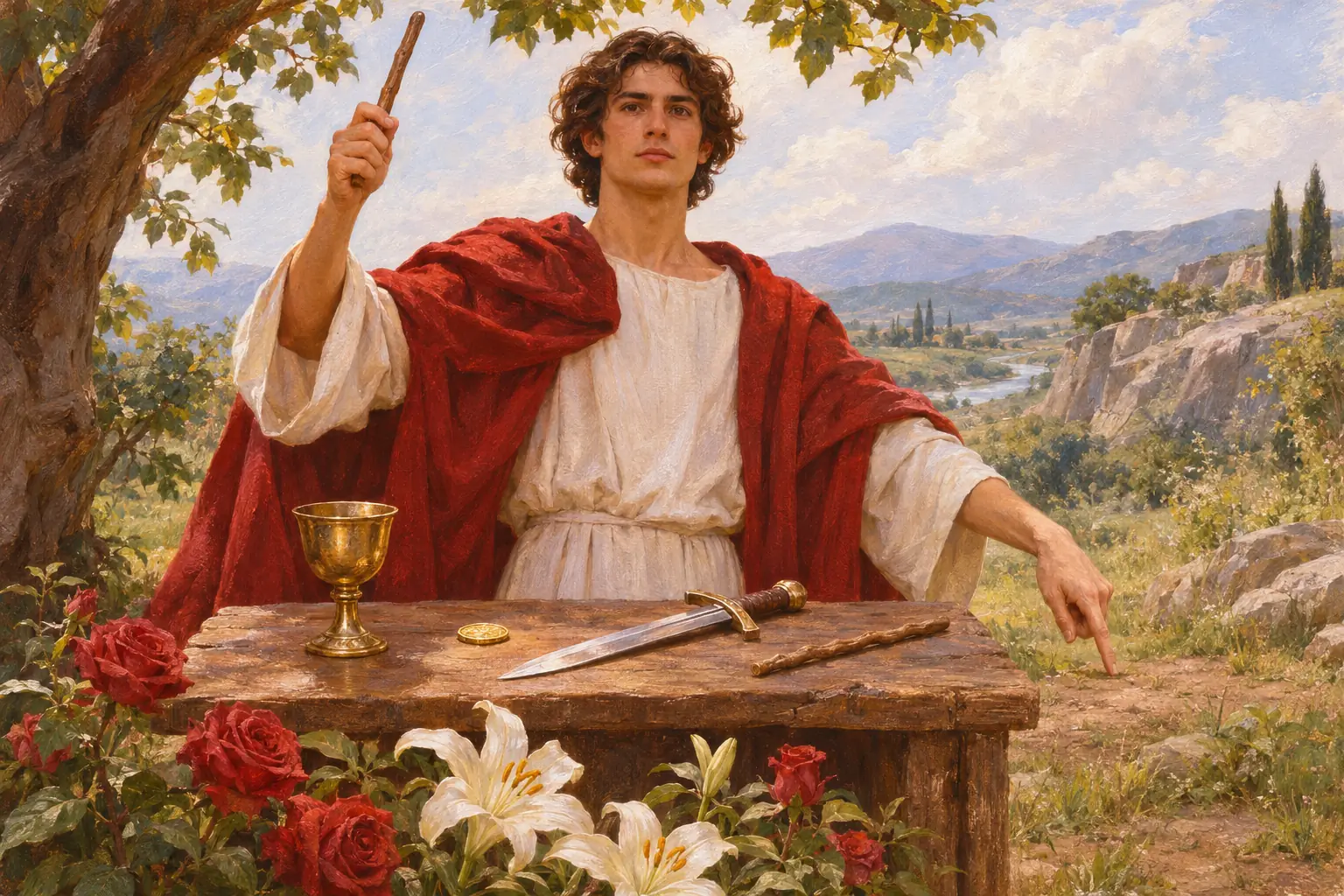
The Magician is the tarot card of turning what you already have into a first real move. A figure stands at a table with the four suit symbols laid out in front of him, a cup, a coin, a sword and a wand, and the usual reading is skill, focus and the nerve to start. The card also has a second side that most quick guides leave out. It began as a street conjurer, and the older meanings mix skill with trickery. So when it turns up, the useful question is not "will this work?" but "am I using what is on my table, or performing it?" It is card I in nearly every deck, it comes straight after the Fool, and like every card it raises a question rather than settling one.
You drew the Magician, maybe about a plan, a job or a person, and want to know whether it means go ahead, and what the reversed card is warning about.
He started as a street conjurer
The earliest Italian decks called this card Il Bagatto. In the hand-painted Visconti-Sforza deck of about 1460, he is shown at a table with what look like cups and balls, the oldest sleight-of-hand trick there is. French Marseille decks named him Le Bateleur, the mountebank: a performer with a little table set up outdoors, cups, coins and knives spread across it, and a baton in his hand. In the card games tarot was made for, he is the lowest trump.
A. E. Waite knew this history and did not like it. In 1910 he described the old reading as "the caster of the dice and mountebank, in the world of vulgar trickery", and called it the "colportage interpretation", the version sold by travelling pedlars. Occultists, starting with Oswald Wirth in 1889, had already turned the mountebank into a magus.
In the 1909 card that Pamela Colman Smith drew for Waite, the baton has become a wand raised to the sky, while his other hand points at the ground. A sideways figure eight floats over his head, the same sign that hangs over the woman on the Strength card. A snake eating its own tail circles his waist. On the table in front of him are a cup, a pentacle, a sword and a wand, set out, in Waite's words, "like counters before the adept, and he adapts them as he wills."
Both figures stand behind the same table. The magus makes something real out of what is there. The conjurer makes you believe something is there. Reading this card well means keeping both in view.
Skill and cunning on the same card
The old meanings never fully let go of that double edge. The Golden Dawn's Book T, the order's manuscript on the cards, gives the Magician this line: "Skill, wisdom, adaptation, craft, cunning, or occult wisdom or power." Waite's own fortune-telling list opens with "Skill, diplomacy, address, subtlety" and then, in the same entry, runs straight on to "sickness, pain, loss, disaster, snares of enemies" before ending on "self-confidence, will". Most modern guides kept the first and last parts and quietly dropped the middle.
Book T also links the card to Mercury, named for the Roman god of messengers and merchants who was also the patron of thieves. Craft and cunning sit together there too.
That is why a simple test helps. When the Magician turns up, ask which of these columns you are standing in.
| Check | The maker | The showman |
|---|---|---|
| What is on the table | Real tools, in use | Props, on display |
| What gets talked about | The next step | The result |
| Questions | Welcomed, answered | Brushed aside, or met with more talk |
| Two weeks later | Something exists that did not before | A better story about what will exist |
| Who gains | The work, and the people in it | Mostly the performer |
Use the table on yourself first. Spotting the showman in someone else is easy. Noticing that your own plan is mostly announcement is harder, and more useful.
The four-item table test
Smith put one object from each suit on the Magician's table. You can do the same with your own situation, on paper, in about ten minutes.
- Write the goal in one line. Keep it small enough that you could begin this week.
- Cup: one person you could ask for help, feedback or an introduction.
- Coin: one material resource you already have. Money, free hours on the calendar, a space, a piece of equipment.
- Sword: one skill or piece of knowledge you already have, something you could explain to a friend over tea.
- Wand: one move that would show you mean it, small enough to do within two days.
- Circle the item you have been avoiding. Then do the wand step within those two days and write down what happened, including if nothing did.
An invented example shows how it plays out. Arjun, 34, wants to teach guitar to beginners on weekends. Cup: a cousin who runs a parents' group for a music school. Coin: free Saturday mornings and a spare guitar. Sword: ten years of playing and the patience to teach a beginner their first few chords. Wand: one message to the group offering two free trial lessons. He circled the cup, because asking his cousin felt like asking a favour. He sent the message on Thursday, and one parent replied. That is a small result, but a real one, and real is the Magician's kind of result.
If you cannot fill a slot, that tells you something too. An empty cup means you are trying to do this alone. An empty wand means the plan does not have a first step yet.
When the Magician is another person
In a love reading, the Magician is often taken to mean someone charming, quick with words and interested. That may well be how they come across. But no card can tell you what another person feels or intends, and this card carries the showman inside it. Treat it as a reminder to grade the actions, not the pitch.
Three plain checks do more than any card can. Do plans happen on the day that was named? Does the story stay the same when it is told twice? Do they ask about you, or mostly about how they are coming across? If charm comes with pressure, secrecy or a push toward money or commitment, take that pattern seriously whatever the cards say. Our guide to mixed signals goes further into reading behaviour instead of signs.
In work questions, the card often turns up around pitches, interviews, launches and side projects. It favours preparation you can show: a portfolio, a demo, a written plan. It does not promise that the pitch will land, and our page on job interview readings is honest about what any reading can say there.
The Magician reversed
Waite's reversed meanings are strange even by his standards: "Physician, Magus, mental disease, disgrace, disquiet." Few modern readers use them. The two readings you will meet most often point in opposite directions, so it helps to work out which one fits.
The first is unused tools. One r/tarot reader, u/EastendAssassin, put it this way in a 2021 thread on the card as a feeling: "you're just standing still, looking at all the cool tools in front of you but not using them". The second is spin: skill turned toward getting your way, a pitch with nothing behind it, whether it comes from someone else or from you.
To sort them, ask one question. Is there too little action here, or too much performance? Too little action points back to the table test, starting with the wand. Too much performance points to the maker and showman checks, applied honestly to yourself. If you are not sure reversals belong in your readings, our guide to reversed cards sets out the options.
Is the Magician a manifestation card?
Many online meanings call it the manifestation card. The picture supports a narrower idea. He is working with what is already in front of him, and the hand pointing at the ground suggests bringing an idea down into the physical world. That is planning plus action. No card makes a wish come true, and no reading can do the step for you. Our look at manifestation and what the research says covers the evidence in more detail.
The Magician as a yes or no
Usually a yes, when the answer depends on you acting with skills and resources you already have. When the question is about someone else's choice, it says very little. Reversed, read it as "not yet" or "not this way": either start, or stop performing and do the work. Our page on yes or no tarot questions explains how to phrase a question so a single card can help.
Common questions
What does the Magician mean in a tarot reading?
Skill, focus and a first real move using what you already have: the four suit symbols on his table stand for your resources. Older meanings also include cunning and trickery, so the card asks whether you are using your tools or just showing them. Treat it as something to think with, not a forecast.
What does the Magician mean as feelings?
It is often read as interest that comes with charm and confidence. No card can tell you what another person actually feels, and this one has a showman side, so judge what they do over time rather than how well they talk.
What does the Magician reversed mean?
Most modern readers take it one of two ways: tools and skills left unused, or skill turned into spin and manipulation. Waite's own reversed list was "Physician, Magus, mental disease, disgrace, disquiet," which few readers use today.
What is the difference between the Magician and the Fool?
The Fool, card 0, is the leap before you know where it leads. The Magician, card I, is the first deliberate use of skill. One is about starting, the other about starting with what is on the table. Our Major Arcana guide shows where each sits in the sequence. Card III, the Empress, comes next but one and tends what is already growing.
Which planet and zodiac sign go with the Magician?
Mercury. The Golden Dawn gave the Magician the planet Mercury and the Hebrew letter Beth. Because Mercury rules Gemini and Virgo in astrology, some readers link the card to those two signs as well.
Sources
- A. E. Waite, The Pictorial Key to the Tarot (1910), Project Gutenberg ebook 43548, also at sacred-texts.com. Part I on the Magus as "mountebank", Part II "I. The Magician" and Part III divinatory meanings.
- S. L. MacGregor Mathers and others, Book T: The Tarot (Golden Dawn manuscript, about 1888), PDF transcription, for the title "The Magus of Power", the Mercury and Beth attribution and the brief meaning.
- Wikipedia, The Magician (tarot card), for Il Bagatto and the cups and balls in the Visconti-Sforza deck, Le Bateleur, the card's place as the lowest trump, and Oswald Wirth's 1889 magus.
- Reddit r/tarot, "Magician reversed (as a feeling) - what's your opinion?" (September 2021), for the quoted reply.
- The Arjun example is invented for illustration.