The Major Arcana are the 22 named cards of a 78-card tarot deck, numbered 0 to 21, from the Fool to the World. Readers usually treat them as the big themes of a reading, while the 56 minor cards cover the day-to-day detail. The table below gives each card in plain words, with one question it tends to raise.
You have a tarot deck, or a reading that turned up a Major Arcana card, and want a plain explanation of each card you can come back to.
These meanings are a tradition built up by card makers and occult writers since the late 1700s. They are not predictions, and no study has shown that the cards foretell events. They work best as prompts for reflection, which is how this guide uses them.
All 22 cards at a glance
| No. | Card | Golden Dawn link | In plain words | A question it raises |
|---|---|---|---|---|
| 0 | The Fool | Air | Starting before you feel ready, trusting more than planning | What would you try if you did not need to know the ending? |
| I | The Magician | Mercury | Using the skills and tools already in front of you | What do you have that you are not using yet? |
| II | The High Priestess | Moon | Knowing something you have not said out loud | What do you sense but have not put into words? |
| III | The Empress | Venus | Growth that comes from care, comfort and making things | What needs feeding rather than fixing? |
| IV | The Emperor | Aries | Structure, rules and someone taking charge | Where would a clear rule make life easier? |
| V | The Hierophant | Taurus | Tradition, teachers and doing it the accepted way | Whose rules are you following, and do you still agree with them? |
| VI | The Lovers | Gemini | A bond, or a choice that shows what you value | What do you care about enough to choose it? |
| VII | The Chariot | Cancer | Steering two pulls in one direction by will | Where are you being pulled two ways at once? |
| VIII | Strength | Leo | Calm, patient handling of a strong feeling | What would gentleness toward your own fear look like? |
| IX | The Hermit | Virgo | Stepping back to think on your own | What can you only work out alone? |
| X | Wheel of Fortune | Jupiter | Circumstances turning, the part you do not control | What is changing around you, and what is still your call? |
| XI | Justice | Libra | Fairness, consequences and weighing the facts | What would a fair decision look like if it were someone else's? |
| XII | The Hanged Man | Water | A pause that changes how you see things | What looks different if you stop pushing? |
| XIII | Death | Scorpio | An ending that clears space. Almost never literal | What is already over that you are still holding? |
| XIV | Temperance | Sagittarius | Mixing, moderating, finding the right measure slowly | What needs a little less, or a little more? |
| XV | The Devil | Capricorn | A habit or tie that feels binding but may not be | What are you choosing that you call being stuck? |
| XVI | The Tower | Mars | A sudden shake-up of a structure that was never solid | What have you been propping up? |
| XVII | The Star | Aquarius | Hope and quiet repair after a hard stretch | What small thing gives you hope this week? |
| XVIII | The Moon | Pisces | Uncertainty, worry, things only half seen | What are you assuming without evidence? |
| XIX | The Sun | Sun | Warmth, clarity and plain good things | What is going well that you have stopped noticing? |
| XX | Judgement | Fire | A wake-up call, or settling accounts with the past | What is asking you for an answer? |
| XXI | The World | Saturn | Completion, a cycle closed before the next one | What have you finished that deserves marking? |
The numbering follows the Rider-Waite-Smith deck, the one most beginners own. The Golden Dawn column comes from the order's Book T, written around 1888, which is where most modern sign and planet links for tarot cards come from. Book T gives the World both Earth and Saturn, and Judgement both Fire and Spirit.
For the other 56 cards, see the four suits.
Where the meanings come from
The cards did not start as a fortune-telling tool. Decks with extra picture cards called trionfi, or triumphs, are first recorded in northern Italy in the 1440s, in cities such as Florence, Milan and Ferrara. The extra cards were trumps in a trick-taking game. Early ones often carried no names or numbers, and their order changed from one region to the next.
The occult reading came three centuries later. In 1781 the French writer Antoine Court de Gébelin claimed in Le Monde primitif that tarot preserved the wisdom of ancient Egypt. Historians have found nothing to support that, but the idea stuck. Two years later the Paris card reader Etteilla published a method for reading the cards, and later a deck made for divination. In 1870 the French writer Jean-Baptiste Pitois, who wrote as Paul Christian, used the terms "Major Arcana" and "Minor Arcana", which card game players still do not use.
The deck most people learn on came out in London in 1909, drawn by Pamela Colman Smith to a design by Arthur Edward Waite. Waite's book The Pictorial Key to the Tarot followed in 1910. He admitted the order was never settled. "The truth is that the real arrangement of the cards has never transpired," he wrote. In his own book he describes the Fool after card XX and before card XXI, even though the card itself carries a zero.
Strength and Justice: card 8 or card 11?
Waite swapped them. In older Marseille-style decks Justice is 8 and Strength is 11. Waite moved Strength to 8 for reasons he said "satisfy myself" and did not explain. Neither order is wrong. Use the numbers printed on your own deck. Our year card guide has a table for both numbering systems.
Reading the 22 as one story
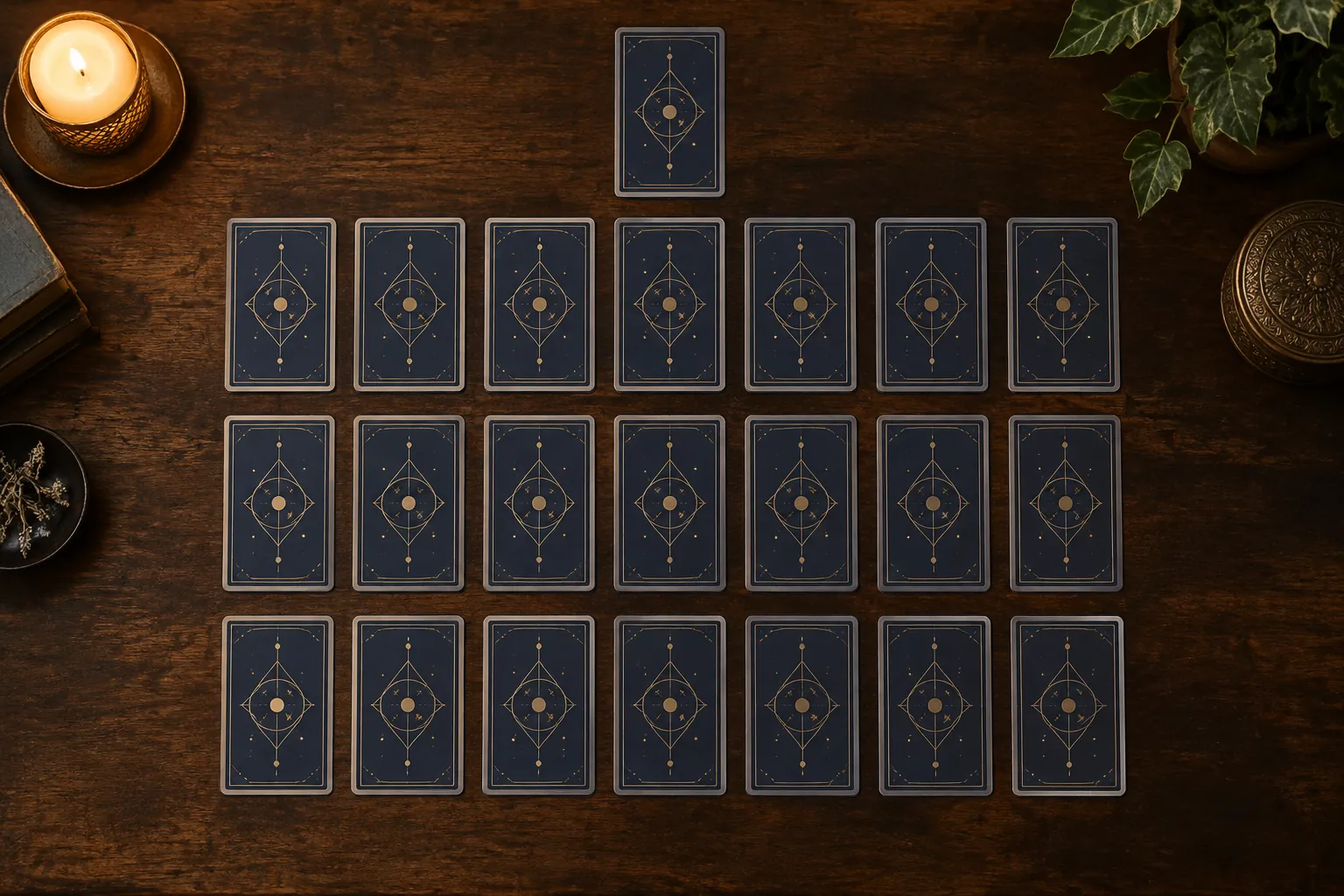
Many modern teachers read the Major Arcana as a sequence rather than 22 separate cards. One popular layout comes from Rachel Pollack's Seventy-Eight Degrees of Wisdom, first published in 1980. She sets the Fool apart as the traveller and lays the other 21 out in three rows of seven.
| Row | Cards | What the row is about, in Pollack's scheme |
|---|---|---|
| One | I The Magician to VII The Chariot | Consciousness: the outer concerns of life and society |
| Two | VIII Strength to XIV Temperance | The subconscious: the inward search for who you really are |
| Three | XV The Devil to XXI The World | The superconscious: spiritual awareness and the release of deep, shared patterns |
Read down the columns and other pairings appear. The Magician sits above Strength and the Devil. One way to read that column is as three kinds of power. The Lovers, Death and Judgement share another, which you could read as choices and their endings.
The model is one teacher's way in, not a rule. It helps if you like stories. If you prefer to learn card by card, skip it.
The 22 cards one by one
Each note describes the Rider-Waite-Smith picture, then gives an example of the card in a reading. The example questions are invented for illustration.
0. The Fool
A young man walks toward a cliff edge with a white rose in one hand, a small bag on a stick over his shoulder and a dog at his heels. Waite called him "the spirit in search of experience". In a question about a new job, the Fool tends to say the leap matters more than the plan. It does not mean you are foolish.
More on this card: the Fool in depth.
I. The Magician
One hand raises a wand, the other points to the ground, and the four suit symbols lie on the table in front of him. In a reading about a stalled project, he points at resources you already have, such as a skill, a contact or a draft sitting unfinished.
II. The High Priestess
She sits between a black pillar and a white one with a half-hidden scroll in her lap and a crescent moon at her feet. She is the card of things kept quiet. Asked "should I tell my friend how I feel?", she suggests checking what you know before you speak.
More on this card: the High Priestess in depth.
III. The Empress
A crowned woman sits on cushions in a field of ripening corn, with a shield bearing the symbol of Venus beside her. She is about care that makes things grow, including your own body and rest. In a burnout question, she is a strong nudge to feed yourself first.
IV. The Emperor
He sits on a stone throne carved with rams' heads, holding a sceptre and an orb. He stands for order, responsibility and authority. He can be a boss or a parent in a reading, or your own need for a routine.
V. The Hierophant
A figure in a triple crown sits between two pillars, with crossed keys at his feet and two people kneeling before him. He is tradition, schooling, religion and any institution with its own rulebook. He often turns up when someone is weighing the expected path against their own.
VI. The Lovers
A man and a woman stand beneath an angel, with a fruit tree behind each of them and a serpent in the tree behind her. Older decks showed a young man standing between two women, a picture of choice. Waite replaced it and called his version the card of human love. Modern readers keep both senses. In a love reading it can mean a real bond. In a career reading it can mean a decision that shows what you value.
More on this card: the Lovers in depth.
VII. The Chariot
A crowned figure rides a chariot pulled by two sphinxes, one black and one white. Waite called him "above all things triumph in the mind". The card is about willpower holding opposite urges on one road. Our Cold Moon guide covers the Chariot's link to Cancer.
VIII. Strength
A woman gently closes a lion's mouth, with the infinity sign above her head. The strength here is patience. Our Wolf Moon guide explains the card's Leo link.
IX. The Hermit
An old man stands on a peak holding up a lantern with a star inside. Waite gave the lantern's message as "where I am, you also may be", so the Hermit is also a guide. In a reading he asks for time alone with a problem, which is different from loneliness.
More on this card: the Hermit in depth.
X. Wheel of Fortune
A wheel turns in the sky with a sphinx on top and a winged creature in each corner. It is the card of change you did not choose. Read it as a reminder to separate what is moving from what you can still decide. It promises luck in neither direction.
More on this card: the Wheel of Fortune in depth.
XI. Justice
A crowned figure sits between pillars holding an upright sword and a pair of scales. Justice is about fairness and the results of what has already been done. In a question about a dispute, she asks for the facts, including the ones that do not favour you.
More on this card: Justice in depth.
XII. The Hanged Man
A man hangs upside down by one foot from a living tree, with a halo around his head. Waite noted that his face shows "deep entrancement, not suffering". The card is a chosen pause. In a question about pushing for an answer, it suggests waiting and looking from a new angle.
XIII. Death
The most feared card is about endings and change, and it is very rarely read as a physical death. Our scary cards guide explains Death in full, with Waite's own notes.
XIV. Temperance
An angel pours liquid between two cups, one foot on land and one in water. The card is about balance found by patient mixing. Our Sagittarius season guide covers Temperance in detail.
XV. The Devil
Two figures stand chained below a horned figure, but the chains around their necks are loose. Readers often take that as the point: the tie can be lifted. Our Capricorn season guide covers the Devil and Capricorn.
XVI. The Tower
Lightning strikes a tower and two people fall from it. It is the card of sudden change to something that was not as solid as it looked. The scary cards guide covers the Tower in full.
XVII. The Star
A naked woman kneels by a pool under one large star and seven small ones, pouring water onto the land and into the pool. After the Tower, the Star is repair. In a reading after a breakup or a loss, it often reads as hope that does not need proof yet.
More on this card: the Star in depth.
XVIII. The Moon
A dog and a wolf howl at the moon while a crayfish climbs out of a pool, and a path runs between two towers into the distance. Waite read the dog and the wolf as "the fears of the natural mind". The card asks you to separate what you know from what you fear.
More on this card: the Moon in depth.
XIX. The Sun
A naked child rides a white horse in front of a garden wall topped with sunflowers, holding a red banner. It is one of the plainest cards in the deck. It stands for warmth, health and things going right. It is a fair moment to notice what is working.
XX. Judgement
An angel blows a trumpet and people rise from their coffins with their arms open. The card is a call to answer for the past or to start fresh, and readers often link it to big decisions. Asked "should I go back to studying?", it asks what has been calling you for a while.
XXI. The World
A dancing figure moves inside a large wreath, with the same four winged creatures from the Wheel in the corners. It is completion, a project, a stage of life or a long lesson brought to a close. It is a natural point to pause before the Fool starts again.
What it means when several Major Arcana show up
A common belief holds that a spread full of majors signals a big life event. The maths says to go easy on that. The 22 majors make up just over 28% of the deck. In a three-card spread, at least one major turns up about 64% of the time by chance, and two or more about 19% of the time. All three are majors about 2% of the time. In a ten-card Celtic Cross you can expect about three majors, and a spread with none happens less than 3% of the time.
So one or two majors are normal. Three in a three-card spread is unusual enough to notice, and still just chance. For the odds on specific scary cards, see the odds section of our scary cards guide. Spread size is covered in Celtic Cross vs three cards.
If one card keeps returning, check the shuffle first. Our guide to why the same tarot card keeps showing up covers the odds and the shuffling research.
Five common misreadings
- Death means someone will die. Readers almost never read it that way. A beginner who reads it as a threat is reacting to the name printed on it.
- The Lovers always means new romance. Often it is about a choice, and it shows up in career questions too.
- The Fool means a mistake. The card is about beginnings and nerve.
- The Devil means a bad person. It usually points at a habit or pattern, and the loose chains say you can step out.
- Wheel of Fortune means good luck is coming. It means change, and change runs both ways.
How to learn the Major Arcana without memorising
Draw one major a day for 22 days. Before you look anything up, write one sentence about what the picture shows you. Then compare it with the table above. Your sentence and the textbook will often disagree, and the gap is where you learn the card. Our self-reflection guide has a simple spread to use once the 22 feel familiar.
Still choosing a deck to learn them on? See how to choose your first tarot deck.
If a major turned up in answer to a yes-or-no question, our yes or no guide shows how to reword the question so the card has something to say. A few other choices change how the majors read. Some readers also use reversed cards, which turns 22 meanings into 44. The 56 Minor Arcana and the court cards among them are a separate puzzle. If you are choosing between decks, our oracle vs tarot guide explains why only tarot has the 22.
If you would rather have someone else lay the cards, Psychic Maria's written readings take up to three questions of your own.
Common questions
How many Major Arcana cards are there?
There are 22, numbered 0 to 21, from the Fool to the World. The other 56 cards in a standard 78-card deck are the Minor Arcana.
Is the Fool card 0 or 22?
Most modern decks print it as 0. Some writers have placed it last or between cards XX and XXI. Waite himself described it after Judgement while keeping the zero.
Does a Major Arcana card mean something big will happen?
No card predicts events. Majors are read as bigger themes, but at least one appears in about two out of three three-card spreads by chance.
Why are Strength and Justice numbered differently in some decks?
Waite swapped them in 1909, putting Strength at 8 and Justice at 11. Marseille-style decks keep Justice at 8. Use the numbers on your deck.
Should beginners learn the Major Arcana first?
It is a common starting point because there are only 22 and each has a strong picture. Learning one a day, starting from your own description, works better than memorising keywords.
A card you keep coming back to
If one Major Arcana card keeps showing up for you, Maria can write a personal reading around up to three of your questions. It is delivered by email within 24 hours, so you can read it next to your own notes.
- Her perspective on the question the card raised for you.
- A look at what may be pulling you in more than one direction.
- Possible next steps to weigh, in a format you can keep.
Maria’s approach: a USA-based psychic and tarot reader, Maria combines intuition and tarot to read the connection behind your questions. Her focus is on what comes through about the feelings, the blockage, and the path ahead—including where the picture feels mixed.
What you receive from Maria
A personal written reading shaped around up to three questions and the details you share, delivered by email within 24 hours. You provide your questions and relevant details with your order. This is a reading you can keep and return to, not a live call you need to schedule.
View the reading details and current price before ordering. You can review our refund policy and privacy policy at any time.
Sources
- Wikipedia, Major Arcana and Tarot, drawing on Michael Dummett and Ronald Decker's histories, for the trionfi, the 1440s records, Court de Gébelin, Etteilla and Paul Christian.
- A. E. Waite, The Pictorial Key to the Tarot (1910), Project Gutenberg, for the card descriptions and the quotations.
- S. L. MacGregor Mathers and the Golden Dawn, Book T, The Tarot (about 1888), for the sign and planet links.
- Rachel Pollack, Seventy-Eight Degrees of Wisdom (1980), for the three rows of seven.
- The probabilities are my own calculation from a 78-card deck with 22 majors, drawn without replacement.
- The example reading questions are invented for illustration.
A personal reading by Maria
The cards are prompts
A card can raise a question. What you do with it stays your call.
Your Full Psychic Reading is built around up to three questions and the context you share. Receive your written guidance by email within 24 hours.