
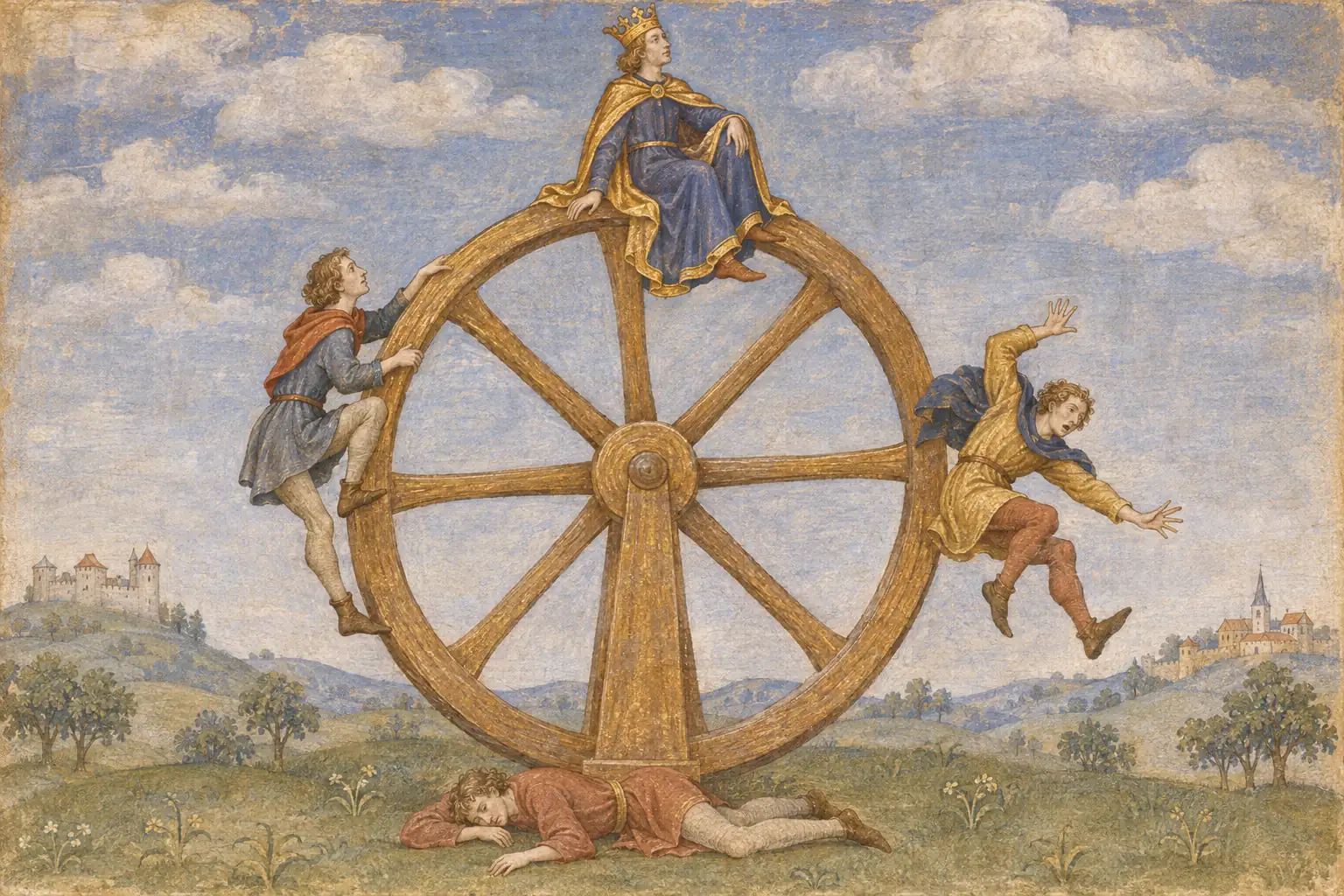
The Wheel of Fortune (card X) is the tarot card of change you did not start. Most modern guides call it a lucky card, and Waite's 1910 list of meanings opens with "Destiny, fortune". But the image is much older than tarot, and for most of its history it was a warning: whoever is on top of the wheel is about to come down. It works best read as a sorting question. What is turning around me, where am I on that turn, and which part is still my decision? It does not promise good luck, and it cannot pick a winner. It is also the 2027 year card for 39 birthdays by the usual method, and our year card guide shows whether yours is one of them.
You drew the Wheel of Fortune and want to know whether it means good luck is coming, bad luck, or something else.
What is on the card, and where does it come from?
The wheel belonged to Fortuna, the Roman goddess of chance. Around the year 524 the Roman official Boethius, writing in prison, gave her a speech in The Consolation of Philosophy, a book copied and illustrated all through the Middle Ages. In H. R. James's 1897 translation she says: "I turn the wheel that spins. I delight to see the high come down and the low ascend." She adds that you may climb on, as long as you do not complain about coming down "when the rules of my game require it."
Medieval artists drew that wheel with four people on it, often labelled in Latin. On the rising side, regnabo, "I shall reign". At the top, crowned, regno, "I reign". Going down, regnavi, "I have reigned". Underneath, sum sine regno, "I am without a kingdom". The same four figures appear in the Carmina Burana manuscript and in cathedral rose windows. When tarot cards were first painted in Italy in the fifteenth century, the Wheel was one of the trumps.
The French Marseille-style cards kept the wheel but replaced the people with odd animals. Waite described them in 1910 as "of nondescript character, one of them having a human head", with a crowned winged beast on top. For the 1909 Rider-Waite-Smith deck he and the artist Pamela Colman Smith followed the French occultist Éliphas Lévi instead: a sphinx with a sword sits on top, a snake (Waite calls it Typhon) slides down one side, a jackal-headed figure rises on the other, and a winged creature reads a book in each corner. The letters T, A, R, O on the rim can also be read as ROTA, Latin for wheel. Our Major Arcana guide has the short version of the card next to the other 21.
Does the Wheel of Fortune mean good luck?
Not quite, and the card's main sources disagree with each other.
- Waite's divinatory list reads like a lucky card: "Destiny, fortune, success, elevation, luck, felicity."
- Waite's own commentary says the opposite about chance. "Behind the general notion expressed in the symbol there lies the denial of chance," he wrote, and he called the sphinx on top a picture of "stability amidst movement". He was rude about most occult explanations of the card ("of a singularly fatuous kind") and admitted that plain fortune-telling did better with it.
- The Golden Dawn's Book T gives the meaning as "Good fortune, happiness (within bounds). Intoxication of success." The words "within bounds" and the warning about intoxication are the medieval wheel again: being on top is pleasant and temporary.
So read the card as change in circumstances, with no promise about which direction. The hopeful version is that a stuck situation is starting to move. The cautious version is that whatever is going well now is not permanent, so do not build as if it were.
One firm line. A card drawn before a bet, a trade or a lottery ticket does not change the odds by a single fraction. Each spin of a real wheel is independent of the last one, and so is each shuffle. If money decisions keep landing on a card, that is a reason to step away from both.
Where are you on the wheel? A four-rider check
The four medieval riders make a better tool than a list of keywords. Take a page, write the four labels down the side, and give each one a single line about your situation. It takes about five minutes.
| Rider | Plain meaning | Ask yourself | The part that is yours |
|---|---|---|---|
| Regnabo, "I shall reign" | Rising | What is starting to go my way? | Whether you prepare for it or coast |
| Regno, "I reign" | At the top | What is going well that I am treating as permanent? | What you save, share or protect while it lasts |
| Regnavi, "I have reigned" | Coming down | What is ending, however much I would like it not to? | How you let it go, and what you take with you |
| Sum sine regno, "I am without a kingdom" | At the bottom | What is the lowest point, and is it actually as low as it feels? | The next small step, and who you ask for help |
Most people find they are in two places at once: rising in one part of life and coming down in another. That is the honest picture the card offers. A single draw cannot tell you how long any position will last.
An invented example, to show how it reads:
- Regnabo: "My side project got its first three paying customers."
- Regno: "My day job is stable and I have stopped thinking about it."
- Regnavi: "My old friend group is drifting apart since two people moved away."
- Sum sine regno: "Savings are low after the house repairs."
- What she does with it: keeps the day job, builds the project on weekends, and phones one of the friends who moved.
What does it mean in love?
In a love reading the Wheel usually describes timing and circumstance rather than feelings: a move, a new job, a family event, a chance meeting. For a single person readers often take it as a sign that things may shift soon. For a couple it can mark a turning point, good or hard.
What it does not say is that someone is fated to come to you, or that an ex will come back because the wheel has turned. If you are asking "will they return?", the card points at what has changed in both your lives since you parted. That question is worth answering on its own.
What does it mean for work and money?
At work the Wheel often shows up around restructures, new managers, market swings and offers you did not seek. Read it as a reason to check where you sit on the four riders. If you are near the top, it is a good moment to save or document your wins. If you are at the bottom, it suggests the position is not fixed, which is a reason to apply, ask or retrain, not to wait.
For money decisions the card adds nothing a budget would not. Use it as a prompt to look at the numbers, not as permission to take a risk.
What does the Wheel of Fortune mean reversed?
Here the books are surprising. Waite's reversed meaning is "Increase, abundance, superfluity", which is more of the same rather than bad luck. Most modern sites read the reversed card as delay, resistance to change, or a cycle repeating.
Some readers skip reversals for this card. One r/tarot commenter argued that Fortuna "should have no different meaning reversed, because its whole function is reversing things through lucky breaks and bad breaks." If you do read it reversed, a fair approach is to ask whether you are resisting a change that has already happened, or repeating a loop you could step out of. Our guide to reversed tarot cards shows how Waite's reversals work across the deck.
Is the Wheel of Fortune a yes or no card?
It answers one kind of question well and another not at all. "Will this situation change?" gets a clear yes, because change is the whole card. "Will it change the way I want?" gets nothing, because the wheel turns both ways. If you drew it for a yes or no question, change the question so it asks what you will do. Our yes or no guide's rewrites show how.
Common questions
Is the Wheel of Fortune a good card?
It is usually read as a hopeful card of change, but its history is a warning that good positions do not last. Whether it feels good depends on where you are on the turn.
What does the Wheel of Fortune mean as feelings?
Many readers take it to mean the other person feels swept along, as if events are moving faster than they can steer. A card cannot confirm what someone else feels. If it matters, ask them.
What planet and zodiac sign go with the Wheel of Fortune?
In the Golden Dawn system the card is ruled by Jupiter, and Book T titles it "the Lord of the Forces of Life". It has no zodiac sign of its own.
Is the Wheel of Fortune about karma?
Some modern readers link it to karma, the idea that what goes around comes around. That is a later reading. The older image is about chance and the rise and fall of fortune, not about anyone getting what they deserve.
Can the Wheel of Fortune predict a lottery win or a good bet?
No. A card has no effect on the odds, and no reading can pick numbers or results. If you notice that you are using cards to justify bets, take a break from both.
Sources
- A. E. Waite, The Pictorial Key to the Tarot (1910), Project Gutenberg ebook 43548. Part I note on the Wheel of Fortune (the older animals), Part II "Ten. Wheel of Fortune" and the divinatory meanings in Part III.
- S. L. MacGregor Mathers and the Golden Dawn, Book T, The Tarot, titles and attributions list and "Brief Meanings of Twenty-Two Keys".
- Boethius, The Consolation of Philosophy, Book II, translated by H. R. James (1897), on Wikisource.
- Wikipedia, Wheel of Fortune (medieval), for the four Latin labels, the Carmina Burana image and rose windows, and Wheel of Fortune (tarot card), for the TARO and ROTA letters and the Rider-Waite-Smith figures.
- Reddit r/tarot, "How you interpret Reversed Wheel of Fortune?" (June 2024), for the commenter's view on reversals.
- The four-rider example is invented for illustration.