
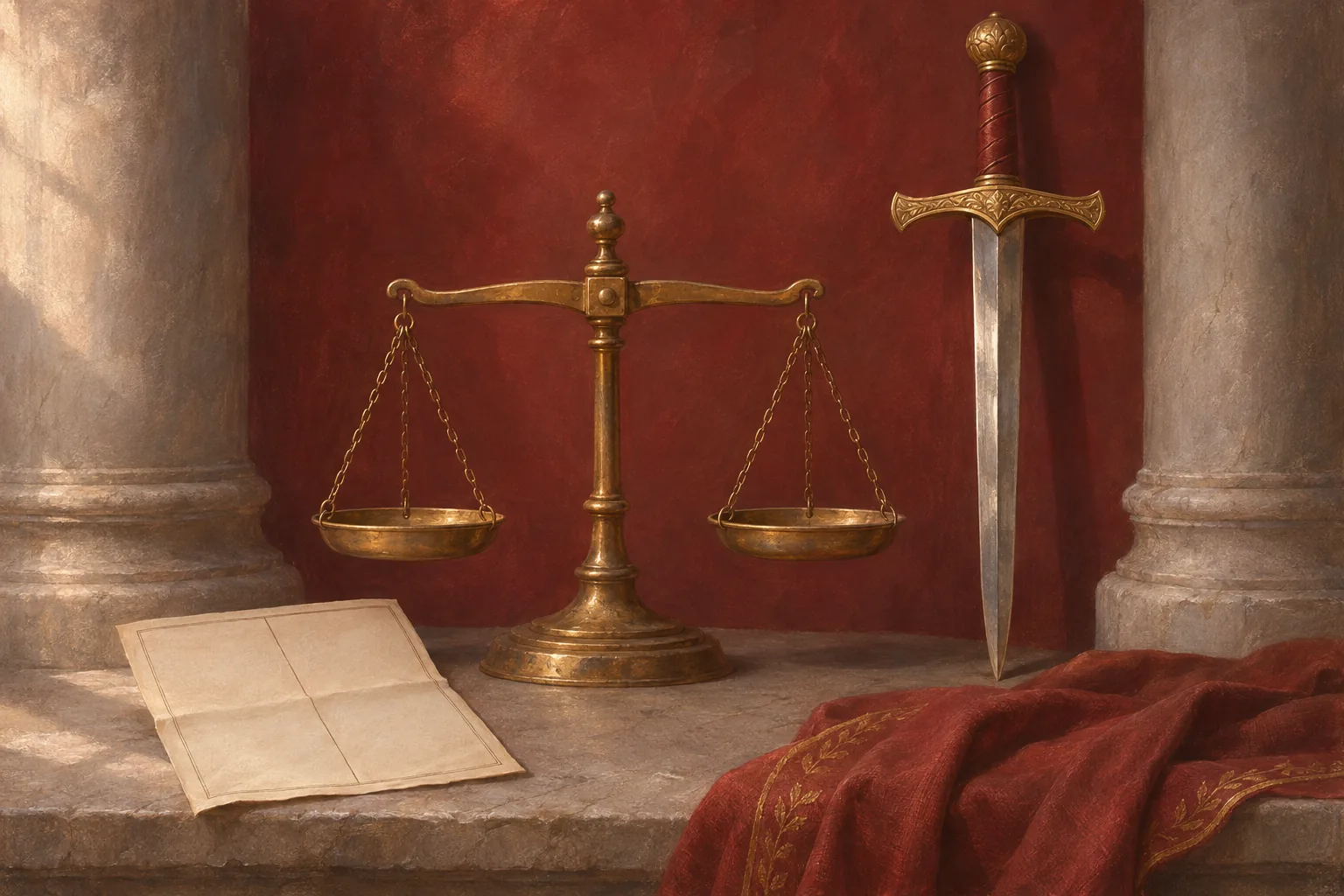
Justice is the tarot card of fair weighing. It shows the facts on both sides, your own share in what happened, and the consequences that follow from things already done. It is numbered XI in the Rider-Waite-Smith deck and in most modern decks, and VIII in Marseille-style decks. Read well, it asks you for an honest account. It does not hand you a verdict. It cannot tell you how a court case, an appeal or a family quarrel will end, and it does not promise that someone who wronged you will pay for it. Justice is also the shared tarot card for 2027 (2 + 0 + 2 + 7 = 11), so you will see it a lot over the coming year. Our year card guide explains that sum.
You drew Justice, maybe in the middle of a dispute or a hard decision, and want to know whether it means things will go your way, someone will get what they deserve, or something else.
Four things Justice gets mistaken for
Most confusion about this card comes from treating it as something it is not. Here are the four mix-ups that come up most in questions about it, with what the older sources actually support.
| Mistaken for | Why people think so | What the sources support | A better question |
|---|---|---|---|
| A court verdict | The sword, the scales and a list of meanings that mentions law | Waite himself used the card to ask whether a legal matter exists, not who wins it (see below) | What do the documents say, and who can advise me on them? |
| Karma, or payback | Modern readers often link it to "what goes around comes around" | Waite wrote of a moral principle that "deals unto every man according to his works". That is a principle, not a schedule of punishment | What is my part in this, and what would putting it right look like? |
| The Judgement card | Similar name, and both are read around big decisions | In Book T the "sentence ... without appeal" meaning belongs to Judgement, not Justice | Am I still weighing, or has the decision already been made? |
| Proof that I am right | People often draw it in the middle of a dispute | Scales weigh both pans, including the one you would rather not look at | What would a fair person say about my side? |
The picture, and the virtue that went missing
The Rider-Waite-Smith card shows a crowned figure on a throne between two pillars, holding an upright sword in the right hand and a pair of scales in the left. Waite pointed out that she sits between pillars "like the High Priestess", and then drew a firm line between the two cards: "the pillars of Justice open into one world and the pillars of the High Priestess into another." The High Priestess is about what is hidden. Justice is about what can be weighed in the open.
The card is one of a set. Medieval and Renaissance Europe counted four cardinal virtues, Justice, Fortitude, Temperance and Prudence, and early tarot trumps include three of them: Justice, Strength (Fortitude) and Temperance. Prudence is missing. Waite called it "a curious omission". The eighteenth-century writer Court de Gébelin tried to find Prudence hidden in the Hanged Man, which Waite dismissed with "wherein he deceived himself". Waite's own suggestion was that the Hermit, walking alone by his lamp, gives "a certain high counsel" about prudence. He also mentioned, without much enthusiasm, that the figure "is said to be Astræa", the star maiden of Greek myth who left the earth when people became unjust.
In the Golden Dawn's Book T the card's title is "The Daughter of the Lords of Truth: the Ruler of the Balance", and it is given to Libra, the sign of the scales. That Golden Dawn scheme is also the usual explanation for why Waite moved Justice from 8 to 11: it lined Strength up with Leo and Justice with Libra. Our Major Arcana guide covers the swap. Use the number printed on your own deck.
Can the Justice card predict a court case?
No. It is the most common thing people hope it will do, and the card's own history argues against it.
Waite's list of divinatory meanings does include "triumph of the deserving side in law". But in the same book, explaining how to choose a card to stand for the question, he drew a distinction. If the question is "Will a lawsuit be necessary?", he said, take Justice, because it "has reference to legal affairs". If the question is "Shall I be successful in my lawsuit?", he told readers to choose a court card instead. Even the man who wrote the keyword list used Justice to name a legal matter, not to pick its winner.
A 2016 thread on r/tarot shows the stakes. Someone serving on a jury, unsure of a verdict, drew reversed Justice and asked for help with the title "Help interpreting the reversed Justice card!! Important!!!". One reply read the card as "a very direct statement that it would be unjust (justice inverted) to base your decision about a person's guilt or innocence on the outcome of tarot cards." That is the fairest reading of the card we know of.
If you have a real legal problem, the papers and a lawyer matter far more than any draw. In India, the National Legal Services Authority and your District Legal Services Authority arrange free legal aid for people who qualify. A reading can help you get your thoughts in order before that conversation. It cannot replace it.
Justice or Judgement?
The two names sound alike and both cards turn up around decisions, so they are easy to mix up. The older sources draw the line in a place that surprises most people.
| Justice | Judgement | |
|---|---|---|
| Number (Rider-Waite-Smith) | XI | XX |
| Picture | A seated figure with sword and scales | An angel blowing a trumpet as the dead rise from their graves |
| Book T meaning | "Eternal justice. Strength and force, but arrested as in act of judgment. May mean law, trial, etc." | "Final decision, judgment, sentence, determination of a matter without appeal" |
| Waite 1910 | "Equity, rightness, probity, executive" | "Change of position, renewal, outcome." He adds that "another account specifies total loss through lawsuit" |
| Read it as | The weighing, still going on | The call, once it has come |
| Question it suits | What is fair here? | What am I being asked to wake up to? |
So the arrested sword belongs to Justice and the sentence without appeal belongs to Judgement. If you drew Justice, the scales are still moving and your account still counts. A Reddit thread titled "What does the Justice and Judgement card mean to you?" shows how often readers ask this.
A fair-witness page
A card about fair weighing is a good excuse to actually weigh something. This takes about fifteen minutes and a sheet of paper folded down the middle.
- Facts only. At the top, write what happened in words a stranger could check. Dates, amounts, who said what. No adjectives.
- Your side. In the left column, write your account as you would tell it to a friend.
- Their best case. In the right column, write the other person's account as their most reasonable friend would tell it. Not the worst version. The best one.
- What is owed. Under both columns, list anything you owe and anything you are owed. An apology, money, an answer, time.
- One fair act. Write one thing you could do this week that you would still call fair if someone else did it to you.
Here is an invented example. Two flatmates in Hyderabad are arguing over a ₹30,000 deposit after one of them moved out early. The facts line shows the lease had both names on it and the landlord kept ₹8,000 for repairs. Her own column says she gave a month's notice. Writing the other side's best case, she sees that her flatmate had to cover two weeks of rent alone. Her fair act is to offer to split the ₹8,000 and pay one week of the extra rent, then let her flatmate answer. The card did none of this. The page did.
If the page shows a decision that involves other people and you would like a second view on it, Maria can write a reading on your question, which you can set beside your two columns.
Justice in love, work and money
In love, readers often take Justice as a call for honesty and an even give and take. In a new relationship it can stand for clear terms. In a hard one it asks whether both people are carrying a fair share. It cannot tell you what someone else feels or plans. That is a question for them.
At work, it shows up around contracts, appraisals, complaints and anything that gets put in writing. Keep records, read the terms, and ask for decisions in writing.
For money, it points at the paperwork: agreements, receipts, a loan between friends that was never written down. The card is a reminder to check the numbers, not a forecast of what they will be.
What does Justice mean reversed?
Waite's reversed meaning is not quite what most modern sites say. He listed "Law in all its departments, legal complications, bigotry, bias, excessive severity". That reads less like "you are getting away with something" and more like the weighing itself going wrong: too much process, a biased judge, a punishment out of proportion.
Many readers now read reversed Justice as unfairness, or someone dodging responsibility. A useful way to hold both is to ask two questions. Is something weighing against me unfairly? And is the "excessive severity" coming from me, toward someone else or toward myself? People going through a breakup or a mistake at work often find the harshest judge in the room is their own voice. Our guide to reversed tarot cards explains how Waite's reversals work across the deck, if you are deciding whether to read them at all.
Why does Justice keep showing up?
"Why do I keep getting the Justice card" is a common question on r/tarot. Some of it is plain odds. A named card turning up again over a few weeks of daily draws is less unusual than it feels, and our post on the same card showing up again runs the numbers and covers shuffling habits that make repeats more likely. If it still feels pointed, treat the repeat as a nudge to finish a fair-witness page you have been avoiding. In 2027 you also have the year card to account for: many readers will be working with Justice all year on purpose.
Is Justice a yes or no card?
It answers a different question from the one usually asked. "Is this fair?" is the question Justice is built for. "Will I get what I want?" is not. If the fair outcome and the outcome you want are the same, many readers would call it a yes. If they are not, the card is pointing at the gap. It often helps to turn the question round to your own next step, for example "What would a fair offer look like?" Our guide to yes or no questions has more rewrites like that.
Common questions
Is Justice a good card to get?
It is usually read as a steady, even-handed card rather than a lucky or unlucky one. It feels good when you have been fair and uncomfortable when you have not, which is the point of it.
What does Justice mean as feelings?
Readers often take it to mean the other person is thinking things through carefully and wants to be fair, or is holding back until they have the facts. The card is a prompt for your own reflection, not a report on someone else's mind.
What zodiac sign is the Justice card?
Libra, the sign of the scales, in the Golden Dawn system that most modern decks follow. Book T titles the card "the Ruler of the Balance".
Does the Justice card mean karma?
Some modern readers use it that way. The older sources talk about equity and consequences in this life, and Waite describes a moral principle that "deals unto every man according to his works". Neither promises that a particular person will be punished, and the card is more useful pointed at your own choices than at someone else's comeuppance.
Is Justice card 8 or card 11?
Both, depending on the deck. It is XI in the Rider-Waite-Smith deck and most modern decks, and VIII in Marseille-style decks. In Crowley's Thoth deck the matching card is called Adjustment.
A second view on a fair decision
If your fair-witness page involves other people and you would like an outside view, Maria can write a personal reading around up to three questions you choose. It is delivered by email within 24 hours, so you can read it next to your two columns.
- Her perspective on the situation you are weighing.
- A second view on the one fair act you wrote down.
- A written reading you can come back to once the matter is settled.
Maria’s approach: a USA-based psychic and tarot reader, Maria combines intuition and tarot to read the connection behind your questions. Her focus is on what comes through about the feelings, the blockage, and the path ahead—including where the picture feels mixed.
What you receive from Maria
A personal written reading shaped around up to three questions and the details you share, delivered by email within 24 hours. You provide your questions and relevant details with your order. This is a reading you can keep and return to, not a live call you need to schedule.
View the reading details and current price before ordering. You can review our refund policy and privacy policy at any time.
Sources
- A. E. Waite, The Pictorial Key to the Tarot (1910), Project Gutenberg ebook 43548. Part I section on Justice (the missing Prudence, Court de Gébelin, Astræa), Part II "Eleven. Justice" (the pillars, "deals unto every man according to his works"), Part III divinatory meanings for Justice and the Last Judgment, and the section on choosing a Significator (the lawsuit example).
- S. L. MacGregor Mathers and the Golden Dawn, Book T, The Tarot, titles and attributions list and "Brief Meanings of Twenty-Two Keys".
- Wikipedia, Justice (tarot card), for the cardinal virtues in the trumps and the Golden Dawn reason for the 8 and 11 swap, and Cardinal virtues.
- Reddit r/tarot, "Help interpreting the reversed Justice card!! Important!!!" (October 2016), for the juror's question and the quoted reply.
- National Legal Services Authority of India, nalsa.gov.in, for free legal aid.
- The flatmate example is invented for illustration.
A personal reading by Maria
What would I still call fair if it were done to me?
Write it down first. A reading can add a view, and the decision stays yours.
Your Full Psychic Reading is built around up to three questions and the context you share. Receive your written guidance by email within 24 hours.