
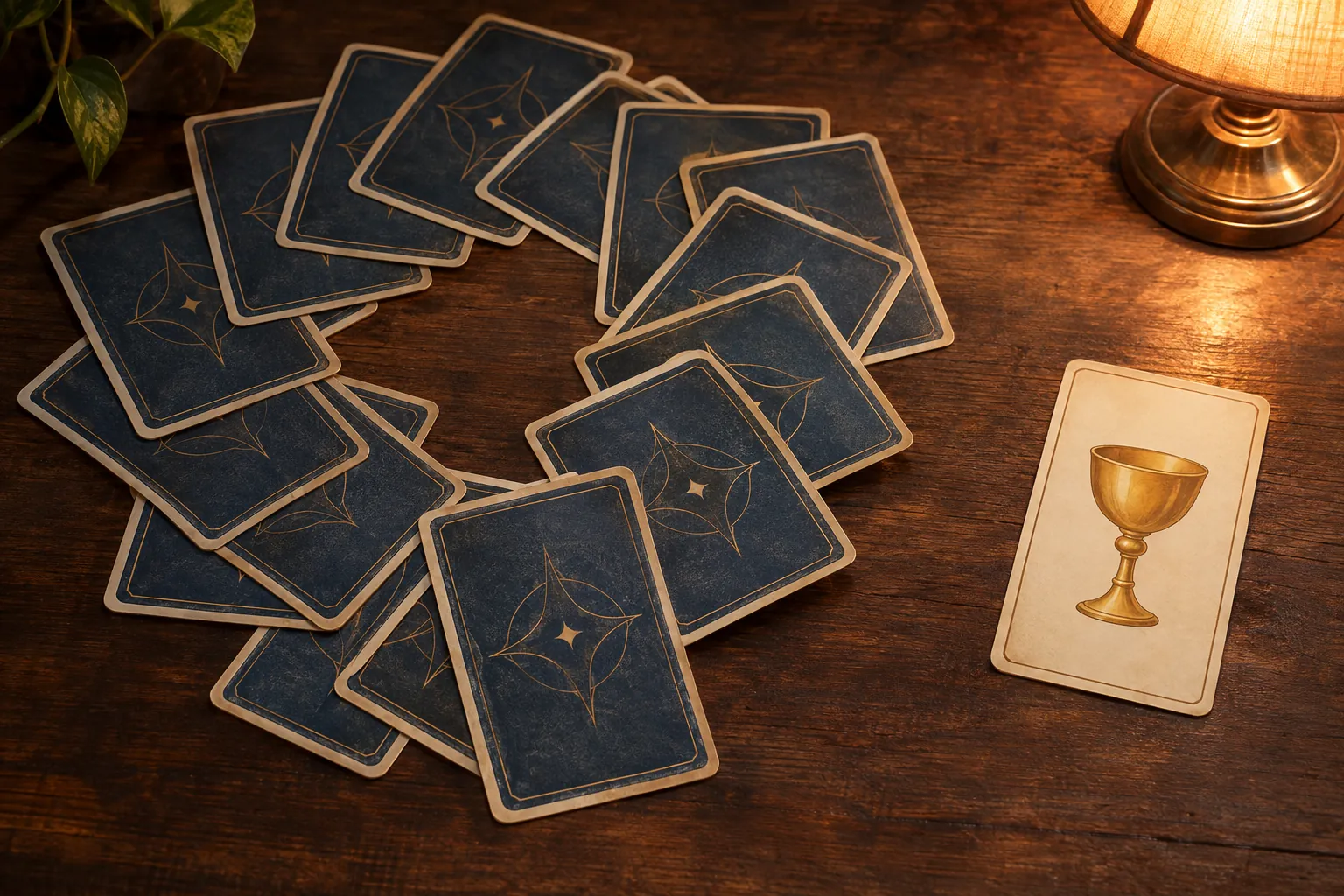
Usually it is chance plus shuffling, and sometimes it is also a question you keep asking. In any run of readings, some card repeating is close to certain. The rare event is a card you named in advance turning up again and again. When that happens, the most common cause is a shuffle that did not mix the deck, not a message. Many readers still treat a card that keeps returning as a theme worth a closer look, and that is a fair way to use it, as a prompt for reflection rather than a forecast.
One card has turned up in reading after reading, and you want to know whether it means something or whether it is your shuffle.
This page gives you the odds, the shuffling research, the mechanical reasons a card sticks, and a two-week test you can run on your own deck.
How often should a card repeat by chance?
We worked these out for a standard 78-card deck that is properly mixed, drawing without replacement inside a spread and mixing again before the next reading.
| What you are looking at | How often it happens by chance |
|---|---|
| One card you name in advance, in a single one-card pull | 1 in 78, about 1.3 percent |
| That named card, in a three-card spread | About 3.8 percent, 1 in 26 |
| That named card, in a ten-card Celtic Cross | About 12.8 percent, 1 in 8 |
| Any card at all repeating, over 10 daily one-card pulls | About 45 percent |
| Any card at all repeating, over 30 daily one-card pulls | About 99.8 percent |
| Some card turning up three or more times, over 30 daily pulls | About 42 percent |
| Some card turning up in three or more of 10 three-card spreads | About 37 percent |
| The card you named turning up in three or more of 10 three-card spreads | About 0.56 percent, 1 in 180 |
| The same named card in seven weekly three-card readings in a row | About 1 in 8 billion |
For one card worked through the same way, see how often the Moon turns up.
The gap between the rows is the whole story. If you pull one card a day for a month, a repeat is almost guaranteed, and nearly half the time one card will appear three times or more. You just cannot say in advance which card it will be. Once it happens, it feels picked out for you.
The last row is different. One r/tarot member described drawing the Queen of Cups in seven weekly readings in a row. Odds that long point to something physical in how the cards were handled, which the next two sections cover.
The shuffling problem
Card shuffling has been studied by mathematicians for decades, mostly with 52-card playing decks. Three findings matter here.
- Riffle shuffles. In 1992 Dave Bayer and Persi Diaconis showed that about seven riffle shuffles are needed to mix a 52-card deck well. Fewer than that leaves a lot of the old order in place. Their rule of thumb grows with deck size, and for 78 cards it works out to about nine. Riffling also bends tarot cards, which is why our first-deck guide suggests gentler methods.
- Overhand shuffles. This is the hand-to-hand shuffle most tarot readers use. Robin Pemantle's 1989 analysis found that a 52-card deck needs more than 1,000 overhand shuffles before it is truly mixed. Nobody does that. So a card that ended your last reading near the top tends to stay near the top.
- Smooshing. Spreading the cards face down on a table and swirling them, sometimes called washing, did better than expected. In tests reported in 2015, Diaconis and colleagues smooshed a 52-card deck 100 times at each of three lengths. Fifteen seconds failed their checks for leftover order. Thirty seconds and one minute passed all ten checks. Diaconis was careful to say this was not proof, only that the longer smooshes showed no strong order.
A short overhand shuffle is a ritual, and a ritual can be worth keeping. It just does not reset the deck.
Mechanical reasons one card keeps coming back
Beyond the shuffle itself, look at how the card goes back into the deck.
- Where you return it. If you put the last reading's cards on top or on the bottom and then shuffle lightly, they will often land near the same place again.
- A card that sticks out. A new deck is stiff, and one card with a slight bend, a rough edge or a different finish slides out more easily. The same goes for a card you handle more because you study it.
- Jumpers. A card that flies out while you shuffle is often read as a message. It is also, more often than others, the card with a bend or a slick spot.
- Factory order. A new deck usually comes out of the box in order, Majors first and then each suit Ace to King. A few light shuffles leave long runs of that order in place, so the same neighbours keep turning up together.
- How you cut. Cutting the deck once moves a block of cards, not single cards. A block that stays together keeps its neighbours.
None of this means the card is fake or the reading is spoiled. It means the deck has a physical history, and your shuffle may not erase it. To find the culprit, check the deck for bent or sticking cards as you sort it.
What changes on your side
The other half of a repeat happens in the reader, not the deck.
You are asking the same question. The author of the tarot teaching site Labyrinthos wrote that they get the same card again and again when anxiety has them asking about one situation in different words. Rephrasing the question does not change what is on your mind, and a broad card fits many phrasings.
You notice it more once you have noticed it. The linguist Arnold Zwicky named this the frequency illusion in 2005. After something catches your attention, it seems to appear all the time. A card that came up in three readings out of twenty can easily feel like it came up in all of them, until you count.
Big cards are easier to remember. A Tower or a Death stays with you. A Six of Pentacles slips past. Our guide to the cards people fear has the odds for those three, and its common questions cover what to do when a feared card keeps returning.
What readers say a repeating card means
Many readers call a card that keeps returning a "stalker card". The common view in tarot communities is that it marks a lesson or theme you have not taken in yet. One r/tarot member put it simply: "Pulling the same card means you need to heed its lesson." Someone in a beginners' thread pointed out that "statistically speaking, it's actually not that weird". Another said they got far more repeat pulls as a beginner who did not shuffle thoroughly, and now pay attention only when a card keeps returning after a proper shuffle.
That second approach is a sensible middle path. It keeps the reflective use of tarot and drops the part that depends on a poor shuffle. Card meanings come from a reading tradition, not from evidence that cards foresee events. Treat them as prompts for thinking, and our page on whether tarot works covers what that means in practice.
Try it: a two-week repeat log
If one card seems to follow you, test it before you read meaning into it.
- Name the card first. Write down which card you think keeps appearing. This turns a feeling into something you can check.
- Change the shuffle. Smoosh the cards face down on a table for a full minute, or do as many gentle shuffles as you can in that time. Cut into three piles and restack them in a new order.
- Return cards to the middle. After each reading, slide the drawn cards into different places in the deck, not on top.
- Log every draw for 14 days. Date, question, how you shuffled, and the cards drawn.
- Count. For one daily card, the named card should appear in 14 draws about once every five or six fortnights. Turning up once or twice is ordinary. Turning up five times is worth a closer look at your shuffle again.
Here is an invented example of how a log might look after two weeks.
| Day | Question | Shuffle | Card drawn | Named card? |
|---|---|---|---|---|
| 1 | What do I need to see about work? | 1-minute smoosh, 3-pile cut | Eight of Cups | No |
| 4 | What is pulling at me this week? | 1-minute smoosh, 3-pile cut | Five of Wands | No |
| 7 | What do I need to see about work? | Overhand, about 20 seconds | Eight of Cups | Yes |
| 11 | What would help me rest? | 1-minute smoosh, 3-pile cut | Page of Swords | No |
| 14 | What is pulling at me this week? | 1-minute smoosh, 3-pile cut | Queen of Wands | No |
In this invented log, the named card came back once, on the day of a quick overhand shuffle and the same work question. That points to the shuffle and the question, not to the card.
If the card keeps coming back anyway
Sometimes a card returns even after a careful shuffle. Chance allows that, and you can still use it. Three questions work well in a journal:
- Where in my life does this card's picture fit right now, without stretching?
- What have I been avoiding deciding, saying or feeling about that?
- If the card stopped showing up tomorrow, would anything about the situation be different?
Write one honest answer to each. Then do one small thing the answers point to. Our psychic journal guide shows how to look back over a week of notes for themes, and the self-reflection spread gives you a short layout to put the card in context. If it is a numbered card, our Minor Arcana guide shows how to read its suit and number together. If it is a trump, the Major Arcana list has every meaning on one page.
If you would rather talk the theme through with someone, a written reading from Maria can take it as one of your three questions.
When to stop drawing
Repeat draws can turn into a loop, especially when a question feels urgent. Signs to pause:
- You are shuffling again because you did not like the answer.
- You are asking the same thing more than once a day.
- The card is making you more anxious, not clearer.
Set the deck aside for a few days. A card that keeps appearing is not a warning, and no reader can remove or fix a card for a fee. Our fake psychic red flags page explains why that offer is a sign to walk away.
Common questions
Is a repeating tarot card a sign?
It can be a useful prompt, but the most likely causes are chance, a shuffle that did not mix the deck, or asking the same question. Any card repeating over a month of daily pulls is close to certain. A card you named in advance repeating many times usually points to the shuffle.
Does a card that jumps out of the deck mean something?
Many readers treat a jumper as a message, so it is up to you whether to include it. Physically, the card that jumps is often one with a slight bend or a slick edge, so check whether the same card keeps doing it.
How long should I shuffle tarot cards?
Research on 52-card decks found that about seven riffle shuffles, or 30 seconds to a minute of smooshing the cards on a table, mixed a deck well, while short overhand shuffling did not. A 78-card tarot deck needs a bit more. A one-minute smoosh is a practical choice that does not bend the cards.
Should I stop reading if the same card keeps coming up?
Not necessarily. Change how you shuffle and return cards, and log your draws for two weeks. If you are drawing again because of worry, take a few days off instead.
Can the same card show up in readings for different people?
Yes. The deck does not know who the reading is for. If you read for several people in a row with light shuffling, the same card can pass from one reading to the next.
When one card will not leave you alone
If one card keeps turning up around the same question, Maria can write a personal reading around up to three of your questions. It is delivered by email within 24 hours, so you can read it next to your own card log.
- Her perspective on the theme the card keeps raising for you.
- A look at what may be keeping that question open.
- Possible next steps to weigh, in a format you can keep.
Maria’s approach: a USA-based psychic and tarot reader, Maria combines intuition and tarot to read the connection behind your questions. Her focus is on what comes through about the feelings, the blockage, and the path ahead—including where the picture feels mixed.
What you receive from Maria
A personal written reading shaped around up to three questions and the details you share, delivered by email within 24 hours. You provide your questions and relevant details with your order. This is a reading you can keep and return to, not a live call you need to schedule.
View the reading details and current price before ordering. You can review our refund policy and privacy policy at any time.
Sources
- Dave Bayer and Persi Diaconis, "Trailing the dovetail shuffle to its lair", The Annals of Applied Probability 2 (1992), pages 294 to 313. Summary at Harvey Mudd College Math Fun Facts.
- Persi Diaconis, Mathematical developments from the analysis of riffle shuffling, for the three-halves log rule for deck size.
- Robin Pemantle, "Randomization time for the overhand shuffle", Journal of Theoretical Probability 2 (1989), pages 37 to 49, author PDF.
- Erica Klarreich, For Persi Diaconis' next magic trick, Quanta Magazine, April 14, 2015, for the smooshing tests.
- Arnold Zwicky, Just between Dr. Language and I, Language Log, August 7, 2005, where he named the frequency illusion.
- Labyrinthos, Repeating tarot cards and how to interpret them.
- Reddit r/tarot threads: how to think about repeater cards, pulling the same card over and over, new reader, same card keeps showing up and same cards in multiple readings.
- The odds table is our own calculation for a properly mixed 78-card deck. The repeat log is invented for illustration.
A personal reading by Maria
Shuffle well, then reflect
Check the deck first. If the card still returns, let it start a question, not end one.
Your Full Psychic Reading is built around up to three questions and the context you share. Receive your written guidance by email within 24 hours.