The Moon (card XVIII) is the tarot card of things seen in poor light. It usually means uncertainty, worry, imagination running ahead of the facts, or a situation you cannot see clearly yet. It is not a curse, a death card or proof that someone is lying to you. The most useful way to read it is as a prompt to sort facts from fears, and then to check the fear before you act on it.
You drew the Moon, or keep drawing it, and want to know whether it is a bad sign and what to do with it.
What is on the card
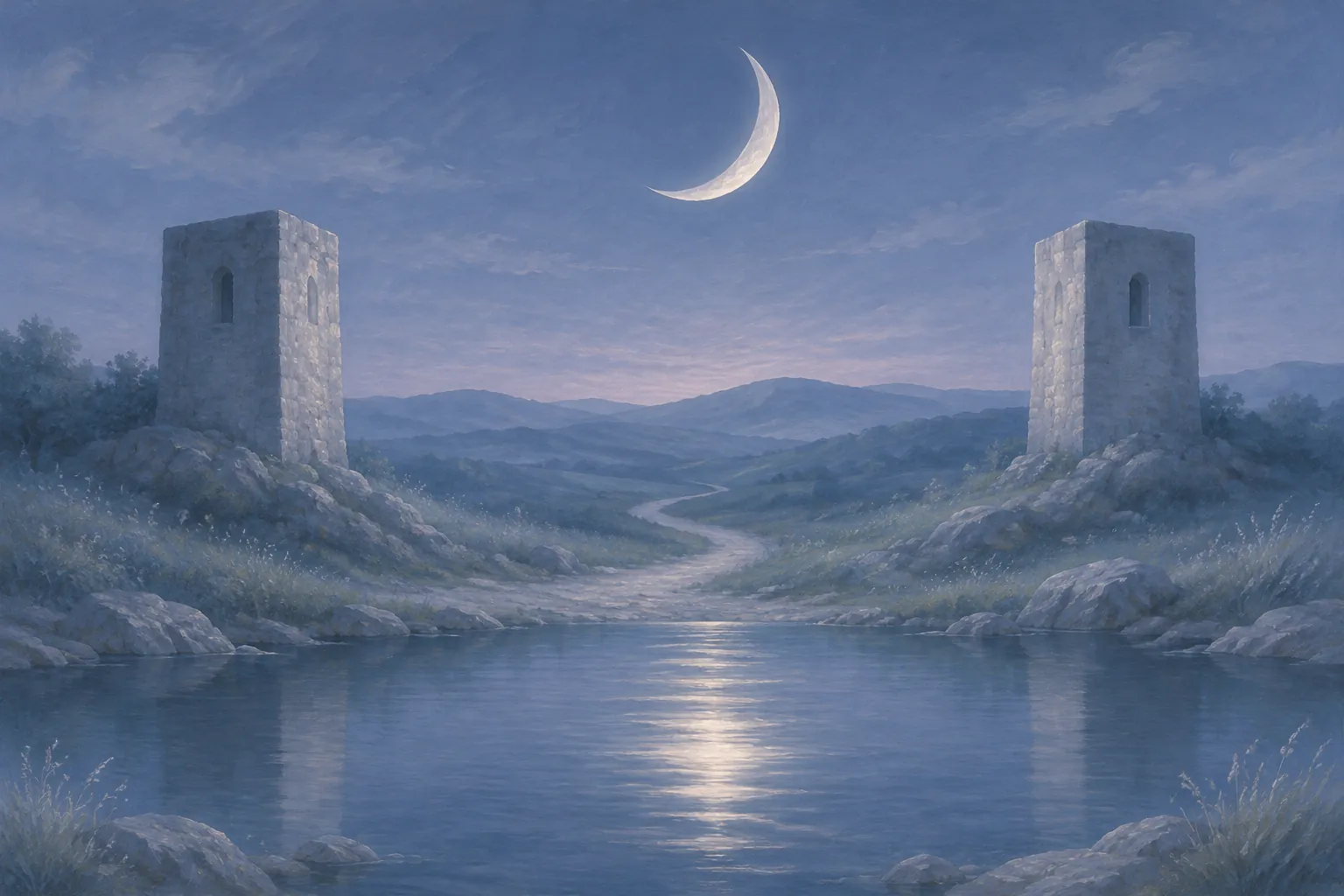
Most beginners own a Rider-Waite-Smith deck. Its Moon picture has five parts:
- The moon, drawn as a sun with a face inside a crescent, dropping drops of dew.
- Two towers, one on each side, with a path running between them toward distant hills.
- A dog and a wolf, both howling up at the sky.
- A pool in the foreground.
- A crayfish climbing out of the pool onto the land.
Arthur Edward Waite, who designed the deck with the artist Pamela Colman Smith, described older versions of the card in his 1910 guide: "Two dogs, or alternatively a wolf and dog, are baying at the moon, and in the foreground there is water, through which a crayfish moves towards the land." So the scene is older than his deck. What changed with Waite is the explanation.
What Waite said the Moon means
Waite gave the card two layers, and they point in different directions.
His symbolic reading is calm. He wrote that the card "represents life of the imagination apart from life of the spirit", that "the path between the towers is the issue into the unknown", and that "the dog and the wolf are the fears of the natural mind in the presence of that place of exit, when there is only reflected light to guide it." He ends with "the message is: Peace, be still."
His fortune-telling list, printed later in the same book, is much darker: "Hidden enemies, danger, calumny, darkness, terror, deception, occult forces, error."
"Why does the Moon sound so bad?" is a question readers still ask on r/tarot. Most of that fear comes from the second list, which is copied into many guidebooks and websites. Most modern readers lean on the first layer. Moonlight is reflected light. You can see shapes, but not detail, and your mind fills in the rest. The dog and the wolf are the tame and the wild versions of the same fear. The crayfish is the half-formed worry that crawls up from below and, in Waite's words, "as a rule it sinks back whence it came."
A three-column check for when you draw it
Because the card is about telling fact from fear, it gives you a small job to do. Take a sheet of paper and make three columns.
| What I know | What I fear | How I could check |
|---|---|---|
| Things you have seen, heard or read yourself | The story your mind has built around them | One small step that would give you a real answer |
An invented example shows how it works.
| What I know | What I fear | How I could check |
|---|---|---|
| My friend has replied slowly for two weeks | She is angry with me | Ask her directly if something is wrong |
| She posted photos from a trip | She has new friends and is drifting away | Ask about the trip |
| She cancelled our call on Sunday | She does not want to talk to me | Suggest another time and see what she says |
The left column is usually short. The middle column is usually long. That gap is what the Moon is pointing at. The card cannot tell you which fear is true. A message, a question or a little patience can. If you have filled in the columns and the situation still feels murky, Maria can give you a calm second view in a written reading.
The Moon in love, work and money
Love. In a love reading the Moon usually points to mixed signals, unclear intentions or your own anxiety colouring how you read someone. It does not mean your partner is cheating. Waite's word "deception" leads some readers to that conclusion, but a card cannot show what another person is doing. If you asked how someone feels about you, the Moon usually reads as mixed or unclear feelings, on their side or yours. The card cannot show what anyone is hiding. If trust is the real question, the check column above is the honest next step.
Work. Readers often take the Moon as a project where the facts are not in yet. Rumours, an unclear brief or a decision being made somewhere above you. The practical advice is to ask for the missing detail before you plan around a guess.
Money. Treat it as a reminder to read the small print and to avoid deciding while you are scared. It says nothing about whether an investment or purchase will work out, and it is never a reason to skip real advice.
Health. No tarot card can tell you anything about your health. If the Moon turns up when you are worried about your body, the sensible move is to talk to a doctor rather than to the deck.
Is the Moon a yes or no card?
Most readers treat it as "not yet" or "not clear". A card about poor visibility is a poor source of a firm yes. If you asked a yes or no question and got the Moon, it is often more useful to ask what information is missing. For more on when that kind of question works, see can tarot answer yes or no questions?
The Moon reversed
Waite's reversed meanings were "instability, inconstancy, silence, lesser degrees of deception and error." Note the phrase "lesser degrees". Even in his scheme the reversed card is a softer version, not a worse one.
Modern readers who use reversals often read the reversed Moon as fog starting to lift. A fear you have already named, a confusion that is clearing, or a worry that turned out to be smaller than it looked. If you are still deciding whether to read reversals at all, our guide to reading reversed tarot cards sets out both choices.
The Moon as past, present or future
In a simple three-card spread, position changes the emphasis.
| Position | A common reading | A question to ask |
|---|---|---|
| Past | A stretch of confusion or worry that still shapes how you see things | What did I believe then that I never checked? |
| Present | You are working with partial information right now | What do I actually know today? |
| Future | Expect some uncertainty before things become clear | What could I find out before that point? |
Tarot does not forecast events, and no study has shown that it can. Read the future position as a theme to prepare for, not a fixed outcome.
Where the Moon sits in the Major Arcana
The Moon is card XVIII, after the Star (XVII) and before the Sun (XIX). Many readers treat the last cards of the Major Arcana as a short story. The Tower breaks something, the Star brings quiet hope, the Moon is the uneasy walk through the dark, and the Sun is daylight. Our Star card page covers that run from the Star's side, and the Major Arcana guide gives all 22 cards in short form.
The Golden Dawn, the Victorian occult order that Waite and Smith both belonged to, linked the Moon card to Pisces and to the Hebrew letter Qof, and its card list, Book T, gives the card the title "The Ruler of Flux and Reflux", the ebb and flow of the tides. That is why astrology-minded readers connect the card with dreams and blurred edges. The link is a tradition, not a discovery.
People also confuse the Moon with the High Priestess, card II, because both are lit by moonlight. The short version is that the High Priestess hides a fact you do not have yet, and the Moon blurs your view of the facts you do have. Our High Priestess page has a side-by-side table of the two cards.
How often will you see it?
If the Moon keeps turning up, it can feel like a message. Some plain numbers help. We worked these out for a full 78-card deck, shuffled well.
| How you read | Chance the Moon appears |
|---|---|
| One three-card spread | about 3.8% (3 in 78) |
| One ten-card Celtic Cross | about 12.8% (10 in 78) |
| A three-card spread once a week for four weeks | about 14.5% |
| A Celtic Cross once a week for four weeks | about 42% |
| One daily card for thirty days | about 32% |
So a regular reader will meet the Moon often, and that is normal. If it really does keep coming back, our guide to a tarot card that keeps coming back looks at shuffling and the odds in more detail.
When the Moon lands on a fear you already had
The Moon is one of the cards most likely to frighten someone who is already anxious, because it seems to confirm whatever they were worried about. If that happens:
- Put the deck away for the day. Drawing more cards to "clarify" usually adds noise, not answers.
- Fill in the three columns above, on paper.
- Pick one item from the check column and do it, or decide to wait a set time before you do.
- If worry is keeping you awake or stopping you from getting through the day, talk to someone you trust or a health professional. A card is not the right tool for that.
Our tarot card of the day routine is a gentler way to live with a hard card over a single day.
Common questions
What does the Moon tarot card mean?
The Moon usually means uncertainty, worry or imagination running ahead of the facts. In Waite's 1910 description the dog and the wolf stand for "the fears of the natural mind." The practical reading is to list the facts apart from the fears and check a fear before you act on it.
Is the Moon a bad card in tarot?
No. It is uncomfortable, not bad. Waite's old fortune-telling list for it was dark, but his own symbolic reading ends with "Peace, be still." Most modern readers treat it as a card about poor visibility, not a warning of harm.
Does the Moon card mean someone is lying to me?
Not on its own. A card cannot show what another person is doing or thinking. If you are worried about honesty in a relationship, the useful step is a direct conversation, not another card.
What does the Moon reversed mean?
Waite listed "instability, inconstancy, silence, lesser degrees of deception and error." Many modern readers read the reversed Moon as confusion beginning to clear or a fear turning out smaller than it seemed.
What zodiac sign is the Moon tarot card?
Pisces. The Golden Dawn linked the card to Pisces and the Hebrew letter Qof in the late 1800s, and most modern decks keep that link.
When the fog will not lift
If the Moon keeps turning up around one situation, Maria can write a personal reading around up to three of your questions. It is delivered by email within 24 hours, so you can read it beside your own notes.
- A calm outside view on a situation that feels unclear.
- Help separating what you know from what you fear.
- A written reading you can come back to.
Maria’s approach: a USA-based psychic and tarot reader, Maria combines intuition and tarot to read the connection behind your questions. Her focus is on what comes through about the feelings, the blockage, and the path ahead—including where the picture feels mixed.
What you receive from Maria
A personal written reading shaped around up to three questions and the details you share, delivered by email within 24 hours. You provide your questions and relevant details with your order. This is a reading you can keep and return to, not a live call you need to schedule.
View the reading details and current price before ordering. You can review our refund policy and privacy policy at any time.
Sources
- Waite AE. The Pictorial Key to the Tarot (1910), published in some editions as The Illustrated Key to the Tarot. Full text at Project Gutenberg eBook 43548. Sections "The Moon" in Part I and Part II, and the divinatory meanings list in Part III.
- S. L. MacGregor Mathers and the Golden Dawn, Book T, The Tarot, titles and attributions list.
- Odds are our own calculation for a 78-card deck (positions out of 78, and repeated readings treated as independent shuffles).
- The friend example in the three-column check is invented for illustration.
A personal reading by Maria
Know, fear, check
Moonlight shows shapes, not detail. Write down what you know before you decide what it means.
Your Full Psychic Reading is built around up to three questions and the context you share. Receive your written guidance by email within 24 hours.