
The High Priestess, numbered II, is the second trump in a tarot deck. Readers today usually treat her as quiet knowledge: something you sense before you can prove it, or something that has not been said yet. In a reading she usually asks you to wait, notice and find out more before you act. She does not mean that someone is lying to you or that there is a secret third person. Treat her the way you would treat any card: as something to think with, and as entertainment, never as a prediction.
The High Priestess just turned up and you are not sure whether she means wait, trust your gut, or that someone is keeping a secret.
Our Major Arcana list gives her one line. This page answers the questions people bring when she turns up.
What does the High Priestess mean?
In one sentence: you know more than you have put into words, and there is still something you do not know. Both halves matter. The card is about a gap between what you sense and what you can check.
- Upright, as most modern books read it: intuition, privacy, patience, a secret or a fact not yet known.
- Reversed, as most modern books read it: ignoring your own sense of things, overthinking, or something hidden starting to come out.
- Waite's 1910 fortune-telling list: "Secrets, mystery, the future as yet unrevealed", then "silence, tenacity" and "mystery, wisdom, science".
- Golden Dawn: the Moon, the Hebrew letter Gimel, and the title "The Priestess of the Silver Star".
- Number: II, between the Magician (I) and the Empress (III).
What is she holding, and why is it half hidden?
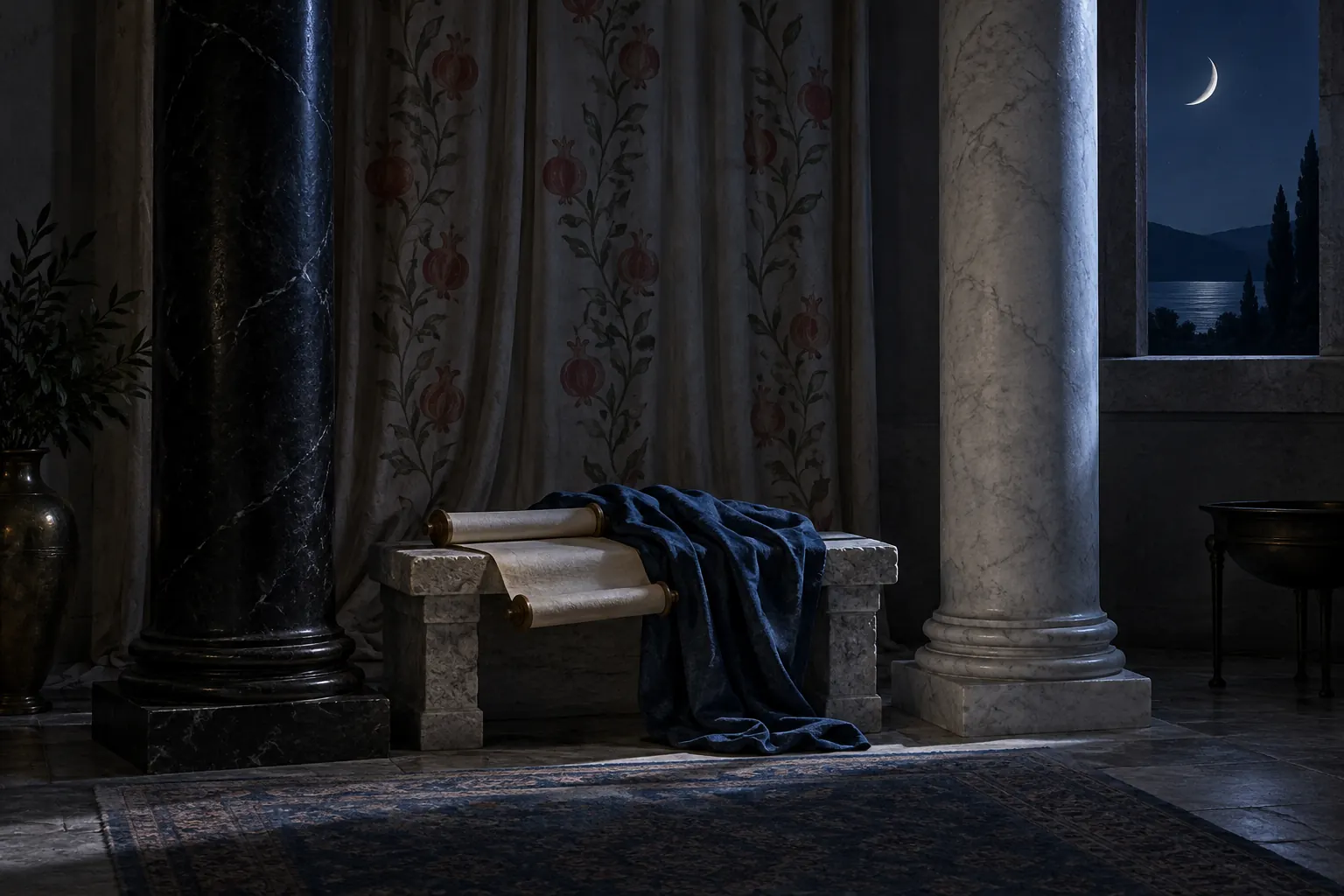
In the Rider-Waite-Smith deck she sits between two pillars, one black and one white, marked B and J. A veil hangs behind her, covered with palm leaves and pomegranates. A crescent moon lies at her feet. In her lap she holds a scroll with the letters TORA on it, and her robe covers part of it.
Waite explained that last detail himself. The scroll "is partly covered by her mantle, to show that some things are implied and some spoken." That one line is the easiest way into the card. Part of the message is readable and part is not, yet.
The pillars carry the names of the two bronze pillars at the porch of Solomon's temple in the Bible, Jachin and Boaz (1 Kings 7:21). Many readers treat them as a pair of opposites, light and dark or known and unknown, with the Priestess sitting in the gap between them. The veil hides what is behind her. Nothing on the card is being handed over.
Why was she once called the Popess?
Older decks did not call her a priestess. In the Tarot de Marseille she is La Papesse, the Popess, a crowned woman with a book. Some writers connect her with the medieval legend of Pope Joan. The art historian Gertrude Moakley argued in 1966 that the Popess in the fifteenth-century Visconti-Sforza cards showed Sister Manfreda, a woman elected "pope" by a small religious group in Lombardy around 1300. Both ideas are theories, and the card's first painters left no explanation.
The Golden Dawn, a Victorian occult society whose teaching shaped the Rider-Waite-Smith deck, already called her the High Priestess and linked her to the Moon. Waite kept that name for his 1910 deck. He wrote that calling her "the Mother, or Pope's Wife" was "opposed to the symbolism", and he read her instead as a figure of hidden spiritual teaching. The Moon link still explains why she is so often read as intuition, cycles and things that are only half lit.
What does the High Priestess mean in love?
She is one of the quieter love cards. The usual readings are:
- If you are single: take your time. Notice what you already sense about someone before you rush to define it.
- If you are in a relationship: something is not being said, possibly by you. A private conversation may help more than a public gesture.
- If you are asking about someone new: you do not have enough information yet. Watch what they do over a few weeks before you decide what it means.
None of these says what the other person will do. She describes the state of your knowledge, which is "incomplete" more often than not. Our list of questions to ask about love helps turn a vague love question into one a card can respond to.
What does she mean as feelings?
Here is the honest answer. No card can confirm what another person feels. When the High Priestess turns up in a "how do they feel about me?" spread, readers often say the person is private, holding back, or reading you before they show their hand. Those are guesses.
What the card can describe is your own position. You sense something, and you cannot check it. A more useful question is: what have I noticed, and what am I filling in? If most of your answer is filling in, the card is a nudge to stop guessing and gather facts, or to ask the person directly.
Does the High Priestess mean someone is hiding something?
This is the fear people raise most in tarot forums. A reader sees a mysterious woman and says "secret woman" or "third party".
There is a reason that reading exists. Waite's 1910 list includes "the woman who interests the Querent, if male" as one meaning. That is a role in an old system where cards could stand for people in the asker's life. It is not a sign of cheating, and Waite gave it alongside "the Querent herself, if female". A card cannot tell you that a partner is unfaithful.
If you already have real reasons to worry about trust, they deserve a real conversation, not another draw. If you do not, a single card is no reason to start.
Is the High Priestess a yes or no card?
Many sites call her a "maybe". A more useful way to put it is "not enough information yet". Instead of drawing again, ask what is missing:
- What fact would change my answer if I knew it?
- Who could tell me, or how could I find out?
- When would I reasonably know, without forcing it?
If you can answer all three, you probably do not need the card's yes or no. Our page on whether tarot can answer yes or no has a short screen for deciding when a yes-no question is worth asking at all.
The High Priestess or the Moon?
People often confuse card II with card XVIII, the Moon. Both are lit by moonlight. They feel different.
| Point | The High Priestess (II) | The Moon (XVIII) |
|---|---|---|
| What is hidden | A fact you do not have yet | Your view of the facts, blurred by worry |
| The feeling | Calm, patient, private | Uneasy, foggy, imaginative |
| Waite's 1910 list starts with | "Secrets, mystery, the future as yet unrevealed" | "Hidden enemies, danger, calumny, darkness, terror" |
| A fair question | What do I still need to find out? | What am I afraid of, and is it true? |
| What to do | Wait and gather | Check your fears against facts |
Our Moon card page covers card XVIII on its own.
The Star sits just before the Moon in the deck, and our Star card page explains how many readers treat cards XVI to XIX as one short story.
What does the High Priestess reversed mean?
Waite's reversed meanings were "passion, moral or physical ardor, conceit, surface knowledge". Few readers use that list now. The common modern reading is calmer: your own sense of things is blocked or hard to hear, not gone. You may be asking everyone else's opinion, drawing card after card, or acting before you know enough. Some readers also take her reversed as a secret coming into the open.
A short self-check helps more than a second draw. Ask yourself: what hunch am I talking over? Write it down in one line, then write what would show whether it is right.
- In love or feelings questions: reversed rarely means "they do not care". It more often points to mixed signals, or to you reading a silence before you have the facts.
- As a yes or no: still "not yet". The missing piece is more hidden than with the upright card, so try rewording the question around what you can find out.
If that sounds like a loop you know, our piece on when reflection turns into overthinking has a short reset. If you do not read reversals at all, the upright meaning above is enough, and our guide on reading reversed cards lays out both approaches.
A known, sensed and missing page
This takes ten minutes and a notebook. Draw three columns. Under Known, write what you can check. Under Sensed, write what you feel but cannot prove. Under Missing, write what you would need to find out.
Here is an invented example, about someone who has started going quiet in a group chat.
| Known | Sensed | Missing |
|---|---|---|
| Replies have dropped from daily to weekly since September | Something changed for them, maybe not about me | Whether anything happened at work or home |
| They still reacted to my photo on Sunday | They are not angry with me | Whether they want to talk or want space |
| They mentioned exams in August | They might be overwhelmed | When the exams end |
The Missing column is the card's real advice. It usually shows that the next step is a plain question to the person, not another reading. If you want practice telling the Sensed column apart from wishful thinking, our guide on trusting your intuition has a five-minute exercise.
If the quiet is something you chose, compare the Hermit.
If the High Priestess keeps sitting on one question for you, Psychic Maria can write you a personal reading that starts from what you already sense.
Common questions
Is the High Priestess a good card?
Most readers see her as a calm, positive card. She is about patience and inner knowledge, not loss. She can still feel frustrating, because she rarely gives a clear go-ahead.
Is the High Priestess a yes or no card?
She usually reads as "not yet" or "not enough information". It is more useful to ask what is missing than to force a yes or no from her.
What planet or sign is the High Priestess?
The Moon. The Golden Dawn linked her to the Moon and to the Hebrew letter Gimel in the 1880s, and most modern decks keep that link.
Does the High Priestess mean someone is cheating?
No. One old meaning in Waite's 1910 list is "the woman who interests the Querent, if male", which some readers turn into a third party. A card cannot show that anyone is unfaithful.
How often does the High Priestess turn up?
In a shuffled 78-card deck, any one card has about a 3.8 percent chance of appearing in a three-card spread and about 12.8 percent in a ten-card Celtic Cross. Seeing her twice in a month is common enough to be chance.
When she keeps sitting on one question
If the High Priestess keeps turning up around one question, Maria can write a personal reading around up to three of your questions. It is delivered by email within 24 hours, so you can read it next to your own notes.
- Her perspective on what you already sense.
- A look at what may still be missing from the picture.
- Possible next steps to weigh, in a format you can keep.
Maria’s approach: a USA-based psychic and tarot reader, Maria combines intuition and tarot to read the connection behind your questions. Her focus is on what comes through about the feelings, the blockage, and the path ahead—including where the picture feels mixed.
What you receive from Maria
A personal written reading shaped around up to three questions and the details you share, delivered by email within 24 hours. You provide your questions and relevant details with your order. This is a reading you can keep and return to, not a live call you need to schedule.
View the reading details and current price before ordering. You can review our refund policy and privacy policy at any time.
Sources
- A. E. Waite, The Pictorial Key to the Tarot (1910), read for card II, Waite's list of older trump names and his fortune-telling meanings for II and XVIII, using the Project Gutenberg text, ebook 43548.
- S. L. MacGregor Mathers and the Golden Dawn, Book T, The Tarot, titles and attributions list.
- Wikipedia, The High Priestess, for La Papesse, Pope Joan and Gertrude Moakley's Sister Manfreda identification (Moakley, The Tarot Cards Painted by Bonifacio Bembo, 1966).
- 1 Kings 7:21, the pillars Jachin and Boaz, King James Version text.
- Odds are our own calculation (3 of 78 positions and 10 of 78 positions).
- The group chat example is invented for illustration.
A personal reading by Maria
Some things are not said yet
A card can point at the gap. Filling it is your call.
Your Full Psychic Reading is built around up to three questions and the context you share. Receive your written guidance by email within 24 hours.