
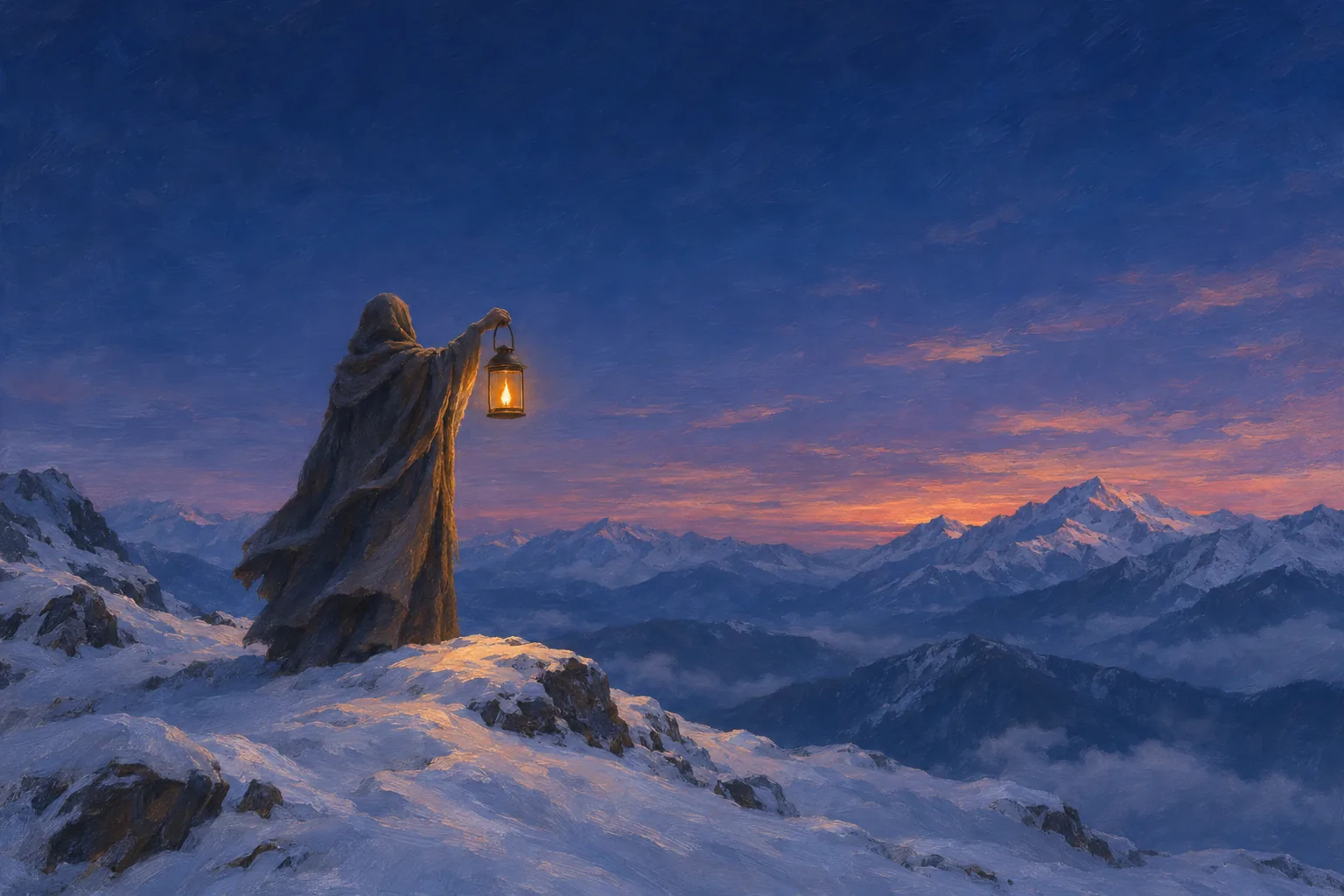
The Hermit (card IX) is the tarot card of stepping back on purpose. Most readers take it as time alone to think, a slower pace, or advice from someone who has walked the road before you. In a love reading it often points to a need for space. It does not mean you will be alone forever, and it cannot tell you whether someone who has gone quiet is thinking things over or losing interest. The useful question it leaves you with is simple: what can I only work out by myself, and how long do I need?
You drew the Hermit, maybe in a love reading, and want to know whether it means loneliness, a need for space, or someone pulling away.
Why an old man with a lantern?
The card did not always show a lantern. In early Italian decks the figure was called il Tempo (Time), il Vecchio (the Old Man) or il Gobbo (the Hunchback). The hand-painted Visconti-Sforza card from about 1450 shows a bent old man in a blue robe holding an hourglass. He was Father Time, a reminder that years pass.
Later French decks renamed him L'Ermite, the Hermit, and the hourglass turned into a lamp. In the Rider-Waite-Smith deck of 1909 he stands on a snowy peak, holding up a lantern with a six-pointed star inside, with a staff in his other hand.
That history helps when the card comes up. The older card was about time passing. The newer one is about light you carry yourself. Most modern readings keep a little of both: give this enough time, and look at it by your own light, not by the crowd's.
Arthur Edward Waite, whose 1909 deck was painted by Pamela Colman Smith, insisted the card shows someone who has already climbed, not someone still searching. He called it "a card of attainment" rather than "a card of quest", and he held the lamp high so others could find their way. That is why the Hermit can also stand for a teacher, a mentor or an older friend. The short entry in our Major Arcana guide quotes the line he gave the lamp. This page goes further into what the card can and cannot answer.
Waite's meaning list has a surprise in it
Most people know the Hermit as wise and quiet. Waite's own fortune-telling list, printed in his 1910 Pictorial Key, starts the same way, "Prudence, circumspection". Then it goes on: "also and especially treason, dissimulation, roguery, corruption".
Modern readers have almost all dropped that second half. It reads like a leftover from older card-reading lists, and it does not match Waite's own description of the picture a few pages earlier. We mention it for two reasons. It shows that card meanings have changed over time and were never fixed. And if a reader ever uses the Hermit to tell you someone is cheating or lying, you now know where that idea came from, and how thin it is.
For reversed cards, Waite listed "Concealment, disguise, policy, fear, unreasoned caution." The last two words are the ones most readers still use.
In the Golden Dawn's Book T, the Hermit is "The Magus of the Voice of Power, the Prophet of the Eternal", linked to Virgo and the Hebrew letter Yod.
Does the Hermit mean someone needs space, or that they are pulling away?
This is the question most people bring to this card, and it is the one it handles worst.
A card cannot see inside another person. If you asked how someone feels and drew the Hermit, the honest reading is that the card describes quiet, not the reason for it. Quiet can mean someone is thinking hard about you. It can mean they are busy, unwell or grieving. It can mean they have lost interest. The Hermit looks the same in all three.
What the card can do is point you at what is in your control:
| What you might want the card to tell you | What it can actually prompt |
|---|---|
| Are they thinking about me? | What do I need to know, and have I asked them directly? |
| Will they come back after their space? | How long am I willing to wait, and what would I do with that time? |
| Are they hiding something? | Is there any evidence, or am I filling a silence with worry? |
| Should I give them space? | What would giving space look like in practice, and for how long? |
If someone has asked for space, the kindest and clearest step is usually a short message that agrees to it and names a time to check in. "Take the time you need. Can we talk on Sunday?" gives both of you a shape to work with. No card can replace that conversation.
Chosen solitude, or hiding?
The Hermit is a card of going quiet on purpose. Going quiet can also slide into hiding. A short check helps you tell the two apart.
| Time alone that is helping | Time alone that has turned into hiding |
|---|---|
| You chose it and you know roughly why | It happened and you cannot say when it started |
| You come out of it with a thought, a plan or more energy | You come out of it more tired or more anxious |
| You still answer the people who matter to you | You have stopped replying, and dread the messages |
| There is an end point, even a vague one | There is no end point and you do not want one |
| You are thinking about something | You are going round the same thought again and again |
If most of what you recognise sits in the right column, the card is not telling you to withdraw further. It may be asking you to come back down the mountain.
If being alone has felt heavy on most days for a couple of weeks, tell someone you trust, or see a doctor. India's free mental health line, Tele MANAS, is open day and night on 14416 (or 1-800-891-4416). In the US, you can call or text 988. A tarot card can give you a question to sit with. It is not a reason to stay alone.
Three questions for when it turns up
These work whether the Hermit appears in a love, work or general reading. Write the answers down, because the card is about your own thinking and that is easier to see on paper.
- What can I only work out by myself? One sentence. If you cannot name it, the card may be pointing at rest rather than reflection.
- Whose lantern do I trust? Name one person whose experience would help, a mentor, an older relative, a friend who has been through it. The Hermit is alone on the peak, but he is holding his light up for someone.
- When do I come back down? Pick a date to review what you have learned. A week, a month, the next full moon. Solitude with an end point is far easier to use well.
An invented example, to show the shape: a reader drew the Hermit while deciding whether to leave a job after a bad year. Her answers were "whether I am tired of the work or tired of this team", "my old manager who left last spring" and "the end of the month". She took two quiet weekends, called her old manager once, and found the answer was the team, not the work. The card did not tell her that. Her notes did.
The Hermit reversed
Reversed, the Hermit is usually read in one of two ways, and they point in opposite directions.
- Too much solitude. Time alone has become isolation. You may have stopped asking for help, or a retreat that began as rest has gone on too long. This matches Waite's "fear, unreasoned caution".
- Too little solitude. You are avoiding any quiet at all, filling every hour with company or noise so that a hard thought never gets its turn.
Ask which one fits. Many readers do not use reversals at all, and a reversed card is not a worse card. Our guide to reversed tarot cards covers the main ways of reading them.
The Hermit next to similar cards
| Card | Kind of quiet | Rough difference |
|---|---|---|
| The Hermit (IX) | Chosen solitude to think something through | Active. He is looking for something, or holding a light for others |
| The High Priestess (II) | Waiting, listening, not yet knowing | Something is still hidden, and you are not the one holding the lamp |
| Four of Swords | Rest after strain | Recovery. Waite gave it "retreat, solitude, hermit's repose" |
| The Star (XVII) | Calm after a storm | Hope and renewal, and it usually comes after the hard part is done |
If the Hermit keeps appearing in your readings, our piece on the same card showing up again explains the odds before you read meaning into it.
Is the Hermit a yes or no card?
Readers who use yes or no usually call it a "not yet" or "wait". That tells you more about the question than the answer. Our guide on yes or no tarot questions shows how to rewrite the question so the card can help. "What do I need to think through before I decide?" works better with this card than "Will it happen?"
Common questions
Does the Hermit mean I will be alone?
No. It describes a stretch of solitude or reflection, not a future without people. Many readers see it as preparation, the time you spend getting clear before the next step.
What does the Hermit mean as feelings?
It describes quiet, not the reason for the quiet. Someone may be thinking things over, or may have lost interest, and the card looks the same either way. The only reliable way to know is to ask them.
What does the Hermit mean in a career reading?
Often a time to work on something alone, study, or step back from a team to think. It can also point to a mentor whose experience would help.
Does the Hermit mean a breakup?
Not on its own. It can show one or both people needing space. Space and a breakup are different things, and a card cannot tell you which is coming.
What zodiac sign is the Hermit?
Virgo, in the Golden Dawn system that most Rider-Waite-Smith readers follow. Book T also gives it the Hebrew letter Yod and the title "the Prophet of the Eternal".
If you are weighing a step back
If you have answered the three questions and would like an outside view on what you are stepping back from, Maria can write a personal reading around up to three of your questions. It is delivered by email within 24 hours, so you can read it in your own quiet time.
- A calm outside view on a decision you are thinking through alone.
- Her perspective on the question you wrote down first.
- A written reading you can return to when you come back down.
Maria’s approach: a USA-based psychic and tarot reader, Maria combines intuition and tarot to read the connection behind your questions. Her focus is on what comes through about the feelings, the blockage, and the path ahead—including where the picture feels mixed.
What you receive from Maria
A personal written reading shaped around up to three questions and the details you share, delivered by email within 24 hours. You provide your questions and relevant details with your order. This is a reading you can keep and return to, not a live call you need to schedule.
View the reading details and current price before ordering. You can review our refund policy and privacy policy at any time.
Sources
- A. E. Waite, The Pictorial Key to the Tarot (1910), Project Gutenberg ebook 43548. Part I note on card 9, Part II section "Nine. The Hermit", the Four of Swords, and the divinatory meanings list in Part III.
- S. L. MacGregor Mathers and the Golden Dawn, Book T, The Tarot, titles and attributions list.
- Wikipedia, Tarot of Marseilles, for the Italian names il Gobbo, il Vecchio and il Tempo (citing Dummett and Mann, The Game of Tarot, 1980), and The Hermit (tarot card) for the Rider-Waite-Smith description and the Virgo attribution.
- Wikimedia Commons, Visconti-Sforza card 9, described as "The Father Time card", about 1450, attributed to Bonifacio Bembo and Antonio Cicognara.
- Reddit r/tarot threads nth8ns, 15rgt84, x1upna and u5qnxd, public discussions of the Hermit as feelings, in love and reversed.
- Tele MANAS, Ministry of Health and Family Welfare, India, telemanas.mohfw.gov.in.
- The job example in the three questions section is invented for illustration.

A personal reading by Maria
What can I only work out by myself?
Write it in one sentence and set a date to come back to it. A reading can add a view, and the thinking stays yours.
Your Full Psychic Reading is built around up to three questions and the context you share. Receive your written guidance by email within 24 hours.