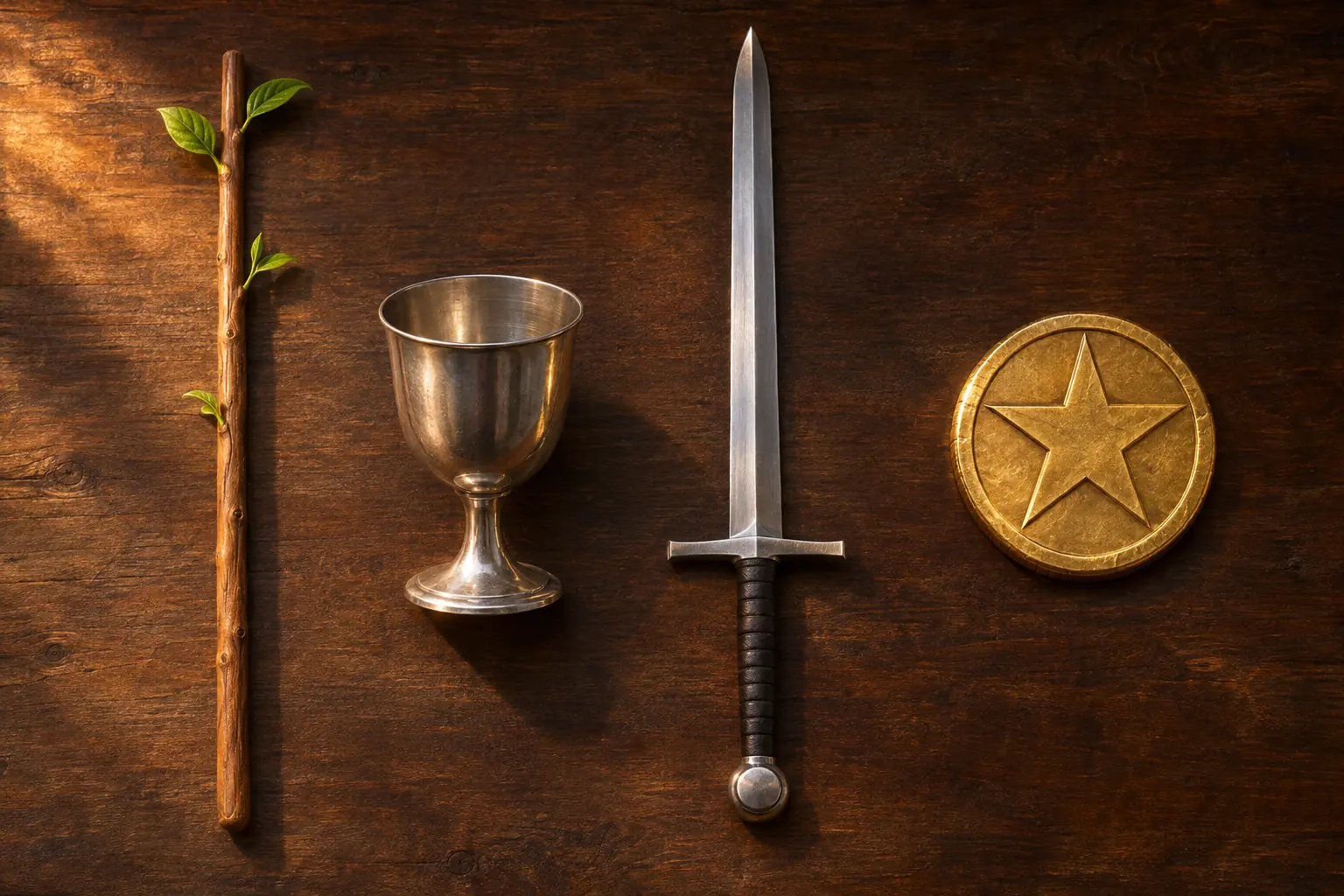
The Minor Arcana are the 56 suit cards in a 78-card tarot deck. There are four suits, Wands, Cups, Swords and Pentacles. Each suit has ten numbered cards, Ace to Ten, plus four court cards. In most modern readings the suit points to an area of life and the number points to a stage. Wands cover drive and work. Cups cover feelings and relationships. Swords cover thoughts, words and conflict. Pentacles cover money, the body and home. These meanings are a reading tradition, most of it written down since the 1880s. Use them as prompts for reflection. They do not predict events.
You keep drawing numbered cards and want a simple way to read them without memorising 40 meanings.
This page covers the four suits and the 40 numbered cards. The 16 court cards have their own guide, and the 22 picture trumps are in our Major Arcana list.
The four suits at a glance
| Suit | Other names you will see | Element (Golden Dawn) | Area of life in modern readings | A question to bring to it |
|---|---|---|---|---|
| Wands | Rods, staves, batons, clubs | Fire | Drive, work, ideas, ambition, desire | What do I want to start or push forward? |
| Cups | Chalices, goblets, vessels | Water | Feelings, love, friendship, imagination | What am I feeling, and who is it about? |
| Swords | Blades | Air | Thoughts, words, decisions, conflict | What am I telling myself, and is it true? |
| Pentacles | Coins, disks, deniers | Earth | Money, body, home, practical work | What do I have, and how am I looking after it? |
The elements come from Book T, the tarot manuscript of the Hermetic Order of the Golden Dawn, dated to the late 1880s. It calls the Ace of Wands "the Root of the Powers of Fire" and names the other three aces after water, air and earth in the same way. The questions in the last column are our own.
There is an older idea about the suits too. The Victoria and Albert Museum's history of tarot says it is "possible" the suits once stood for four classes of society: swords for the aristocracy, cups for the clergy, coins for merchants and batons for peasants. The museum frames that as a possibility, so read it as a theory.
Ace to Ten: what the numbers add
Once you know the suit, the number tells you where you are in that suit's story. Readers usually treat Ace to Ten as an arc. The Ace is the seed, the middle numbers test it, and the Ten is the full load.
The first column below is our own plain summary of how modern readers tend to use each number. The four suit columns are the titles Book T gave each card. Every Book T title begins "Lord of", which we have dropped for space. The Aces are each called "Root of the Powers of" their element.
| Number | Common modern theme | Wands | Cups | Swords | Pentacles |
|---|---|---|---|---|---|
| Ace | A seed, the raw force of the suit | Fire | Water | Air | Earth |
| Two | A choice, or a pairing | Dominion | Love | Peace Restored | Harmonious Change |
| Three | A first result | Established Strength | Abundance | Sorrow | Material Works |
| Four | Holding still, a structure | Perfected Work | Blended Pleasure | Rest from Strife | Earthly Power |
| Five | Friction, loss, a shake-up | Strife | Loss in Pleasure | Defeat | Material Trouble |
| Six | Recovery, give and take | Victory | Pleasure | Earned Success | Material Success |
| Seven | Holding a position under test | Valour | Illusionary Success | Unstable Effort | Success Unfulfilled |
| Eight | Movement, or feeling stuck | Swiftness | Abandoned Success | Shortened Force | Prudence |
| Nine | Close to the end, at full strength | Great Strength | Material Happiness | Despair and Cruelty | Material Gain |
| Ten | Completion, and its weight | Oppression | Perfected Success | Ruin | Wealth |
Read across a row and the tradition's logic shows. Every Five is rough: Strife, Loss in Pleasure, Defeat, Material Trouble. Every Six recovers. Swords run darker than the other suits from the Three onward, which is why the Three, Nine and Ten of Swords worry people most. Our scary cards guide looks at those three cards and Waite's notes on them. Two of our seasonal posts go deeper on single rows: the Eight, Nine and Ten of Wands and the Two, Three and Four of Pentacles.
You can also use this order to check a deck for missing or doubled cards, suit by suit.
Why books disagree about the suits
If two guides give you different answers about a suit, neither is broken. Tarot has never had one rulebook. Four disagreements come up most.
Which playing-card suit matches which. Many modern guides, Tarot.com among them, pair Wands with clubs, Cups with hearts, Swords with spades and Pentacles with diamonds. A. E. Waite paired them differently in his 1910 book, The Pictorial Key to the Tarot. He called Wands "the antecedents of Diamonds in modern cards" and said Swords "answer to Clubs". He called Pentacles "the prototypes of Spades". Only Cups and hearts agree.
| Suit | Common modern match | Waite, 1910 |
|---|---|---|
| Wands | Clubs | Diamonds |
| Cups | Hearts | Hearts |
| Swords | Spades | Clubs |
| Pentacles | Diamonds | Spades |
Which element goes with Wands and Swords. The Golden Dawn's fire for Wands and air for Swords is the version most decks print. Some writers swap them. Stefan Stenudd, on his site tarotcardmeanings.net, argues that Wands belong to earth and Swords to fire, and calls the usual fire link for Wands a modern change. If your deck's little book gives a different element, read that deck by its own book.
What the suits are called. Pentacles appear as coins or disks, and Wands as rods, staves or batons. The suit is the same.
Who first drew a scene on every card. The V&A calls the 1909 deck drawn by Pamela Colman Smith for Waite "the first deck to have fully illustrated pip cards". Yet the Sola Busca deck, engraved in Italy in the late 1400s, already had a picture on every suit card. Wikipedia notes that the Busca family gave photographs of the Sola Busca cards to the British Museum in 1907, where Waite and Smith "likely" saw them. A fair summary is that Smith's deck made illustrated pips normal, rather than inventing them.
How to read a numbered card in three steps
- Start with the suit. Ask which part of life the card points to: drive, feelings, thoughts or practical things.
- Add the number. Ask what stage that part of life is at: a start, a test, a recovery, a full load.
- Then look at the picture. Waite wrote that the scenes on his Minor Arcana illustrate the meanings "but without exhausting" them. The picture gives you a concrete moment to compare with your own.
Here is how that works on two cards. On the Eight of Cups, Cups (feelings) meets Eight (movement), and the picture shows a figure walking away from a row of stacked cups. Book T calls it Abandoned Success. A useful question is: what am I ready to walk away from, even though it still works? On the Five of Pentacles, Pentacles (money, body, home) meets Five (a shake-up), and two figures struggle through snow past a lit window. Book T calls it Material Trouble. Ask: where am I short of support, and who have I not asked?
Neither question has a right answer. The card gives you a place to start thinking. If you read cards upside down, our guide to reversed cards explains the main methods.
What a spread full of one suit means
A common belief holds that a spread crowded with one suit sends a strong message about that area of life. Some of that is just shuffling. These are our own figures for a well-shuffled 78-card deck.
| Spread | Event | How often it happens by chance |
|---|---|---|
| Three cards | At least two cards share a suit | About 33 percent, 1 spread in 3 |
| Three cards | All three cards share a suit | About 2 percent, 1 in 52 |
| Three cards | No Major Arcana, only suit cards | About 36 percent |
| Ten cards | Average count of any one suit | About 1.8 cards |
| Ten cards | One suit turns up four or more times | About 29 percent |
| Ten cards | One suit turns up five or more times | About 5.5 percent |
| Ten cards | At least one suit is missing entirely | About 43 percent |
So two Cups in a three-card spread is ordinary. A missing suit in a ten-card Celtic Cross happens almost half the time. Five or more of one suit in ten cards is rare enough to notice, and still chance.
When one suit does dominate, readers take it as the area your question keeps coming back to. When a suit is missing, a gentle question is: is there a part of this I am leaving out? Neither one is a warning. The Major Arcana odds and court card odds work the same way.
A worked example (invented)
This example is invented for illustration. Asha, a made-up reader, has a job offer in another city. She asks: "What should I think about before I answer the offer?" She draws three cards.
| Position | Card | Suit plus number | Book T title | The question she writes down |
|---|---|---|---|---|
| What brought me here | Three of Wands | Drive, first result | Established Strength | Which of my efforts earned this offer? |
| What I am doing now | Two of Swords | Thoughts, a choice | Peace Restored | Am I putting off the decision to keep things calm? |
| What pulls on me | Six of Cups | Feelings, give and take | Pleasure | Who would I miss, and what would I miss about them? |
Asha's spread has three suits and no majors, which is common. No card tells her to take the job or turn it down. What she gets is three questions she might not have written on her own. She takes the second one to a friend over the weekend.
Learn the 40 numbered cards in four weeks
You do not need to memorise 40 separate meanings. Learn four suits and ten numbers, which is 14 ideas, and combine them.
- Week one, Wands. Lay the Ace to Ten of Wands in a row. Write one sentence that tells a story from the Ace to the Ten. Then compare each card with the table above.
- Week two, Cups. Do the same. Notice how the Five and the Eight feel different from the Wands versions.
- Week three, Swords. Go slowly. This is the suit people find hardest to sit with.
- Week four, Pentacles. Then mix all 40 cards. Draw one, cover the name, and say the suit and number theme out loud before you check.
A deck with full scenes on every card makes this easier. Our guide to choosing your first deck compares the main styles. Once the suits feel familiar, the self-reflection spread gives them something to work on. Card meanings are a tradition, and our honest look at whether tarot works explains what the cards can and cannot do.
If you would rather hand the cards to someone else, Psychic Maria writes personal readings around questions you send her.
Common questions
How many cards are in the Minor Arcana?
56. There are four suits of 14 cards each: ten numbered cards from Ace to Ten and four court cards, usually the Page, Knight, Queen and King.
What is the difference between the Major and Minor Arcana?
The 22 Major Arcana are named picture cards, the Fool and the Tower among them, and readers treat them as big themes. The 56 Minor Arcana are suit cards, and readers treat them as the day-to-day detail. Both are part of a standard 78-card tarot deck.
Which tarot suit is about love?
Cups is the suit most readers link with love, friendship and feelings. Love questions often draw on the other suits as well. Swords can show an argument, Pentacles a shared home or money, and Wands attraction or a fresh start.
Are the Minor Arcana less important than the Major Arcana?
No. They make up most of the deck, so most of the cards you draw will be minors. Waite saw the minors as fortune-telling cards and the majors as the deeper symbols. Modern readers usually read the two together.
Do I need to learn reversed meanings for all 56 cards?
No. Many readers never use reversals. If you do, start by learning the upright suit and number themes, then add reversals once those feel easy.
When the suits keep pointing at one question
If one suit keeps turning up around the same question, Maria can write a personal reading around up to three of your questions. It is delivered by email within 24 hours, so you can read it next to your own card notes.
- Her perspective on the area of life your cards keep returning to.
- A look at the stage you may be at, and what could come next.
- Possible next steps to weigh, in a format you can keep.
Maria’s approach: a USA-based psychic and tarot reader, Maria combines intuition and tarot to read the connection behind your questions. Her focus is on what comes through about the feelings, the blockage, and the path ahead—including where the picture feels mixed.
What you receive from Maria
A personal written reading shaped around up to three questions and the details you share, delivered by email within 24 hours. You provide your questions and relevant details with your order. This is a reading you can keep and return to, not a live call you need to schedule.
View the reading details and current price before ordering. You can review our refund policy and privacy policy at any time.
Sources
- A. E. Waite, The Pictorial Key to the Tarot (1910), Project Gutenberg, for the four suits and their playing-card matches, and his note that the pictures illustrate the meanings "but without exhausting" them.
- S. L. MacGregor Mathers and the Golden Dawn, Book T: The Tarot (transcription), for the element of each Ace and the titles of the numbered cards.
- Victoria and Albert Museum, A history of tarot cards (updated 16 July 2026), for the suits and elements, the four-classes theory and its line on illustrated pip cards.
- Wikipedia, Sola Busca tarot, for the illustrated suit cards of the late 1400s and the 1907 photographs at the British Museum.
- Wikipedia, Minor Arcana, for the 56-card structure and the alternative suit names.
- Tarot.com, Tarot cards and playing cards, for the common modern playing-card matches.
- Stefan Stenudd, Tarot cards vs. regular playing cards, for the argument that Wands belong to earth and Swords to fire.
- Odds table: we worked these out exactly for a well-mixed 78-card deck (four suits of 14 plus 22 majors).
- Asha and her spread are invented for illustration.
A personal reading by Maria
Suit, number, then you
The cards give you a place to start. What you do next is your call.
Your Full Psychic Reading is built around up to three questions and the context you share. Receive your written guidance by email within 24 hours.