
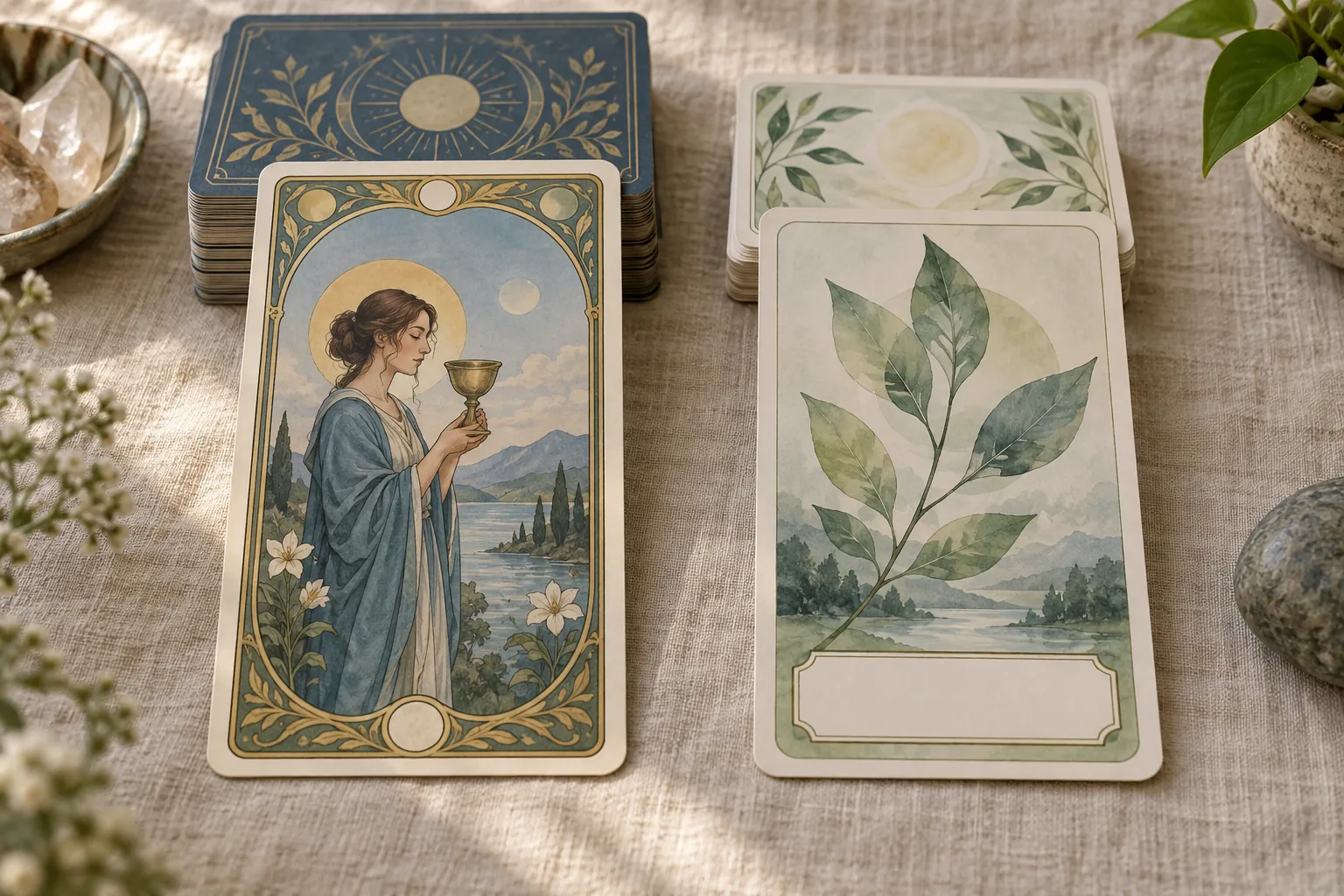
Tarot is one fixed system. A standard tarot deck has 78 cards: 22 Major Arcana, such as the Fool and the Tower, and 56 Minor Arcana in four suits of 14. Learn the system once and you can read almost any tarot deck. An oracle deck is anything else a designer chooses to make. It can have 20 cards or 70, any theme, and meanings that belong to that one deck.
You are about to buy your first deck, or a reader offered you an oracle card on top of a tarot spread, and you are not sure what the difference is.
Neither kind of deck has been shown to predict anything. Both are sets of pictures that prompt you to think about a question. The difference is how much structure you get.
Tarot and oracle side by side
| Tarot | Oracle | |
|---|---|---|
| Number of cards | 78 | Set by the designer |
| Structure | 22 Major Arcana plus four suits of 14 | None shared between decks |
| Where the meanings come from | A tradition shared across decks | The deck's own guidebook |
| Words on the cards | Usually just a title, or none | Often a word or a short message |
| Upside-down cards | Optional, many readers use them | Depends on the deck, many ignore them |
| Does your skill carry to the next deck? | Yes, mostly | Only partly |
| Hard cards | Yes, Death, the Tower and others | Many decks have none |
Is an oracle deck just an easier tarot?
Easier to start, yes. If a card says "Rest" across the bottom, you know where to begin. Easier to get good at, not really, because your next oracle deck may use completely different cards and words.
Tone is the bigger difference. Many oracle decks are written to encourage. Tarot includes cards for loss, conflict and fear, which is why its scary cards get so many questions. A deck with no hard cards is gentle on a bad day, but it also cannot point at a problem.
One reader on the r/oraclecards forum called the comparison apples to oranges. That is a fair summary. They are different tools, and comparing them is less useful than knowing what each one is for.
Where Lenormand fits
Lenormand cards are neither. The standard deck has 36 cards with fixed images such as the Ship, the House and the Key. It is modelled on a German game from about 1799, the Game of Hope by Johann Kaspar Hechtel, and took its name from the French fortune-teller Marie Anne Lenormand after her death in 1843.
Like tarot, it is a fixed system, so meanings carry from deck to deck. Unlike tarot, readers usually read the cards in pairs or in a big grid, more like sentences than scenes. If a shop files it under oracle, that is a shelf label, not a description.
How to choose: four questions
- Do you want to learn a system? Choose tarot. The effort you put in carries to every deck you buy.
- Do you want a single card to think about each morning? An oracle deck does this well, with no study.
- Do your questions have several moving parts? Tarot spreads give each card a position, such as cause, obstacle or advice. Our Celtic Cross and three-card comparison shows how that works.
- Do hard cards upset you more than they help? Start with an oracle deck and add tarot later, or not at all.
There is no wrong answer. Plenty of people own both.
One question, both decks
Readers who use both often lay a tarot spread first and then draw one oracle card as a summary. Here is an invented example, with a made-up oracle deck.
The question: "What am I not seeing about the job offer in Pune?"
- Tarot, three cards. Eight of Pentacles, then Five of Cups, then Page of Swords. Read as a line: you like the steady work you do now, you are dwelling on what you would lose by leaving, and you have not yet asked the hard practical questions.
- Oracle, one card. A card printed with the word "Roots." It does not add a fact. It puts a name to the theme the three tarot cards circled.
The tarot spread gave a sequence. The oracle card gave a headline. Neither told this person whether to move. That part stays theirs. For how to handle an upside-down card in a spread like this, see reversed tarot cards.
If someone else reads for you
Ask which deck they use. As a rough rule, a question about a decision, a specific situation or the steps ahead suits a tarot spread. A question where you want the overall theme, or something to steady you, suits a single oracle card. With tarot, a reader can name each card and its position, and you can look the card up yourself later. With an oracle card, you need the name of the deck too, because the same card title can mean different things in different decks. Either way, a good reading explains its reasoning instead of asking you to take it on trust. If you are still deciding between a card reading and a psychic one, see psychic reading vs tarot reading. Our guide to how to choose a psychic reader covers the rest.
Common questions
Are oracle cards the same as tarot cards?
No. Tarot is a fixed 78-card system with 22 Major Arcana and four suits. Oracle decks have no shared structure, so each one has its own number of cards, themes and meanings.
Can you use oracle cards and tarot cards together?
Yes. A common way is to lay a tarot spread and then draw one oracle card as a summary or a theme for the whole reading.
Should a beginner start with tarot or oracle cards?
Start with oracle cards if you want one card a day with no study. Start with tarot if you want to learn a system that works with almost any tarot deck you pick up later.
Do oracle cards have reversed meanings?
Only if the deck's guidebook gives them. Many oracle decks print words on the card and do not use reversals, while tarot reversals are optional and common.
Sources
- A. E. Waite, The Pictorial Key to the Tarot (1910), Project Gutenberg, for the 22 Trumps Major and the four suits of the Lesser Arcana.
- Lenormand cards, Wikipedia, for the 36-card deck, Hechtel's Game of Hope and Lenormand's dates (it cites Decker, Depaulis and Dummett, A Wicked Pack of Cards, 1996).
- Tarot and Oracle Card Reading For Dummies, chapter 1 (Wiley, publisher's excerpt), for oracle decks having no set number of cards.
- r/oraclecards threads such as 1noix5c, read for how readers compare the two (paraphrased, not quoted).