
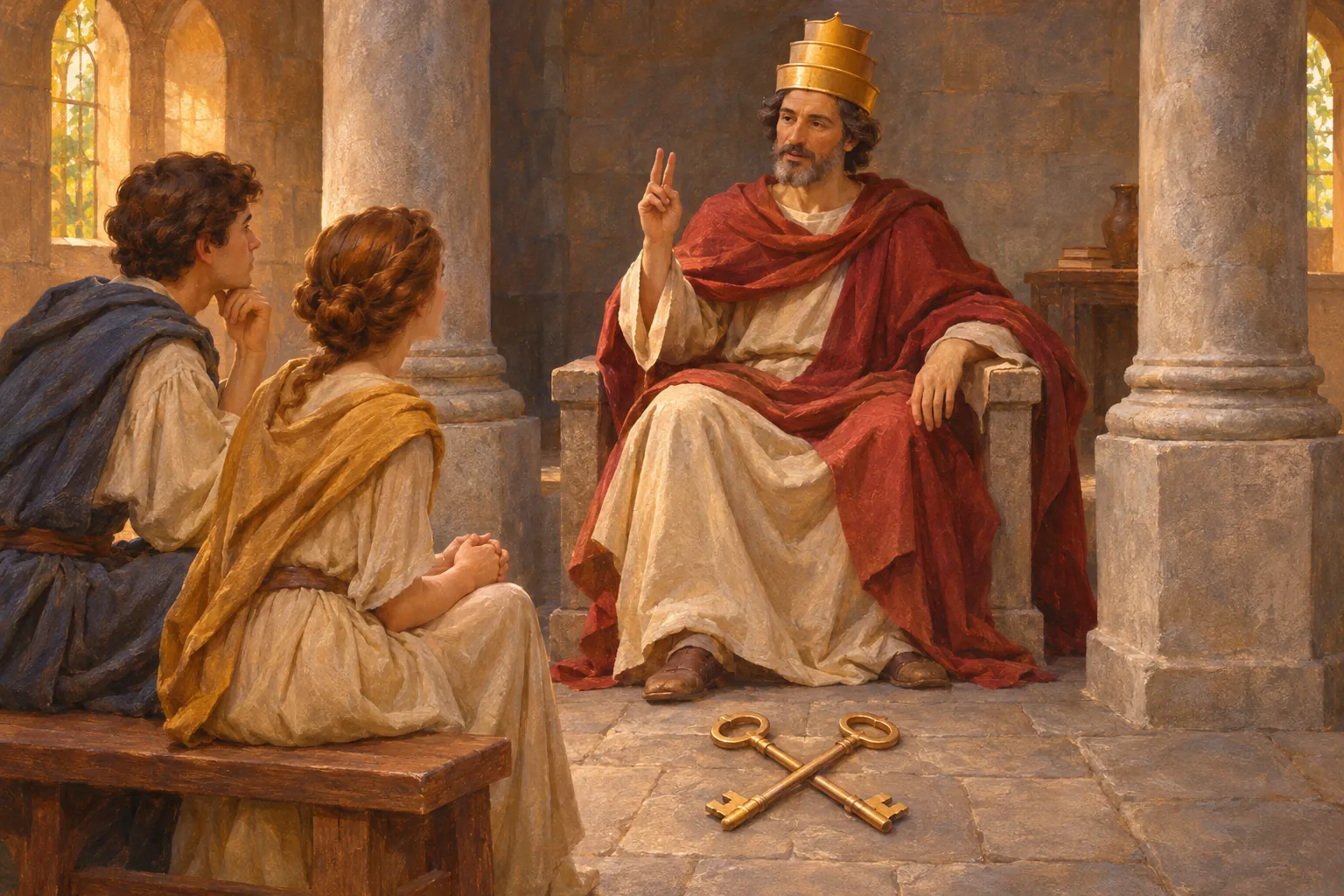
The Hierophant is card V of the Major Arcana. The picture shows a crowned religious figure, his crown in three tiers, raising one hand in blessing over two kneeling men, with a pair of crossed keys on the floor in front of him. Books usually list religion, tradition and marriage. If none of those apply to you, read it as knowledge that is taught rather than discovered: a school, a profession's standards, a family custom, a teacher, the accepted way of doing something. The card asks how you stand with that tradition. Are you learning from it, following it out of habit, or ready to adapt it? It is not a judgement on anyone's faith, and it does not predict a wedding.
You drew the Hierophant, you are not religious and have no wedding plans, and the usual meanings do not seem to apply to you.
Why does the card look so religious?
Because it was the Pope. Early Italian decks and the Tarot de Marseille called the card the Pope, at a time when the papacy also governed a large part of central Italy as the Papal States. The name "Hierophant" came later. According to Wikipedia's history of the card, the eighteenth-century French writer Antoine Court de Gébelin used it, borrowing the title of the chief priest of the ancient Greek Eleusinian Mysteries, because he wrongly believed tarot was older than Christianity.
Waite kept the religious reading but narrowed it. He called the figure "the ruling power of external religion", and set it against the High Priestess as "the prevailing genius of the esoteric, withdrawn power". He also wrote: "I think, however, that in its primitive form this card did not represent the Roman Pontiff." The Golden Dawn's Book T manuscript gives the card the sign Taurus, the Hebrew letter Vau and the title "The Magus of the Eternal".
Under all its names, the card is about one thing: the official channel through which a tradition gets taught.
"None of those things apply to me"
That line comes from an r/tarot post titled "What does the Hierophant mean when you're non-religious and non-traditional?" The writer explained: "Most books/websites say it represents traditions, beliefs, religion, marriage, seeking advice from a spiritual or religious advisor etc." The replies did not try to argue them into religion. One reader, an artist, wrote that "you have to know the rules before you can break them." Another called the card "the teachings, rules, basics of a discipline that you have to master before you can start experimenting."
That reading works for anyone. Here is how it translates to everyday questions.
| If your question is about | The Hierophant can stand for |
|---|---|
| Study or exams | The syllabus, the teacher, the method everyone is expected to use |
| A job or profession | Training, licences, professional standards, how the firm does things |
| Family | Customs passed down, and who enforces them |
| A craft, sport or art | A teacher or a school of practice, and learning the basics first |
| Your own habits | A pattern you repeat because that is how you have always done it |
The last row came from the original poster, who read the card as "making the same mistakes again and again (as if it's some sort of personal tradition I have)".
Inner wisdom or outside knowledge?
Another r/tarot post asked: "Is this card about inner wisdom (spirituality) or is it about knowledge from the outside (religion, schooling)??" The traditional answer is outside. Waite's description keeps returning to the contrast between the Hierophant's public, taught doctrine and the hidden knowing of the High Priestess. The High Priestess is what you sense before anyone tells you. The Hierophant is what someone teaches you, usually with a syllabus and a certificate at the end.
Neither one is better. A simple check is to ask where a belief you hold came from. If you can name the teacher, the book or the institution, it belongs to the Hierophant. If you cannot, it is probably the High Priestess's territory.
Keep it, adapt it or leave it
When the Hierophant turns up, it often lands on a rule you were taught. Three questions help sort that rule.
- Who taught you this? A person, an institution or a family.
- What problem was it solving? Most traditions started as an answer to something.
- Is that problem still yours? If yes, the rule may still be earning its place. If no, you can change the rule and keep the reason behind it.
An invented case, to show the questions at work. Divya, 26, has learned Bharatanatyam in Kochi since she was eight. Her teacher starts every class with the same long warm-up, and Divya, now working full time, has begun skipping it. She draws the Hierophant. Working through the three questions, she sees that the warm-up was protecting her knees, and that reason has not gone anywhere. She keeps it and asks her teacher for a shorter version on weekday evenings. The tradition stayed. The conversation about it changed.
The Hierophant in love and marriage
Waite's divinatory list begins "Marriage, alliance", which is why so many guides call this the wedding card. A closer reading is formal commitment and the expectations around it: a ceremony, a family's view of who you should marry, a promise made in public. It cannot tell you whether or when you will marry. If your question involves family approval, our page on when your family disapproves of your partner goes further, and for couples from different faiths there is can an interfaith relationship work. The Lovers, the next card, deals with the personal choice that sits beside those expectations.
What does the Hierophant reversed mean?
Waite's reversed list is oddly sociable: "Society, good understanding, concord, overkindness, weakness." Modern readers mostly read the reversed card as the unconventional path, choosing your own way over the official one. Both can fit, depending on the question.
- Your own path. You are questioning or leaving a tradition. The card does not say whether that is right. It asks whether you know what the tradition was for before you walk away from it.
- Overkindness. Going along with a group or a family to keep the peace while privately disagreeing. The question: what would you say if agreement were not expected?
Is the Hierophant a yes?
A conditional yes when the question is about doing something the accepted way, such as an exam, an application or a formal process. It says little about shortcuts or bending the rules. By the method in our year card guide, it is the 2027 card for anyone born on January 2 or February 1 (how to find your 2027 year card). The card just before it is the Emperor (IV), who makes rules rather than teaching the ones handed down. To see it in sequence with the other 21, open the Major Arcana table.
Common questions
What does the Hierophant mean in tarot?
Taught knowledge and the institutions that pass it on: schools, religions, professions, families and teachers. It asks how you relate to a tradition, whether you are learning from it, following it from habit, or ready to adapt it.
What does the Hierophant mean if I am not religious?
Read it as the accepted way of doing something and the people who teach it. A syllabus, professional standards, a family custom, a dance or music teacher, or a habit you keep repeating all fit. The card does not require any faith.
What zodiac sign is the Hierophant?
Taurus. The Golden Dawn's Book T gives the card Taurus and the Hebrew letter Vau. The match comes from the Victorian occult tradition. Use it to think with, not to pick dates.
Does the Hierophant mean marriage?
Waite listed "Marriage, alliance" first, so many readers link it with weddings. It is better read as formal commitment and the expectations around it. It cannot predict whether or when you will marry.
Is the Hierophant a person?
Sometimes: a teacher, mentor, manager, priest or elder whose advice you look for. Waite called it "the man to whom the Querent has recourse". It can just as easily be an institution or a rulebook.
Sources
- A. E. Waite, The Pictorial Key to the Tarot (1910), Project Gutenberg ebook 43548. Part I "5. The High Priest or Hierophant", Part II for the description and the contrast with the High Priestess, Part III for the divinatory and reversed meanings. Quotations were checked against the text reproduced at tarotcardmeanings.net.
- S. L. MacGregor Mathers and others, Book T: The Tarot (Golden Dawn manuscript, about 1888), PDF transcription, for the card's title, the letter Vau and Taurus.
- Wikipedia, The Hierophant, for the Pope name, the Papal States and Court de Gébelin's renaming.
- Reddit r/tarot, "What does the Hierophant mean when you're non-religious and non-traditional?" and "What's up with The Heirophant?", for the quoted wording.
- The Divya example is invented for illustration.