
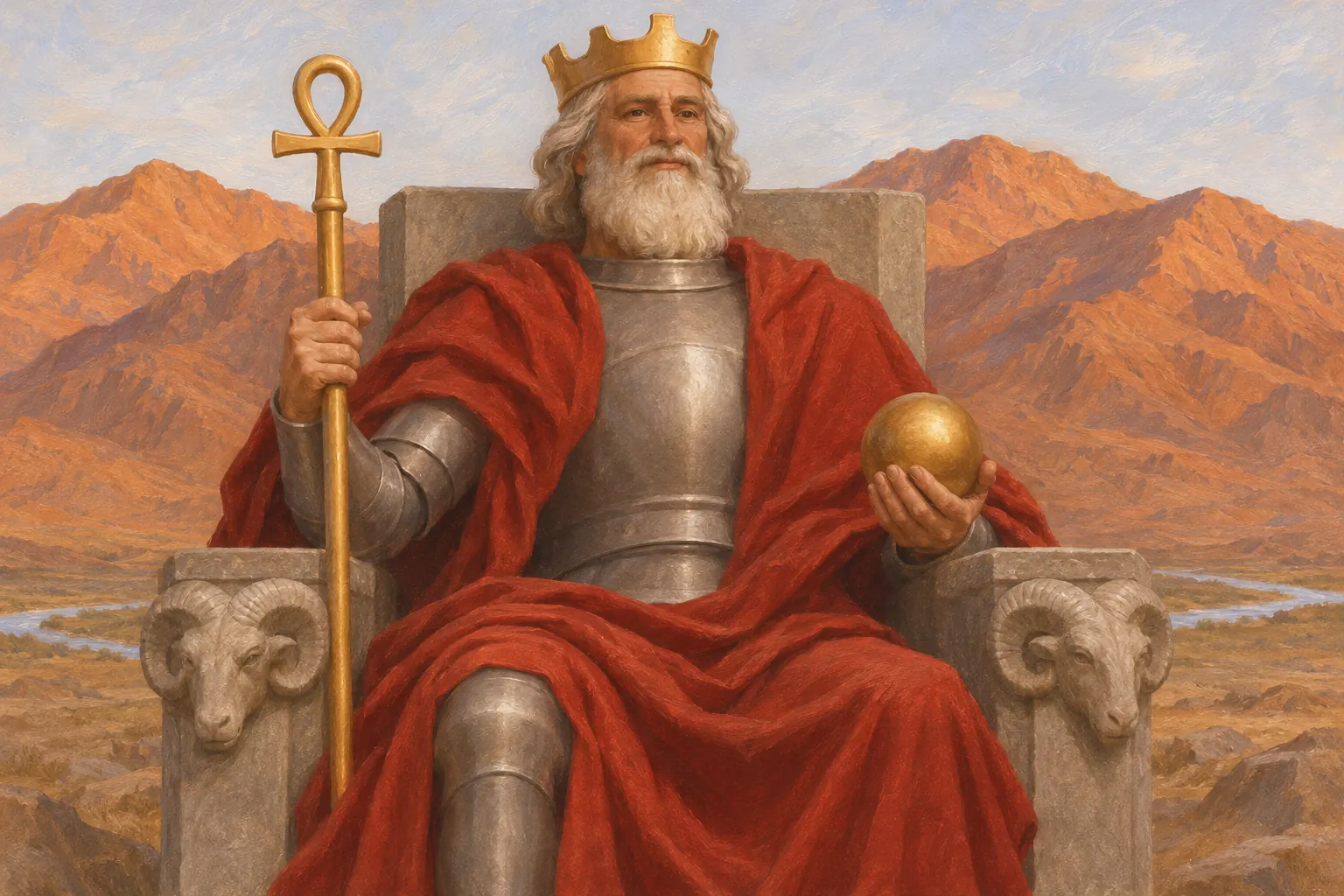
The Emperor is card IV of the Major Arcana: a crowned man seated on a stone throne with rams' heads on its arms, a sceptre in one hand and a globe in the other. Most readers take it as order. Rules, routines, responsibility, and someone willing to take charge. In a reading it usually asks one of two things. Is there a structure that would make this easier? Or is someone holding power without the care that should come with it? It does not promise control over an outcome, and it is not a verdict on a father, a boss or a partner. It follows the Empress, and the two are often read as a pair. Read it here as a prompt for reflection, never as a forecast.
You keep drawing the Emperor, or you drew it about a boss, a parent or a partner, and "authority" is not telling you what to do with it.
What is on the card?
Waite's 1910 description is short. The Emperor holds "a form of the Crux ansata for his sceptre", the looped Egyptian cross better known as the ankh, and "a globe in his left hand". The arms of his throne are "fronted by rams' heads". Waite called him "executive and realization, the power of this world". He noted that older versions sometimes seat the Emperor on a cubic stone, "which, however, confuses some of the issues", and he waved away one earlier reading of the card as "fantasy". He was not a writer who flattered the cards.
The card itself is as old as tarot. Wikipedia's history places it in the fifteenth-century Italian decks such as the Visconti-Sforza cards and in the Tarot de Marseille. The rams came much later. In the Golden Dawn's manuscript Book T, the Emperor has the sign Aries, the Hebrew letter Heh and the title "Sun of the Morning, chief among the Mighty", and the 1909 Rider-Waite-Smith picture added the rams to show that sign. Pamela Colman Smith also painted armoured legs under his red robe and a range of bare mountains behind the throne. Set it beside the Empress's cornfield and the two pictures split the work between them: one card is about what grows, the other about what keeps its shape.
"I keep pulling the Emperor"
That is almost word for word the title of one r/tarot post: "I keep pulling the emperor tarot card and I'm not sure what the hell it means". Repeat appearances happen with every card, and our page on the same card showing up again covers the odds. When it is the Emperor, three readings come up most often.
- A structure is missing. Something in your week has no rule, no owner and no end date, and it is costing you.
- A person in charge is on your mind. A manager, a parent, a landlord, a partner who makes most of the decisions.
- You are being asked to take charge. The decision is yours, and you have been waiting for someone else to make it.
Most people know which one fits within a minute of reading the list. If none of them fits, the repeat may just be chance.
The Emperor as a rule you write
The most practical way to read the Emperor is as one written rule you would actually keep. Waite's divinatory list begins "Stability, power, protection, realization", and a good rule does all four on a small scale. It steadies a week, gives you some say over it, guards something you care about, and turns an intention into something that actually happens.
A rule that holds has four lines. Try writing one now.
- What exactly? One behaviour, small enough to check. "No client messages after 8 p.m. on weekdays", not "better work-life balance".
- When does it apply? Days, hours or situations.
- Who checks? You, a friend, a partner, a calendar reminder. A rule nobody checks is a wish.
- When is it reviewed? Pick a date. Good rules come with an expiry, and that is the line most people leave out.
Here is an invented example, not a real client. Rohan, 31, is a freelance designer in Bengaluru. Client messages arrive until midnight and he answers all of them. He draws the Emperor three mornings in a row and, slightly annoyed, writes a rule: no replies to clients after 8 p.m. on weekdays, his flatmate asks him every Friday whether he kept it, and he reviews it after four weeks. In week one he breaks it twice. In week three a client complains, and Rohan finds that a polite auto-reply settles it. At the review he keeps the rule and moves the cut-off to 8:30. Nothing mysterious happened. A card gave him a reason to write one sentence down and stick to it.
If your rule keeps running into someone else's choices, a client's or a partner's or a relative's, Maria's email readings offer a second view to set next to it.
| A rule that holds | A rule that hardens |
|---|---|
| Protects something you can name | Protects the person who made it |
| Has a review date | Has never been questioned |
| Everyone it affects knows it | Is enforced by surprise |
| Can bend for a real emergency | Treats every exception as defiance |
| Gets lighter as the habit forms | Needs more force every month |
The right-hand column is where the Emperor goes wrong, and it applies to your own rules as much as anyone else's.
The Emperor as a person
In a reading the Emperor is often a person: a boss, a father, an older relative, a partner who sets the terms. Beginners on r/tarot tend to describe him that way too, as a father figure or an authority tied to rules and order. The card cannot tell you whether that person is fair. What it can do is turn your attention to how their authority works, and that you can check against what they actually do.
- Do they take responsibility when things go wrong, or only credit when things go right?
- Are their rules known in advance, or announced after you have broken them?
- Can you disagree with them without paying for it later?
- Does their authority protect anyone besides themselves?
If the answers are mostly good, the Emperor is describing a steady person in charge, and it may be worth asking what you could learn from how they run things. If the answers are mostly bad, the card is not telling you to obey. For a manager, our page on whether your boss values your work has more grounded questions. Inside a relationship, see when a partner ignores your boundaries.
If someone controls your money, decides who you can see, or makes you afraid, that is not a question for a tarot card. Talk to someone you trust, a qualified counsellor or a local domestic violence support service.
The Emperor is also different from the four Kings. Our guide to court cards explains how Kings are read as people. The Emperor is less a type of person than the role of being in charge, which anyone of any age or gender can hold, including you.
The Emperor and the Empress
The two cards are numbered III and IV and are usually read together. Waite wrote that they "do not precisely represent the condition of married life, though this state is implied". It helps to read them as two kinds of care. The Empress feeds, comforts and lets things grow at their own pace. The Emperor plans, sets limits and keeps a promise. Most households, teams and small businesses need both, and a spread that shows only one of them may be pointing at the one that is missing.
The card after the Emperor is the Hierophant (V). The Emperor makes and enforces rules. The Hierophant teaches rules that were handed down. If you are unsure whether a rule in your life is one you chose or one you inherited, that difference is the gap between these two cards. The Major Arcana table shows all 22 in order.
The Emperor in love
As feelings, the Emperor usually describes someone who wants to be steady and dependable, and who shows care by planning, providing or protecting rather than by saying much. That is a common reading, not a window into another person's heart. What is going on inside someone else stays out of reach of any card.
In a relationship, the useful question is who sets the terms. If one person makes most of the decisions and the other mostly goes along, the Emperor may be naming that pattern. If neither of you decides anything and the same argument returns every month, the card may be hinting that two or three agreed rules would do more than another long talk. For someone single, it can point to wanting stability. It is not a forecast that a commanding stranger is about to appear.
The Emperor in your career and finances
In a job, the Emperor is the card of management, systems and accountability. It can describe a manager, a step up into that kind of role, or simply the need to write down who owns what. If you are the one in charge, Waite's list makes a decent checklist: "aid, reason, conviction". Help people, explain your reasons, and stand by the decision once it is made.
With money, read the Emperor as structure: a budget with categories, a fixed day for paying bills, a savings rule with an amount and a date. It is not a sign that money is coming, and it does not tell you whether to make a particular investment.
What does the Emperor reversed mean?
Waite's reversed list is gentler than the modern one: "Benevolence, compassion, credit; also confusion to enemies, obstruction, immaturity." Modern readers tend to treat the reversed Emperor as tyranny or chaos. Waite's list leaves room for something softer, and it sorts into three forms.
- Soft where firmness is needed. Kindness or credit given when a clear limit would help more. The question: where are you saying yes to avoid an argument?
- Obstruction. A rule, or a person in charge, blocking more than it protects. The question: which rule would you drop if nobody minded?
- Immaturity. Wanting the authority without the responsibility, in you or in someone else. The question: who is making decisions without answering for them?
If you do not read reversals, the same three readings can apply to an upright Emperor in a difficult position. Both approaches are weighed in our guide to reading reversed cards.
Is the Emperor a yes?
Mostly yes, when the question concerns something you control and are willing to organise, such as "can I keep to this study plan until my exam?" Read it as "only with a plan" when the question is vague. It says little about decisions that belong to someone else. For help phrasing a single-card question, read can tarot answer yes or no questions.
Common questions
What does the Emperor mean in tarot?
Order and responsibility: rules, routines, and someone willing to take charge. In a reading it often asks whether a structure would help, or whether someone in charge is using their authority well. It does not promise control over an outcome.
What does the Emperor mean as feelings?
Usually a wish to be steady, dependable or protective, often shown through planning or providing rather than words. A card has no access to another person's heart, so read it as a description of how someone may show care, not as proof of it.
What zodiac sign is the Emperor?
Aries. The Golden Dawn's Book T gives the Emperor the sign Aries and the Hebrew letter Heh, which is why the Rider-Waite-Smith throne has rams' heads. Treat that as a Victorian occult convention to think with, not a way to predict anything. Aries season 2027 runs March 21 to April 20 in India.
Is the Emperor always a man or a father?
No. It often stands for a father, a boss or an older relative, but the card describes the role of being in charge, and anyone can hold that role, including you. Read it by what the person does, not by who they are.
Does the Emperor reversed mean someone is controlling?
Not necessarily. Waite's reversed list was "Benevolence, compassion, credit; also confusion to enemies, obstruction, immaturity", which covers being too soft as well as getting in the way. If someone's control frightens you, please talk to someone you trust or to a support service, not to a deck of cards.
A second view on your rule
When your rule depends on someone else's choices, Maria can write a personal reading around up to three questions you choose. It is delivered by email within 24 hours, so you can read it beside your plan.
- Her perspective on the person or situation your rule runs into.
- A second view on which rule to write first.
- A written reading you can come back to at your review date.
Maria’s approach: a USA-based psychic and tarot reader, Maria combines intuition and tarot to read the connection behind your questions. Her focus is on what comes through about the feelings, the blockage, and the path ahead—including where the picture feels mixed.
What you receive from Maria
A personal written reading shaped around up to three questions and the details you share, delivered by email within 24 hours. You provide your questions and relevant details with your order. This is a reading you can keep and return to, not a live call you need to schedule.
View the reading details and current price before ordering. You can review our refund policy and privacy policy at any time.
Sources
- A. E. Waite, The Pictorial Key to the Tarot (1910), Project Gutenberg ebook 43548. Part I "4. The Emperor", Part II for the description (the Crux ansata, the globe, the rams' heads, the cubic stone, the Empress and married life) and Part III for the divinatory and reversed meanings. Quotations were checked against the text reproduced at tarotcardmeanings.net.
- S. L. MacGregor Mathers and others, Book T: The Tarot (Golden Dawn manuscript, about 1888), PDF transcription, for the card's title, the letter Heh and Aries.
- Wikipedia, The Emperor (tarot card), for the card's place in early Italian and Marseille decks and the later rams' heads.
- Reddit r/tarot, "I keep pulling the emperor tarot card and I'm not sure what the hell it means" for the quoted title, and "What does The Emperor card represent? - Beginner" for the father-figure description (paraphrased).
- The Rohan example is invented for illustration.
A personal reading by Maria
Who is setting the terms this week?
Put your rule on paper first. A reading is a second view, not a replacement for it.
Your Full Psychic Reading is built around up to three questions and the context you share. Receive your written guidance by email within 24 hours.