
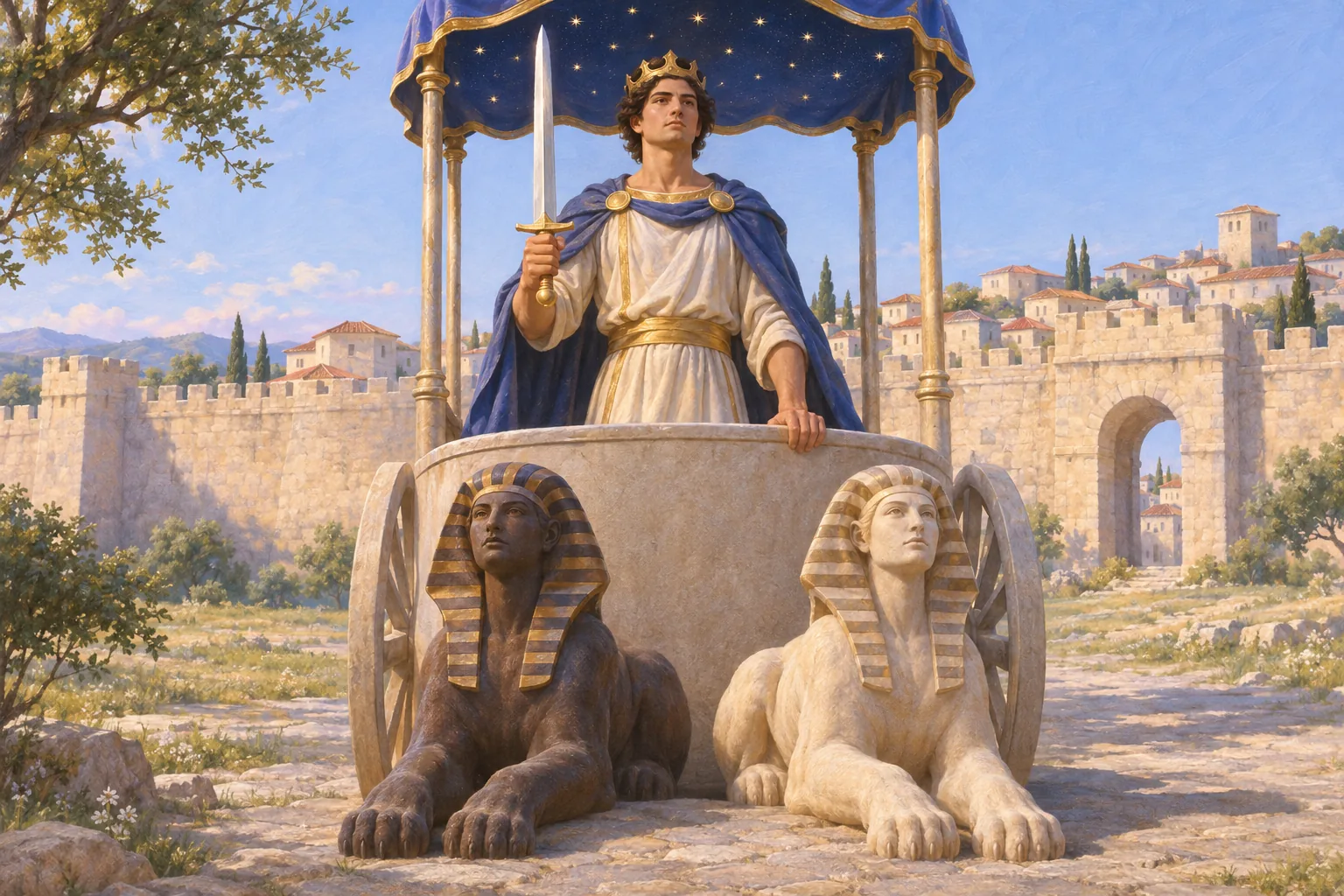
The Chariot is card VII of the Major Arcana. A crowned driver stands in a chariot with a black sphinx and a white sphinx in front of it, and he holds no reins. Most readers take it as willpower: choosing a direction and holding it while two things pull at you. It is not a promise that you will win, and it does not tell you which way to go. What it asks is whether you have picked a direction at all. It comes straight after the Lovers and before Strength, and like every card on this site it is something to reflect on rather than a forecast.
You drew the Chariot about a decision and cannot tell whether it means go ahead or walk away, or you drew it reversed and want to know what has gone wrong.
What does the card show?
In the 1910 guide to the Rider-Waite-Smith cards, which Pamela Colman Smith illustrated to his plan, A. E. Waite called the driver "an erect and princely figure carrying a drawn sword". Stars hang over him on a canopy. Look for the reins and you will not find any, which is why most readers say he steers by will.
The sphinxes are newer than the card. Waite says plainly that he borrowed them from the French occultist Éliphas Lévi, and in the same book he admits that the sphinx version "was invented to support a particular historical hypothesis". He also notes that "in the eighteenth century white horses were yoked to the car", and that other decks used "a lion and a leopard". Wikipedia's history of the card ties it further back, to the Renaissance revival of the Roman triumph, a public procession with a chariot at its centre. Read that way, the older card looks more like a parade for someone who has already won, and the steering-two-forces reading came later.
In the Golden Dawn's manuscript Book T, the card has the sign Cancer, the Hebrew letter Chet and two titles, "The Child of the Powers of the Waters" and "the Lord of the Triumph of Light". Our Cold Moon guide covers that Cancer link, so it is not repeated here.
Does the Chariot mean go ahead or walk away?
This is the question people actually ask. One r/tarot post puts it exactly: "How to know if the chariot means 'go ahead and do it' or 'move away from it'?" The honest answer is that the card does not choose for you. It shows the state of being committed to one heading. Walking away can be that heading as much as going ahead can. A reply in the same thread said it well: "make a choice one way or the other and commit to it."
So instead of asking the card which way, ask yourself three questions and let the answers decide how to read it.
| Question | If you can answer it | If you cannot |
|---|---|---|
| Can you say where you are going in one sentence? | Read the card as "hold the course" | Read it as "pick the direction first" |
| What are the two things pulling at you? | Name them, and decide which one steers and which one follows | The pull you cannot name is often the one doing the steering |
| What will you stop doing to keep this course? | The plan has a cost you have accepted | The plan is still a wish, and the card is early |
An invented example, made up for this page. Ishita, 27, works in a bank in Pune and has a master's place abroad that starts in September. She draws the Chariot and hopes it means "go". Her one sentence will not come: she writes "study abroad" and then "or stay and get promoted". Her two pulls are her savings target and her parents' worry. What she would stop doing is unclear in both versions. Read honestly, the card did not say go or stay. It said the next step is to choose, and she set herself a date by which she would accept or decline the place. Smaller than the answer she wanted, and more useful.
What did Waite say the win does not cover?
Many guides skip this. Waite praised the driver as a conqueror, then listed in five lettered points what the victory leaves out. Two matter for a reading. He wrote that "the planes of his conquest are manifest or external and not within himself", and that "the liberation which he effects may leave himself in the bondage of the logical understanding". He added that if the driver came before the High Priestess, "he could not open the scroll called Tora".
In plain words, the Chariot wins outward contests. A deadline met, a move made, an exam passed, a negotiation pushed through. It says much less about whether you will feel settled afterwards. So the card can lean yes on "can I push this through?" and stay silent on "will this make me happy?" Those are two questions, and it only answers the first.
The Chariot in love and as feelings
As feelings, the Chariot usually describes determination. Someone knows what they want, or is pushing for it, or is trying to keep two parts of their life moving together. What another person truly feels is beyond any card, and this is not a card about winning someone back. The steering in this card is always your own. A Chariot drawn about an ex is better read as "where are you heading now?" than as "how do I get them to turn around?"
Inside a relationship, the two sphinxes make a fair picture of two people with two plans. The card does not say who should give way. It says the direction needs agreeing before either of you speeds up.
The Chariot at work and with money
At work this is the card of exams, deadlines, launches and job moves: anything that needs sustained effort in one direction. Waite's fortune-telling list is mixed, and worth reading in full: "Succour, providence also war, triumph, presumption, vengeance, trouble." The word to notice is "presumption". Pushing hard can tip into assuming you will get your way, which is the Chariot's usual failure. If you are weighing a job change, our guide to changing careers has questions that go further than one card can. With money, read it as discipline over a set period, such as a savings target with a date, and never as a sign that money is coming.
What does the Chariot reversed mean?
Waite's reversed list is short and blunt: "Riot, quarrel, dispute, litigation, defeat." Modern readers soften it, and they mostly split into two readings. One reader on r/tarot wrote of their own draw: "I got the Chariot reversed. To me this means having a lack of willpower." That is the first reading. The second is the opposite problem.
- No heading. The sphinxes pull in different directions and nothing moves. The question: what have you not yet decided?
- Too tight a grip. Control turns into forcing, and the effort becomes the goal. The question: what would you let go of if you trusted the direction?
If reversals are not part of how you read, both readings still apply to an upright card in a hard position. Our page on reversed tarot cards explains the choice.
Is the Chariot a yes?
Lean toward yes if the question is about your own effort, such as "can I finish this by March?" It says little when the result depends on someone else's choice. Reversed, read it as "not until you pick a direction". To word a question that one card can answer, see tarot yes or no questions.
For the full sequence of 22, the Major Arcana table lists each card in order.
Common questions
What does the Chariot mean in tarot?
Willpower with a direction: picking one heading and holding it while two things pull at you. It is a card about effort and focus, not a promise of victory, and it does not choose the direction for you.
What does the Chariot mean as feelings?
Determination, drive, or someone trying to keep two parts of life moving together. It cannot show what another person really feels. Read it as a question about where you are steering, not about whether someone will come back.
What zodiac sign is the Chariot?
Cancer. The Golden Dawn's Book T gives the Chariot the sign Cancer and the Hebrew letter Chet. That pairing is a 19th-century convention, useful for reflection and not for prediction.
Is the Chariot about travel or a new car?
Not in the older meanings. Waite's list for the Chariot has no travel in it, and he gave "voyage, route, emigration" to the World instead. If you drew it about a trip or a move, read it as the effort the move will take, not as a sign that it will happen.
Does the Chariot reversed mean no?
Not exactly. It usually means "not until you choose a direction" or "you are gripping too hard". Waite's reversed list was "Riot, quarrel, dispute, litigation, defeat", which modern readers treat as a warning about conflict, not a fixed outcome.
Sources
- A. E. Waite, The Pictorial Key to the Tarot (1910), Project Gutenberg ebook 43548. Part I "7. The Chariot" for the sphinx history and the horses, Part II for the description and the five limits, Part III for the divinatory and reversed meanings and the World's "voyage". Quotations were checked against the text reproduced at tarotcardmeanings.net.
- S. L. MacGregor Mathers and others, Book T: The Tarot (Golden Dawn manuscript, about 1888), PDF transcription, for the card's titles, the letter Chet and Cancer.
- Wikipedia, The Chariot (tarot card), for the Renaissance triumph and the history of the image.
- Reddit r/tarot, "How to know if the chariot means 'go ahead and do it' or 'move away from it'?" and "Help with single card reading", for the quoted wording.
- The Ishita example is invented for illustration.