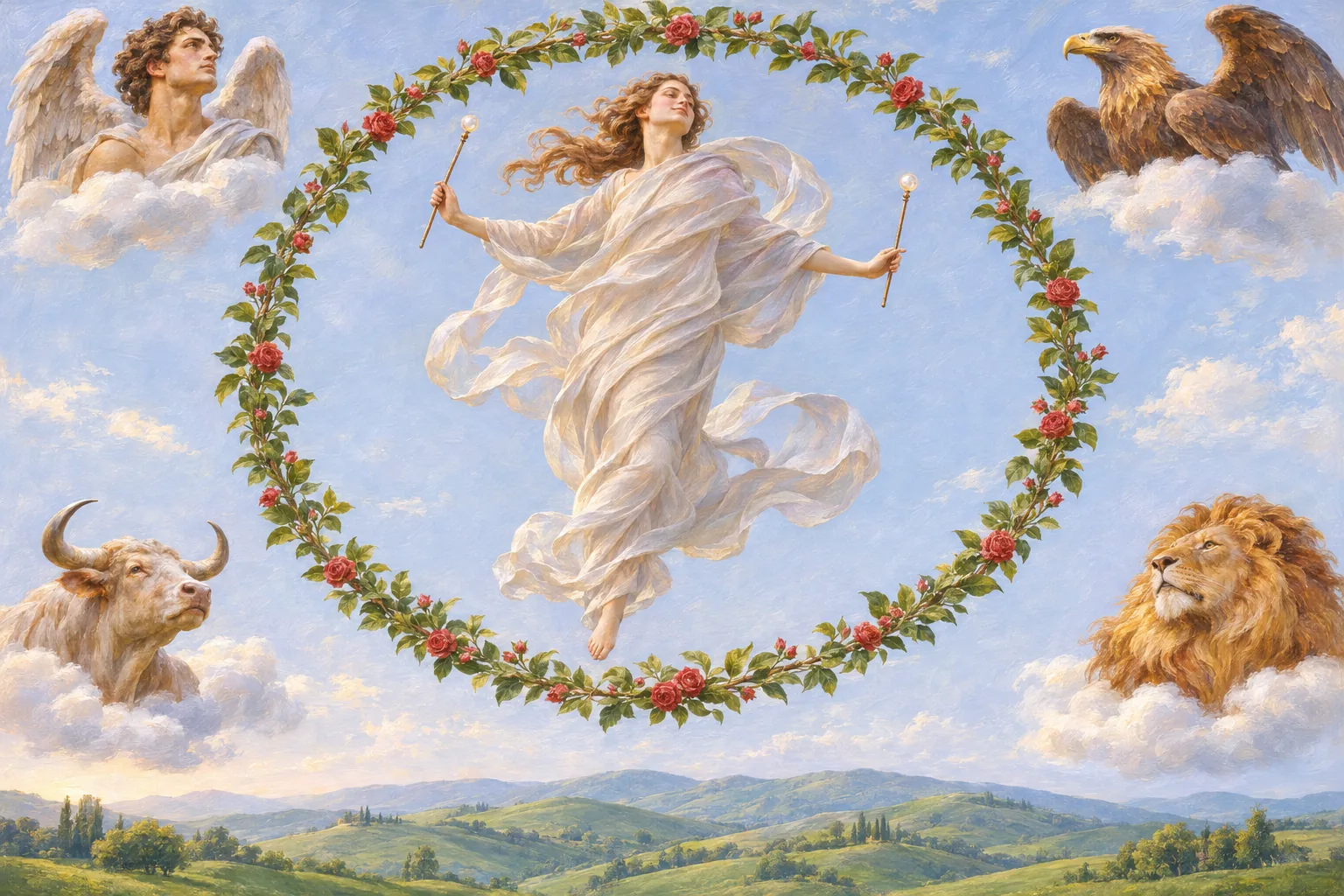
The World is card XXI, the last numbered card of the Major Arcana. A figure dances inside a wreath while four creatures watch from the corners. In a reading it usually points to a cycle that has taken its final shape: a stage, a project or a long effort that is now a finished thing, whether or not anyone has marked it. It does not promise that a goal will arrive, that a person will return or that everything will turn out well. And it does not require you to feel finished. The sharper question is the one most guides skip: who decided this was complete, and does it feel complete to you?
You drew The World and cannot tell whether it means success, an ending or nothing yet, or you keep seeing it when nothing in your life feels finished.
Relief, a pang, or "not quite"?
The card is called a happy ending in half the guides, yet people who draw it often report something less tidy. On r/tarot one reader wrote, "I oscillate between 'oh yay! Good outcome!' and 'oh wait, is this the end?'" Another asked, "Is it always a completion or ending?" A third described "the bittersweet feeling that comes when a phase of life is completed". And a fourth said "nothing in my life seems to be leading up to a conclusion."
Those are four different experiences of one card. A quick way to sort yours:
| What you feel when you see it | What it often means | A question that fits |
|---|---|---|
| Relief, a bit of pride | A stage has taken its shape and you can see it | What exactly is finished, in one sentence? |
| A pang, or an odd flatness | Finishing costs something, even a good finish | What am I leaving behind that I did not choose to leave? |
| Confusion, because nothing seems close to done | The cycle may be smaller or quieter than you assumed, or it ended without a ceremony | What did I stop doing in the last year, and did I ever acknowledge it? |
None of the three rows is the "correct" reaction. The card describes a shape, not a mood.
What the picture actually shows
In The Pictorial Key to the Tarot, A. E. Waite describes the four creatures of the Apocalypse and of Ezekiel's vision "grouped about an elliptic garland". Inside it is "the figure of a woman, whom the wind has girt about the loins with a light scarf", and she is "in the act of dancing, and has a wand in either hand." Wikipedia adds that the four creatures, a man, a lion, an ox and an eagle, are often matched to the four fixed signs: Aquarius, Leo, Taurus and Scorpio.
What stands out is how little anyone agrees on who she is. Waite lists the rival answers himself. Eliphas Lévi called the garland a crown and said the figure represents Truth. Papus linked it with the Absolute and the realisation of the Great Work. Others took it as humanity, or as the eternal reward of a life that has been spent well. He is not shy about the list. The idea that she is the Magus at the highest degree of initiation he calls "one of the worst explanations", and the idea that she represents the absolute he calls "ridiculous". When the author of the best-known guide dismisses two popular readings of the card, that is a reason to hold any reading of it loosely.
His own divinatory list for the upright card is short: "Assured success, recompense, voyage, route, emigration, flight, change of place." Success and recompense are the part guides quote. The rest is travel vocabulary from an older fortune-telling habit, and it is why some readers treat the card as a trip or a move. Neither the success nor the move is a forecast you can plan around.
The Golden Dawn manuscript Book T gives the card the title "The Great One of the Night of Time", the Hebrew letter Taw, and the elements Earth and Saturn. Saturn is the planet traditionally linked with limits, so even that tradition ties the card to a boundary, not only to a prize. That link is our reading, not Book T's wording.
The finish-line audit
This takes ten minutes and replaces a vague feeling about the card with a list of what has actually finished.
- Name the area you asked about. A job, a degree, a relationship stage, a move, a long project.
- Write the "done" sentence. "This is complete when ..." Be honest about whose standard you used. Yours, a family member's, an employer's?
- List what has already happened. Three or four concrete facts, not feelings. The thesis was submitted. The lease ended. The last client paid.
- Sort every item into three columns. Finished and unmarked. Finished enough. Not mine to finish. The first column is where The World usually lives.
- Mark one thing from the first column. Not a party. A note in a drawer, a photograph, a message to someone who helped, a file moved to an archive folder.
Here is an invented example. Neha, 31, in Pune, drew The World three times in a month while finishing a part-time diploma. Her "done" sentence was "I have a portfolio I am proud of", and it was not true yet. Her facts were: classes ended in July, the certificate arrived in August, and she had never opened the envelope. In the sort, the diploma landed in "finished and unmarked", the portfolio in "not mine to finish yet" because two clients still had edits pending, and the old study group chat in "finished enough". She framed the certificate that weekend. The example stops there, because whether the portfolio works out is not something a card can say.
If your own list turns on another person, such as a partner, a family member or a client, Maria writes personal email readings, and one can sit beside your audit.
When nothing is ending
The thread titled "The world card when nothing seems to be ending" captures a common complaint. A card of completion shows up and no finish line is in sight. That has a few ordinary explanations.
- The cycle is smaller than you think. A skill you have been practising for a year, or a friendship that has changed shape, counts as a cycle. Few people call these endings.
- It already ended. You stopped, quietly, and never said so. The audit above is built for this case.
- It is a repeat draw and not a message. One reader reported seeing the card "so. many. times." over two months. Frequent draws can mean a deck that is not well shuffled, a favourite card you keep noticing, or a question you keep asking in the same way. The guide on repeat cards has a test for telling those apart from a real pattern.
Another reader put the usual double meaning well: "Cycle complete, yes, but also next cycle is already calling." That framing is popular because the Fool, card zero, is imagined as the start of the next round. It is a tidy idea and a modern one. Waite did not teach it. In his own arrangement the Zero sits after card 20, ahead of the World, and he said only that the Fool "is an unnumbered card" wherever it goes. If you like the circle, use it as a prompt. It is not doctrine. The Fool's page covers the start of the sequence.
The World reversed: stuck, or simply unfinished
Waite's reversed list reads "Inertia, fixity, stagnation, permanence." Those words are usually taken to mean being stuck. Two readings are fair, and they need different responses.
- The last ten percent. Everything is done except one loose end, and it is draining the rest. Ask what the loose end is and who could close it.
- Staying inside a finished thing. "Permanence" is on the list. A role, a routine or a story about yourself may have run its course while you keep living in it. Ask what you would do next week if you accepted it was over.
If you read reversed cards at all, our reversed cards guide covers the common approaches, including not using them.
Love, work, money and health
Love. A stage between two people has taken its shape. That can be a relationship settling into something steady, or a chapter closing. Whether a particular person returns, and what they feel, is outside what the card can show. It is not a marriage card either.
Work. A project, a contract, a course or a transition at its natural end. It cannot predict an interview result, a promotion or an exam score.
Money. Read it as "a financial chapter has a shape", for example a loan repaid or a savings goal reached. It is not a windfall and it is not financial advice.
Health. Some sites read The World as "completion of treatment" or "full recovery". We do not. No card has information about your body or a test result. A doctor does.
Is The World always positive?
No, and the question hides an assumption. "Positive" depends on what is ending. A finished degree and a finished friendship are both completions, and most people will not file them under the same feeling. For a quick answer, many readers say yes when the card is upright. A one-word answer is thin, though, and the yes or no guide shows how to reshape the question first.
Where it sits
The World follows Judgement, the call to answer something, and the Sun, the clear noon before it. If Judgement is the moment you decide, The World is the shape of what you decided. It also pairs well with the Hanged Man, whose pause is often what makes a finish visible. For all twenty-two cards side by side, see the Major Arcana guide.
Common questions
Is The World a yes or no card?
Readers tend to say yes when it is upright and "not yet" when it is reversed. Treat that as a prompt, not a promise. The World describes a cycle taking its final shape, so a fairer reading of a yes or no question is often "something here is already finished, so what are you waiting for?"
Does The World mean success or the end of something?
Both are common readings, and neither is a prediction. Waite's list opens with "assured success", but the card's picture is of a finished cycle, and a finish can feel like relief or like loss. Ask what is complete and how it feels to you.
What does The World reversed mean?
Waite's reversed list is "inertia, fixity, stagnation, permanence". Readers usually take it as either one loose end holding everything up, or staying inside something that is already over. Which one fits is for you to judge, since a card cannot tell you.
Can The World predict marriage, a job offer or recovery?
No. Waite's list includes success and travel, but no card can forecast a marriage, an offer or a medical outcome. Some sites read it as full recovery, and we do not. For anything about health, a doctor has the information. The card is a prompt to reflect on what has finished.
Why do I keep drawing The World?
There are several ordinary causes: a deck that is not well shuffled, a favourite card you keep noticing, asking the same question in the same words, or a real cycle you have not named. Try the finish-line audit on this page, and use the repeat-cards guide to test whether the repeats mean anything.
A second view on what is finished
When what you are closing out depends on another person, Maria can write a personal reading around up to three questions you choose. It is delivered by email within 24 hours, so you can read it beside your audit.
- Her perspective on the person or situation behind your list.
- A second view on the one thing worth marking first.
- A written reading you can come back to when the cycle feels unfinished.
Maria’s approach: a USA-based psychic and tarot reader, Maria combines intuition and tarot to read the connection behind your questions. Her focus is on what comes through about the feelings, the blockage, and the path ahead—including where the picture feels mixed.
What you receive from Maria
A personal written reading shaped around up to three questions and the details you share, delivered by email within 24 hours. You provide your questions and relevant details with your order. This is a reading you can keep and return to, not a live call you need to schedule.
View the reading details and current price before ordering. You can review our refund policy and privacy policy at any time.
Sources
- A. E. Waite, The Pictorial Key to the Tarot (1910), Part I section 2 (card 22, the World), Part II "Twenty-one. The World", Part II section 3 on the unnumbered Fool, and Part III divinatory meanings, Project Gutenberg ebook 43548.
- S. L. MacGregor Mathers and others, Book T: The Tarot (Golden Dawn manuscript, about 1888), PDF transcription, for the title "The Great One of the Night of Time", the letter Taw and the elements Earth and Saturn.
- Wikipedia, The World (tarot card), for the four creatures and their fixed-sign matches.
- Reddit r/tarot, "The World: Yes!! But also, not quite...", "The World card when nothing seems to be ending", "Question about the World card", "Your experience with the World card", "The World" and "Negatives of the World", public threads quoted briefly.
A personal reading by Maria
What is already finished?
Write the done sentence first. A reading can sit beside your list, not replace it.
Your Full Psychic Reading is built around up to three questions and the context you share. Receive your written guidance by email within 24 hours.