The December solstice of 2026 falls at 20:50 UTC on Monday, December 21, according to the US Naval Observatory. Indian Standard Time puts it at 2:20 a.m. on Tuesday, December 22. It is the shortest day of the year in the Northern Hemisphere, and the moment the Sun enters Capricorn in the tropical zodiac that Western tarot follows.
You want to mark the shortest day with a spread, and you want the real time in India rather than a US or UK time.
You do not need to be awake at 2:20 a.m. for the spread below. Day length barely changes for several days around the solstice, so any quiet hour from the evening of December 21 to December 23 works.
The times in India
| Moment | UTC | IST |
|---|---|---|
| Delhi sunset, December 21 | 11:58, Dec 21 | 5:28 p.m., Dec 21 |
| December solstice | 20:50, Dec 21 | 2:20 a.m., Dec 22 |
| Delhi sunrise, December 22 | 01:39, Dec 22 | 7:09 a.m., Dec 22 |
| Full Moon (the Cold Moon) | 01:28, Dec 24 | 6:58 a.m., Dec 24 |
The Moon is about 93 percent lit and still growing at the solstice, so the longest night of the year will not be a dark one. The full moon follows about two days later, and NASA lists it as a supermoon.
Why it is called a standstill
The word comes from Latin: sol, the Sun, and sistere, to stand still. Watch where the Sun rises on the horizon through autumn and you will see the point creep south a little each morning. Near the solstice it slows, pauses for a few days, and turns back north. That pause is the standstill.
You can see it in the numbers. In Delhi, the Sun is up for about 10 hours and 19 minutes on December 21, and for the same time on December 22, to within a second. That is about 3 hours and 39 minutes less than at the June solstice.
Here is the part most solstice posts skip. The shortest day is not the day with the earliest sunset. In Delhi, the earliest sunsets come around December 1 and 2, at about 5:23 p.m. The latest sunrises come around January 11, at about 7:15 a.m. The reason is that the Earth's orbit is an ellipse and its axis is tilted, so solar noon drifts later through December. Evenings start lengthening about three weeks before the solstice, and mornings keep getting darker for about three weeks after it.
So if you have felt the evenings ease since early December, you were not imagining it. Mumbai, closer to the equator, has a shorter swing. Its shortest day is about 10 hours and 59 minutes, with the earliest sunset in late November and the latest sunrise in mid January.
The solstice is not Makar Sankranti
Makar Sankranti falls on or near January 14. It marks the Sun entering Makara in the sidereal zodiac used in Indian astrology, which today sits about 24 degrees away from the tropical signs. In astronomical terms, the Sun's northward movement, Uttarayana, begins at the December solstice. The festival and the solstice share a meaning, the Sun turning north, but they are about three weeks apart in the calendar.
The cards for the turn
Most English-language tarot decks follow the Golden Dawn's attributions, and in that scheme Capricorn's card is the Devil. That is a hard name for a season's door, but here the card is about weight, ties and material pressure. For the longer version, see why the Devil looks worse than it reads.
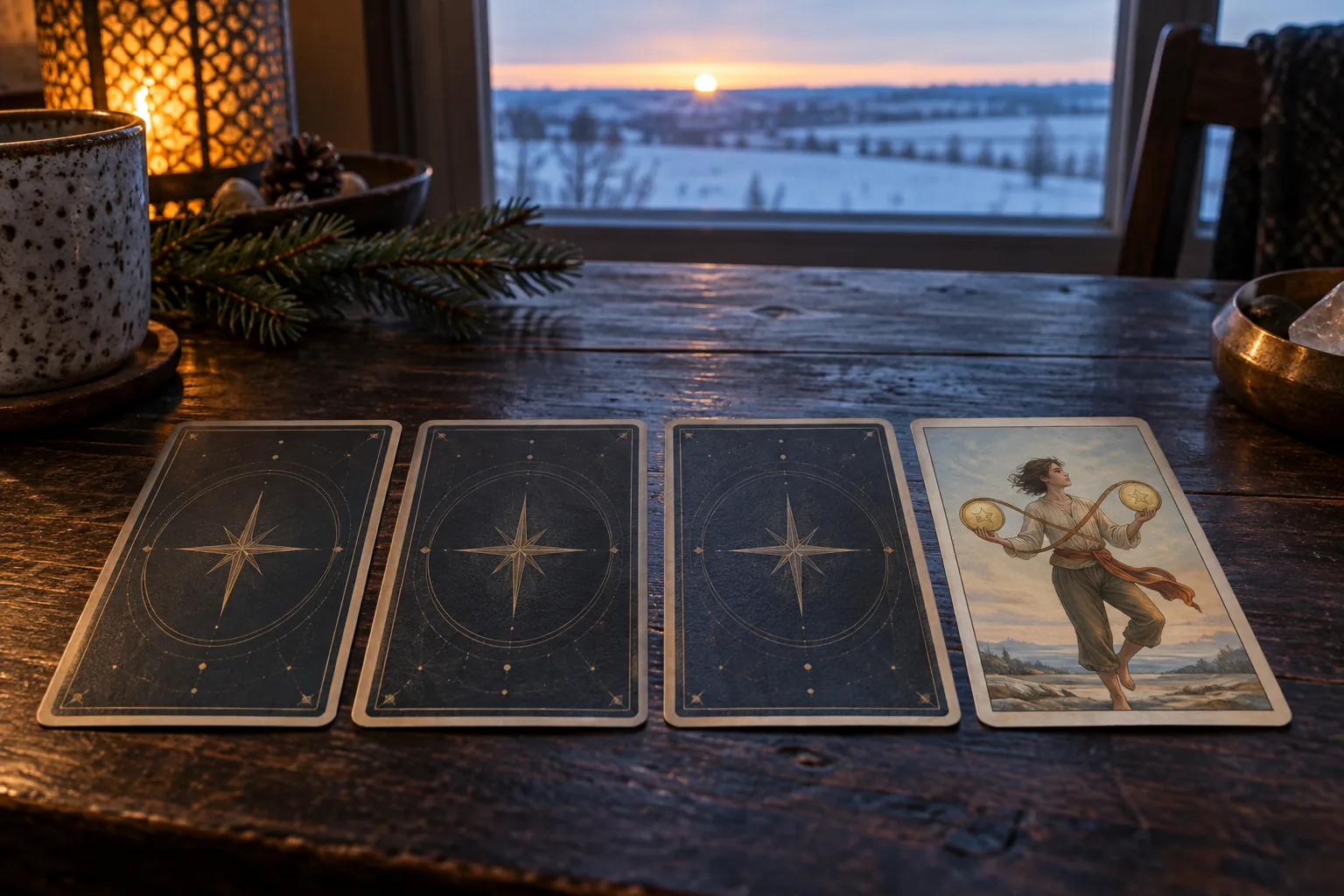
The first ten degrees of Capricorn belong to the Two of Pentacles. The Golden Dawn's Book T names it the Lord of Harmonious Change and calls it "a revolving symbol", describing "the harmony of change, alternation of gain and loss". Waite's 1910 card shows a young man dancing with a pentacle in each hand, the two joined by an endless cord shaped like a figure eight. The Sun stays in that decan from the solstice until late on December 31 IST.
If you followed our Sagittarius season guide, the season before this one closes with the Ten of Wands, a man carrying too many staves. The handover is easy to read. A heavy load goes down, and two things in balance take its place.
A four-card standstill spread
Lay the cards left to right. Each position follows the Sun's movement on the horizon.
- The far point. What has run as far as it can go this year.
- The pause. What needs to stay still for a few days, with no decision forced.
- The turn. What is starting to come back toward you.
- Before the full moon. One small, concrete step to take by December 24.
Write the four cards down with the date. The spread is a prompt for reflection, and the cards do not predict what will happen. Read it again when the latest sunrise comes around January 11, when the mornings finally start to brighten. That second look is often more useful than the first.
An invented example
This is a made-up reading to show how the positions work together.
The question: "What do I carry into next year from this one?"
- The far point: Eight of Cups. A figure walking away from cups it has stacked. Read here, it points to an effort she has already decided to leave, a side business she kept going out of habit.
- The pause: Four of Swords. Rest. She does not need to announce anything this week.
- The turn: Page of Pentacles. A student holding one coin. Something small and practical is returning, perhaps the course she shelved in spring.
- Before the full moon: Two of Pentacles. The decan card itself turning up. Her step: list what she will drop and what she will keep, on one page, by December 24.
The reading did not tell her what next year holds. It gave her a sequence to think through, and the list was her own work.
Other solstice traditions, briefly
The English word Yule has old roots. Bede, writing around 726, said the months the English called Giuli took their name from the day when the Sun turns back and begins to grow. Scholars still debate how the pre-Christian festival was kept. In Ireland, the passage tomb at Newgrange, built around 3100 BC, lets the rising Sun light its inner chamber for about 17 minutes around the winter solstice. The modern archaeologist who first recorded it saw it on December 21, 1967.
If you want to carry one question into the new year, Psychic Maria can take up to three of your questions in a personal email reading. Treat it as one more view to think about. What you do next is up to you. To pick a card for all of 2027 rather than one season, see how to find your tarot year card. For a different layout, see how the Celtic Cross compares with a three-card draw.
Common questions
What time is the winter solstice 2026 in India?
At 2:20 a.m. IST on Tuesday, December 22, 2026. In UTC it is 20:50 on Monday, December 21, per the US Naval Observatory.
Is December 21 or December 22 the shortest day in India in 2026?
Both are almost exactly the same length. In Delhi, the Sun is up for about 10 hours and 19 minutes on each day, with less than a second between them.
Is the winter solstice the same as Makar Sankranti?
No. The solstice is on December 22, 2026 in IST. Makar Sankranti, on or near January 14, marks the Sun entering sidereal Makara, about three weeks later.
What if I draw a hard card in the solstice spread?
Read it by its position, not its name. A Ten of Swords in the far point says something has run its course, which fits the turn of the year. If one card unsettles you, note what it stirs up and look at it again in January.
Which tarot card goes with the winter solstice?
In the Golden Dawn system, the Sun enters Capricorn at the solstice. Capricorn's card is the Devil, and the first decan of Capricorn belongs to the Two of Pentacles, the Lord of Harmonious Change.
One question for the turn of the year
If one question keeps coming back as the year turns, Maria can write a personal reading around up to three of your questions. It is delivered by email within 24 hours, so you can read it next to your solstice spread.
- Her perspective on the question you want to carry into the new year.
- Her reading of what is asking to be set down and what is returning.
- Possible next steps to weigh, in a format you can keep.
Maria’s approach: a USA-based psychic and tarot reader, Maria combines intuition and tarot to read the connection behind your questions. Her focus is on what comes through about the feelings, the blockage, and the path ahead—including where the picture feels mixed.
What you receive from Maria
A personal written reading shaped around up to three questions and the details you share, delivered by email within 24 hours. You provide your questions and relevant details with your order. This is a reading you can keep and return to, not a live call you need to schedule.
View the reading details and current price before ordering. You can review our refund policy and privacy policy at any time.
Sources
- Solstice time: US Naval Observatory, Earth's Seasons and Apsides. Full moon: USNO Phases of the Moon.
- timeanddate.com, Sunrise and sunset times in New Delhi, December 2026, for day length and the solstice in IST.
- Book T, the Golden Dawn's tarot manuscript attributed to Mathers, in a PDF transcription, for Capricorn and the Lord of Harmonious Change.
- Waite's 1910 Pictorial Key to the Tarot on Project Gutenberg, for his Two of Pentacles.
- Wikipedia, Uttarayana, Yule and Newgrange, for the calendar note, Bede and the solstice light.
- Earliest sunset, latest sunrise and the Mumbai figures: computed by us in Python (PyEphem), then compared with timeanddate for December 21 and 22.
A personal reading by Maria
A second view, not a forecast
Share the context that matters and read Maria's perspective in your own time. The choices stay yours.
Your Full Psychic Reading is built around up to three questions and the context you share. Receive your written guidance by email within 24 hours.