
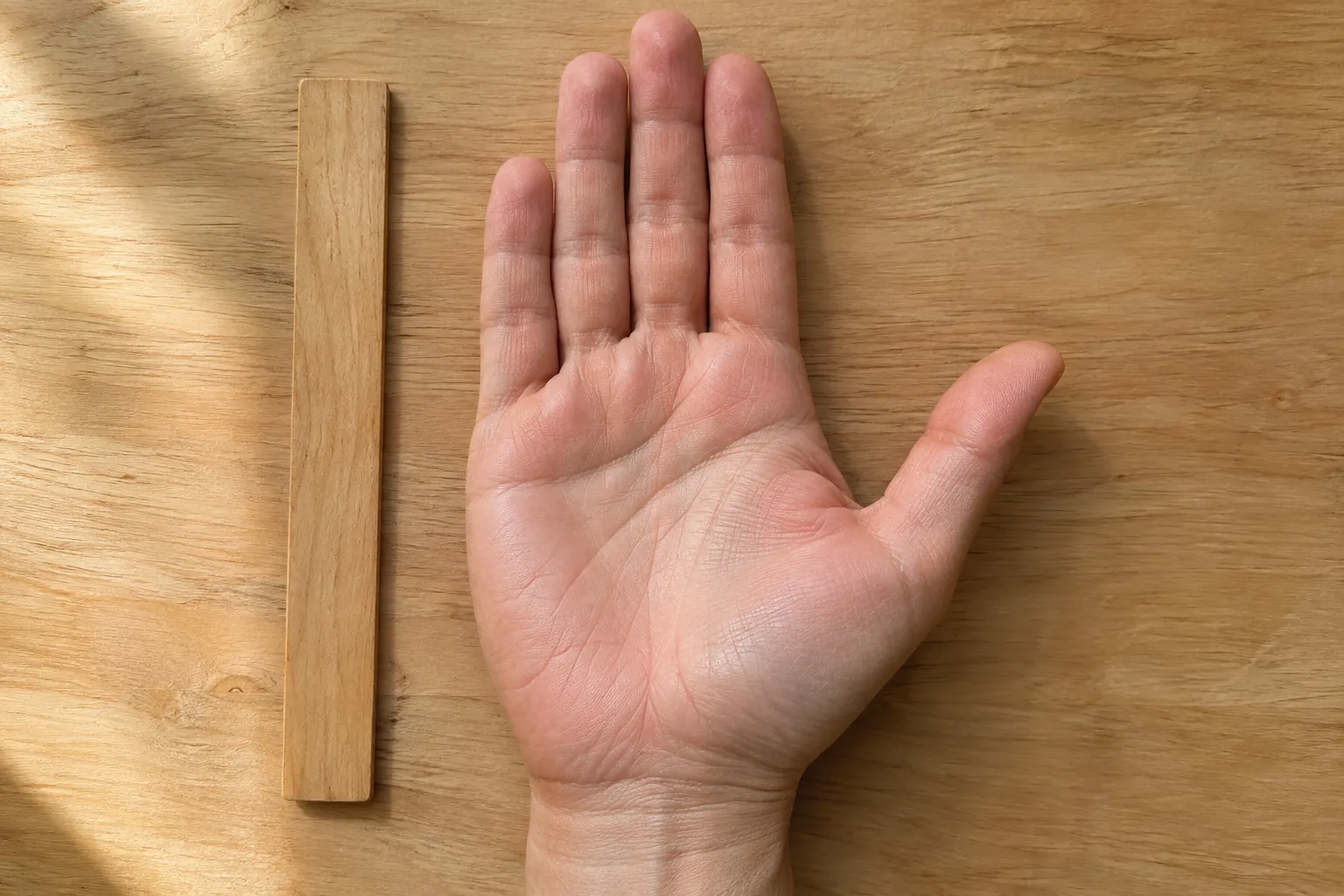
In palmistry, each finger is split into three sections, called phalanges, by the creases across its palm side. Palmists count them from the fingertip down. The top section is read as the mind, the middle as practical life and the bottom as physical comfort and appetite. Whichever section looks longest is said to show where that finger's qualities go. This is a tradition from 19th and early 20th century palmistry books, not a measured finding, and there is no scientific evidence that section length reveals character.
You read that the sections of your fingers mean something in palmistry and want to know which is the first, what each one is said to show, and whether any of it holds up.
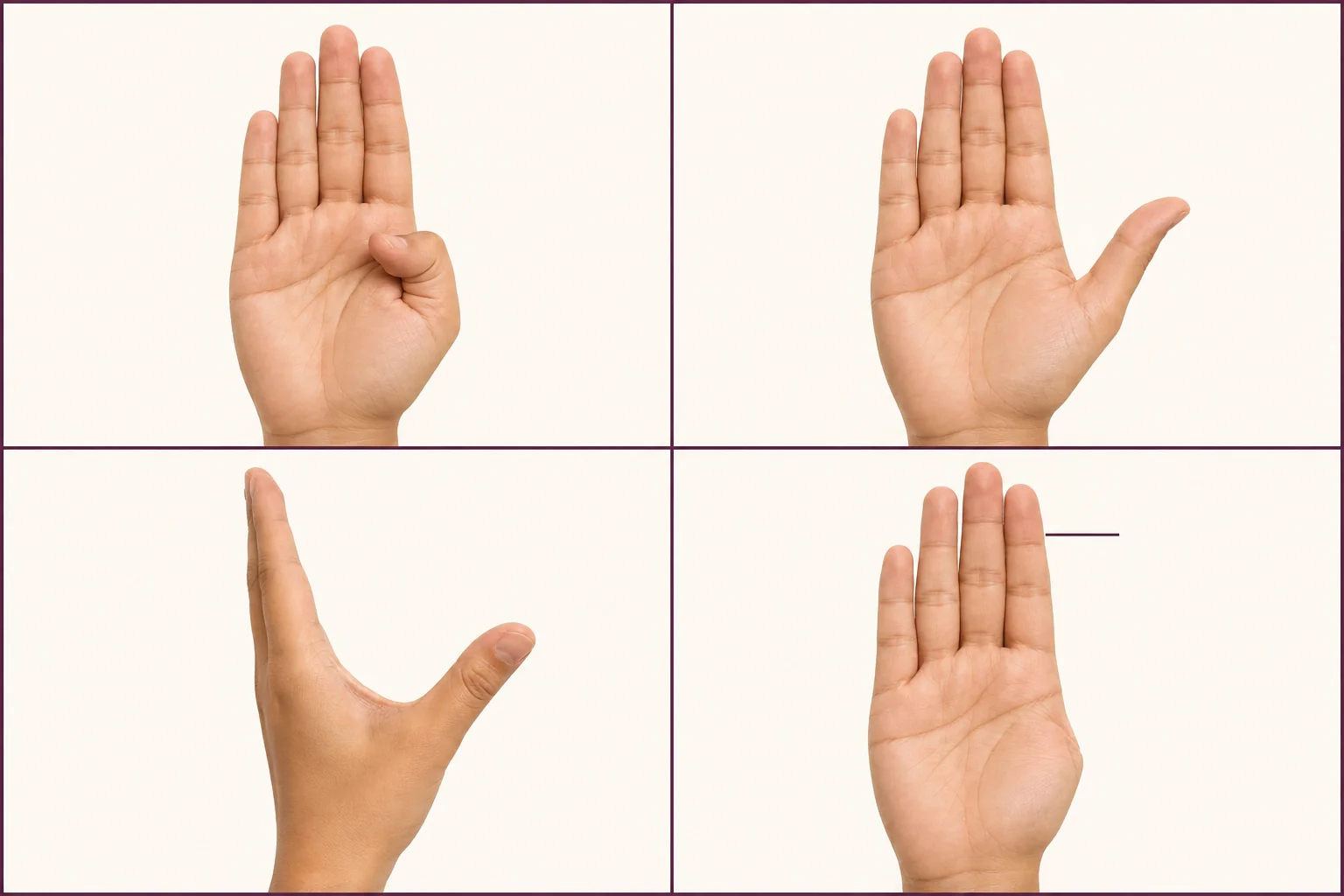
Why palmists and doctors count the other way round
This is the most common source of confusion, so it comes first.
| Palmistry (Benham, 1900) | Anatomy | |
|---|---|---|
| What is counted | Skin sections between the palm-side creases | Bones inside the finger |
| Where counting starts | At the fingertip | At the palm |
| Names | First, second, third phalanx | Distal, middle, proximal phalanx |
| The fingertip section | First | Distal |
| The section nearest the palm | Third | Proximal |
William G. Benham, whose 1900 book The Laws of Scientific Hand Reading shaped much of modern Western palmistry, told readers to examine "the individual phalanges of the fingers, counting first, second, third, from the tip down." Anatomy books do the reverse and name the bones by their distance from the body. So when a palmistry page says "the first phalanx", it means the fingertip section. When a doctor says "the proximal phalanx", they mean the section nearest the palm.
There is a second difference. Palmists measure the skin between creases on the palm side. The bones do not line up neatly with those creases. In a 1993 study, Bugbee and Botte put markers on the creases of 53 hands and X-rayed them. Every finger's base crease turned out to lie 14 to 20 mm toward the fingertip from its knuckle joint. The top crease sat 7 to 8 mm short of the top joint, and the middle crease 2 to 3 mm short of the middle joint. So the base section a palmist measures is much shorter than the bone under it, and the tip section on the skin is longer than the tip bone. Our page on an extra crease on the little finger goes further into what creases are.
The three sections, as palmistry reads them
Benham called the three sections "the three worlds of Palmistry, mental, abstract, and material." In his scheme:
- First section (fingertip). If it is the longest, "the mental will rule." Ideas, study and principles.
- Second section (middle). If it is the longest, "the business side of the type will prevail." Planning, work and practical skill.
- Third section (nearest the palm). If it is the strongest, "the material qualities will prevail." Comfort, food and physical pleasure.
Benham used the same three worlds for the hand as a whole, with the fingers as mind, the middle of the palm as everyday life and the base of the palm as instinct. The phalanges apply that idea to each finger.
Some of his wording has not aged well. He wrote that a strong third section shows "coarseness or brutishness" and that "the extreme thickness of the third phalanx shows a great love for eating and drinking." Modern palmists who use the system usually drop those verdicts and read a fuller base section, if at all, as liking comfort and physical things. We think that is the better choice, because a fleshy base section mostly reflects how much padding a hand has, and that changes with weight, age, work and the weather.
The twelve sections at a glance
Each finger carries its own theme in palmistry. Our finger meanings guide covers those themes. Applying Benham's three worlds to them gives the grid below. Read it as a map of the tradition, not as a test.
| Finger | Usual theme | First section (tip) | Second section (middle) | Third section (base) |
|---|---|---|---|---|
| Index (Jupiter) | Ambition and leadership | Ideals about leading, principles | Organising people and plans | Wanting status and comfort |
| Middle (Saturn) | Duty and seriousness | Study, serious thought | Careful work, steady routines | Practical concern with land, property and savings |
| Ring (Apollo) | Creativity and self-expression | Taste and artistic ideas | Making and showing creative work | Enjoying beautiful and comfortable things |
| Little (Mercury) | Words and trade | Clear thinking and speech | Skill in business and negotiation | Persuasion used for material gain |
The thumb is different. Anatomy gives it two bones, and our thumb guide covers its two sections. Benham counted three by treating the Mount of Venus at the base of the thumb as the third, and Cheiro's 1916 book also describes a "third phalange of the Thumb", which he linked to love. That is a palmistry convention, not a third bone.
How to compare your own sections fairly
Section lengths differ by only a few millimetres, so a careless photo can change the result. If you want to try the system on your own hand:
- Use the palm side. Palmistry measures between the creases, not between the knuckles on the back.
- Straighten the fingers. Rest your hand flat on a table, fingers together and straight, not stretched back.
- Take one photo from directly above, in even daylight, with a ruler beside the hand.
- Measure each section from the middle of one crease to the middle of the next. For the first section, measure from the top crease to the tip, not counting the nail.
- Compare within a finger, not across fingers. The question is which of a finger's own three sections is longest. A little finger is shorter than an index finger for everyone.
- Write the numbers down before you look up meanings. That way the reading cannot shape what you think you measured.
On most fingers the sections are close in length, and many hands show no clear winner. In that case, the tradition has little to say, and that is a fair result.
What the sections can and cannot tell you
Finger proportions are real and vary from person to person. What is missing is any evidence that the length of a skin section between two creases predicts how someone thinks or behaves. We know of no study that has tested Benham's three worlds, and his book gives no data for them. If you want to see how palm reading claims hold up when you test them on yourself, our page on testing palm reading with your own hands sets out a simple method.
A few things are sometimes mistaken for a long or short section:
- An extra crease can split a section and make it look as if a finger has four. A reader on r/palmistry described this exactly: "The lower phalange of the ring finger is divided into two. So it looks like you have four phalanges there." (thread). It is still three bones.
- A swollen or knobbly joint changes how sections look. The knotted vs smooth joints guide covers what palmistry says about joints, and when a change in a joint is something to show a doctor.
- A finger that curves or will not straighten makes measurement unreliable. If a finger has changed shape, hurts or is stiff, that is a question for a doctor, not a palm reader.
Common questions
What are phalanges in palmistry?
They are the three sections of each finger between its creases. Palmists count them from the tip down and read the first as the mind, the second as practical life and the third as physical comfort. The longest section is said to show where that finger's qualities go.
Which phalanx is the first one?
In palmistry, the first phalanx is the fingertip section. In anatomy the naming runs the other way, and the bone at the fingertip is called the distal phalanx.
What does a long bottom section of a finger mean in palmistry?
Benham read a long or thick third section as a strong pull toward comfort, food and physical pleasure. Many modern palmists soften that to liking comfort. A fleshy base section mostly reflects padding, which changes with weight, age and work.
How many phalanges does the thumb have?
Two bones. Some palmistry books, including Benham and Cheiro, count three. Benham treats the Mount of Venus as the thumb's third section. That is a reading convention, not a third bone.
Can phalanges reveal personality?
There is no scientific evidence that they can. The three-section reading is a tradition from palmistry books around 1900. Treat it as a way to look closely at your hands, not as a personality test.
Sources
- Benham WG. The Laws of Scientific Hand Reading (1900). Reprint sections "The Fingers In General, Continued", "The Hand As A Whole" and "The Thumb" at chestofbooks.com.
- Cheiro. Palmistry for All (1916), full text at Project Gutenberg eBook 20480.
- Radiopaedia, Phalanges of the hands.
- Johns Hopkins Medicine, Anatomy of the hand.
- Bugbee WD, Botte MJ. Surface anatomy of the hand: the relationships between palmar skin creases and osseous anatomy. Clinical Orthopaedics and Related Research 296 (1993): 122 to 126.