
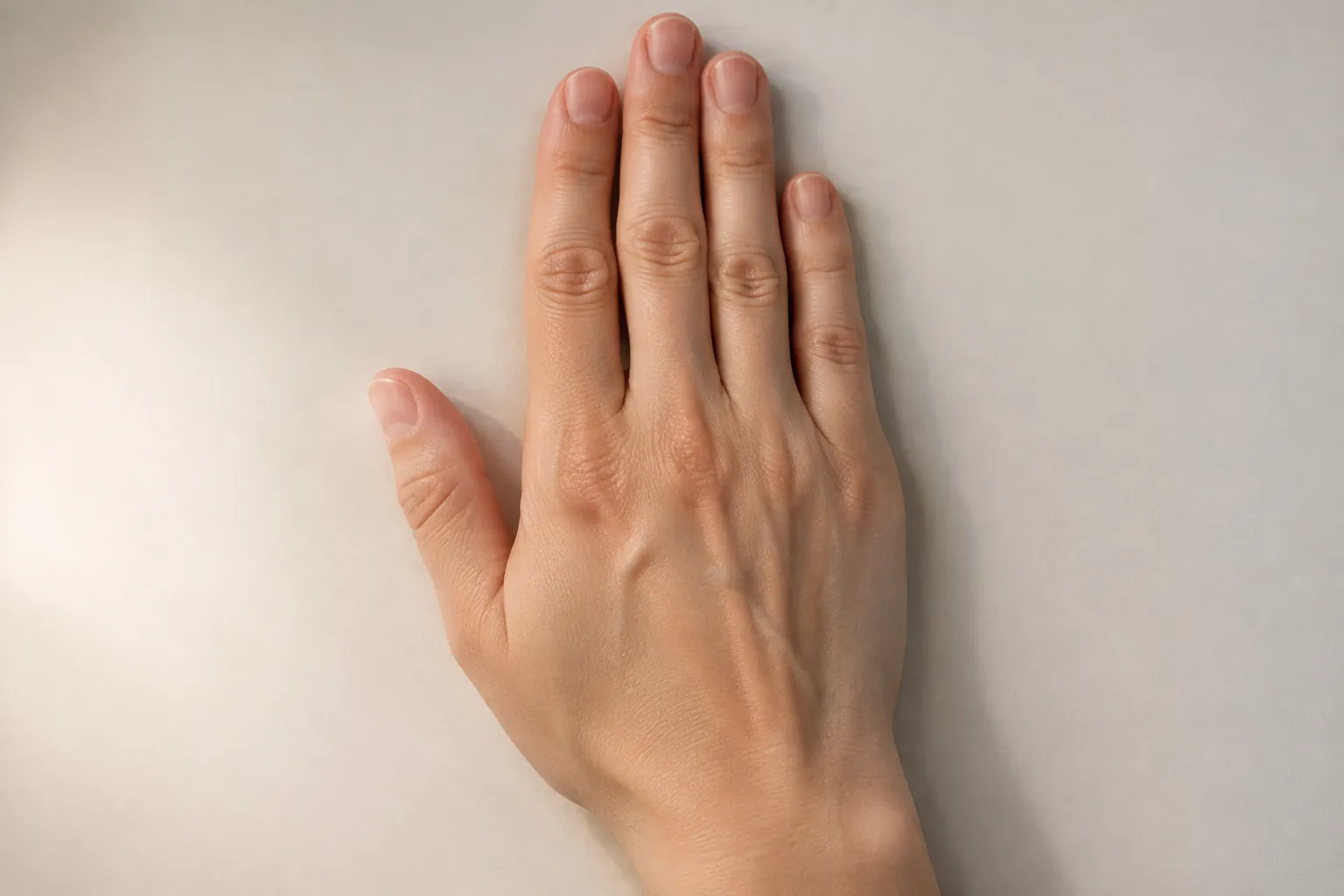
In palmistry, knotted fingers have joints that stand out wider than the finger between them, and smooth fingers run straight from base to tip. The old books read knots as a careful, analytical habit of mind and smooth joints as quick and impulsive. That is a tradition, not a measurement. And a knot you were not born with, or one that hurts, is a matter for a doctor rather than a palm reader.
Your finger joints look wider than other people's, and you want to know what palmistry makes of that and whether it is anything to worry about.
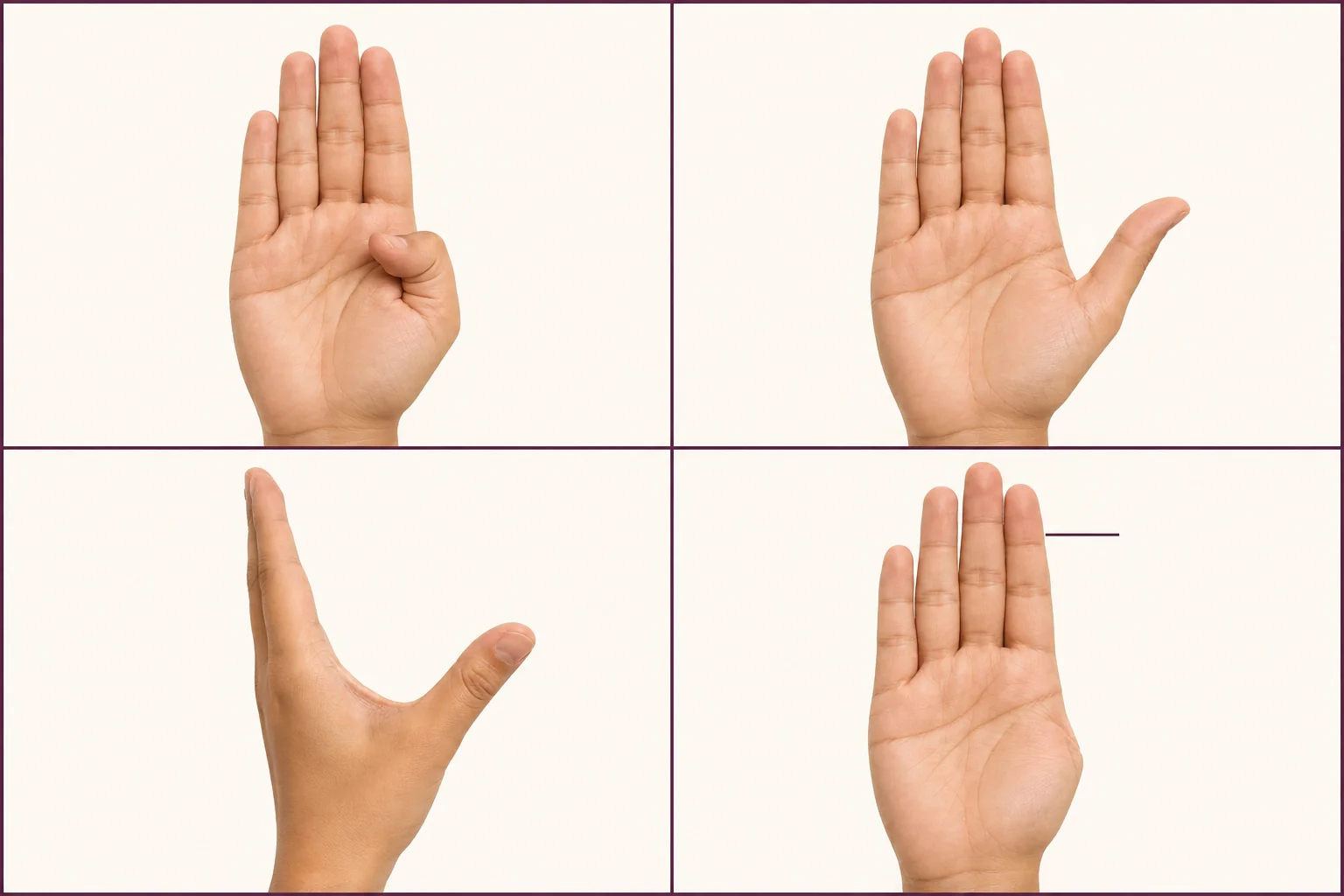
This page shows you how to tell the two apart, what the classic texts actually said, and how to separate a lifelong joint shape from a change worth getting checked.
How to tell knotted from smooth in thirty seconds
Use a good light and look at the back of your hand, then from the side.
- Hold your hand out flat, fingers together. Look at the gaps between the fingers. Smooth fingers touch along most of their length. Knotted fingers touch at the joints and leave small gaps between them, a little like a string of beads.
- Run a fingertip along each finger from the side. On a smooth finger it glides. On a knotted finger you feel a clear rise at one or both joints.
- Note which joint stands out. Palmists name two. The upper knot sits at the joint nearest the nail. The lower knot sits at the middle joint.
- Compare both hands. Lifelong knots are usually similar on both. One swollen joint on one hand is a different question (see the lookalikes below).
This is not about the big knuckles that stand up when you make a fist. Those are the joints where the fingers meet the hand, and everyone has them. The old texts mean the two joints further along each finger.
A line, not a bump? See extra finger creases.
Most hands are somewhere in between. You may have a clear lower knot on two fingers and none anywhere else. That is ordinary.
What the old books said
The knotted and smooth split comes from nineteenth-century hand reading, and the best-known English source is Cheiro (William John Warner). In Palmistry for All he wrote that "the knotted or jointed fingers give carefulness and detail in work or study. They arrest the impulse of the brain, and so acquire time for thought and reflection."
He set this against smooth joints: "Smooth-jointed fingers are more impulsive than those with 'knotty joints'." He tied knots to people who "require thought and reflection in carrying out their plans".
Cheiro also gave knots a whole hand type, the Philosophic Hand, "long, bony, and angular with knotty joints". In his earlier book he went further and attached it to particular religions, nations and famous men. Those claims are a product of his time and of his own opinions, and nobody has tested them.
Many palmists, before and after Cheiro, split the idea into two named knots. The names vary from book to book, so treat the table as common usage rather than a fixed rule.
| Knot | Where it sits | Name some palmists use | Traditional reading |
|---|---|---|---|
| Upper | Joint nearest the nail | Knot of philosophy, or mental order | Thinks things through, questions ideas before accepting them |
| Lower | Middle joint | Knot of material order | Likes method, tidiness and a plan for practical things |
| Neither | Smooth fingers | Smooth or "impulsive" fingers | Quick impressions, acts on feeling, sees the whole before the parts |
Our Mount of Saturn guide uses the same vocabulary in one table row. This page is the full version.
Why the tradition is a reflection prompt, not a verdict
We looked for studies that measured finger joint shape and personality in the same people and found none. Joint width depends on bone shape, the soft tissue around the joint, how slim your fingers are and, over time, on wear and age. A thin person's joints look more prominent than the same joints on a fuller hand.
So use the reading as a question, not an answer. If someone tells you knotted fingers mean you are analytical, ask yourself whether that fits. If it does not, the shape of your knuckles has not proved you wrong.
Online you may also see bolder claims tied to knots, such as trouble speaking your mind, a set career or a health event. Those go well beyond even the old books, and you can set them aside.
Knots that are not a palmistry type
Some bumps at finger joints have a medical cause. They often appear later in life, can change, and may hurt. A palm reader should not interpret them.
| What you see | Where | What it usually is | What to do |
|---|---|---|---|
| Firm, bony bumps that appeared in adulthood | Joint nearest the nail | Heberden's nodes, a sign of hand osteoarthritis | See a GP or doctor, especially with pain or stiffness |
| The same, at the middle joint | Middle joint | Bouchard's nodes, also osteoarthritis | As above |
| A smooth, firm, skin-coloured pad on the back of the joint | Most often the middle joint | Knuckle pads (Garrod's pads), a harmless thickening | Usually no treatment. Ask a doctor if it grows or hurts |
| Warm, puffy, tender joints, often on both hands | Small joints of hands and wrists | Possible inflammatory arthritis such as rheumatoid arthritis | See a doctor promptly |
| Rough, thick skin over the knuckle from rubbing | Any joint | A friction callus from work or a habit | Ease the rubbing and moisturise |
| A sideways bend at a joint | Any finger joint | Can come with osteoarthritis or an old injury | Get it checked if it is new or getting worse |
Arthritis UK describes the nodes of hand osteoarthritis as "firm, knobbly swellings at the finger joints" caused by bony spurs. It notes that the pain may settle after a few years but the nodes remain. The NHS says joints may look "slightly larger or more 'knobbly' than usual" and advises seeing a GP for persistent symptoms.
Knuckle pads are more common than many people think. A case report in the Royal Australian College of General Practitioners' journal cites a Norwegian survey in which about 9 percent of nearly 1,900 people had them. DermNet describes them as well defined, smooth, firm thickenings that usually cause no symptoms.
The key test is time. A knot you can see in childhood photos and that never hurts is a shape. A bump that arrived recently, changed, or comes with pain, warmth or stiffness is a symptom.
A side-by-side check you can do with two photos
If you are curious whether your joints have changed, compare old and new photos rather than relying on memory.
- Find a clear photo of your hands from at least five years ago.
- Take a new photo in the same pose: back of the hand, fingers together, flat on a table, in daylight.
- Look at each joint in turn and note "same", "wider" or "not sure".
- Note anything you feel, such as morning stiffness, pain when gripping or a joint that looks red.
Here is an example of how a filled-in sheet might look. It is invented for illustration and is not anyone's real result.
| Finger | Upper joint | Middle joint | Feel |
|---|---|---|---|
| Index | Same | Same | Nothing |
| Middle | Wider | Same | Stiff in the morning |
| Ring | Same | Same | Nothing |
| Little | Same | Same | Nothing |
In that invented example, the middle finger's upper joint has widened and feels stiff. That is the kind of change to show a doctor. The rest of the hand is simply its usual shape.
How knots fit with the rest of the hand
Palmists rarely read one feature alone. Joint shape is usually read alongside the fingertips, finger length and the overall hand shape. For example, many readers would see square fingertips plus lower knots as a strongly methodical combination, and pointed tips plus smooth joints as a strongly impressionable one. Those are readings, not findings. Our finger meanings guide covers each finger, and the hand shapes guide covers the element system that most modern readers use instead of Cheiro's seven types.
The thumb guide covers the thumb's own joint, which palmists read separately. If you are new to all of this, start with how to read palms for beginners.
Common questions
What does it mean to have knotted fingers in palmistry?
Traditional palmistry reads knotted fingers as a careful, analytical habit of mind, someone who stops to think before acting. It is a traditional interpretation that has not been tested, so treat it as a prompt for reflection.
What are philosophic knots?
It is a palmistry name for a prominent joint nearest the fingernail. The tradition links it to questioning ideas. The middle joint, when prominent, is called the knot of material order.
Are knotted fingers a sign of arthritis?
Not always. Many people have naturally prominent joints all their lives. But bony bumps that appear in adulthood, especially with pain or stiffness, can be a sign of osteoarthritis and are worth showing to a doctor.
Can smooth fingers become knotted?
Joints can look larger with age, weight loss or arthritis. A change you can see between old and new photos is a reason for a medical check, not a new palm reading.
Do knotted fingers mean you are smart?
No. Neither the old books nor any study links joint shape to intelligence. The tradition talks about a style of thinking, not ability.
Sources
- Cheiro, Palmistry for All (1916), sections on the Philosophic Hand and on knotty and smooth joints, full text at Project Gutenberg eBook 20480.
- Cheiro, Cheiro's Language of the Hand, chapter "The Philosophic Hand", Library of Congress record of an 1898 edition.
- NHS, Rheumatoid arthritis: symptoms.
- NHS, Osteoarthritis: symptoms.
- Arthritis UK, Osteoarthritis of the hand and wrist.
- Cleveland Clinic, Heberden's nodes.
- DermNet, Knuckle pads.
- Royal Australian College of General Practitioners, Enlarging knuckle bumps, Australian Family Physician (October 2015).
- The two-photo comparison sheet is invented for illustration.