
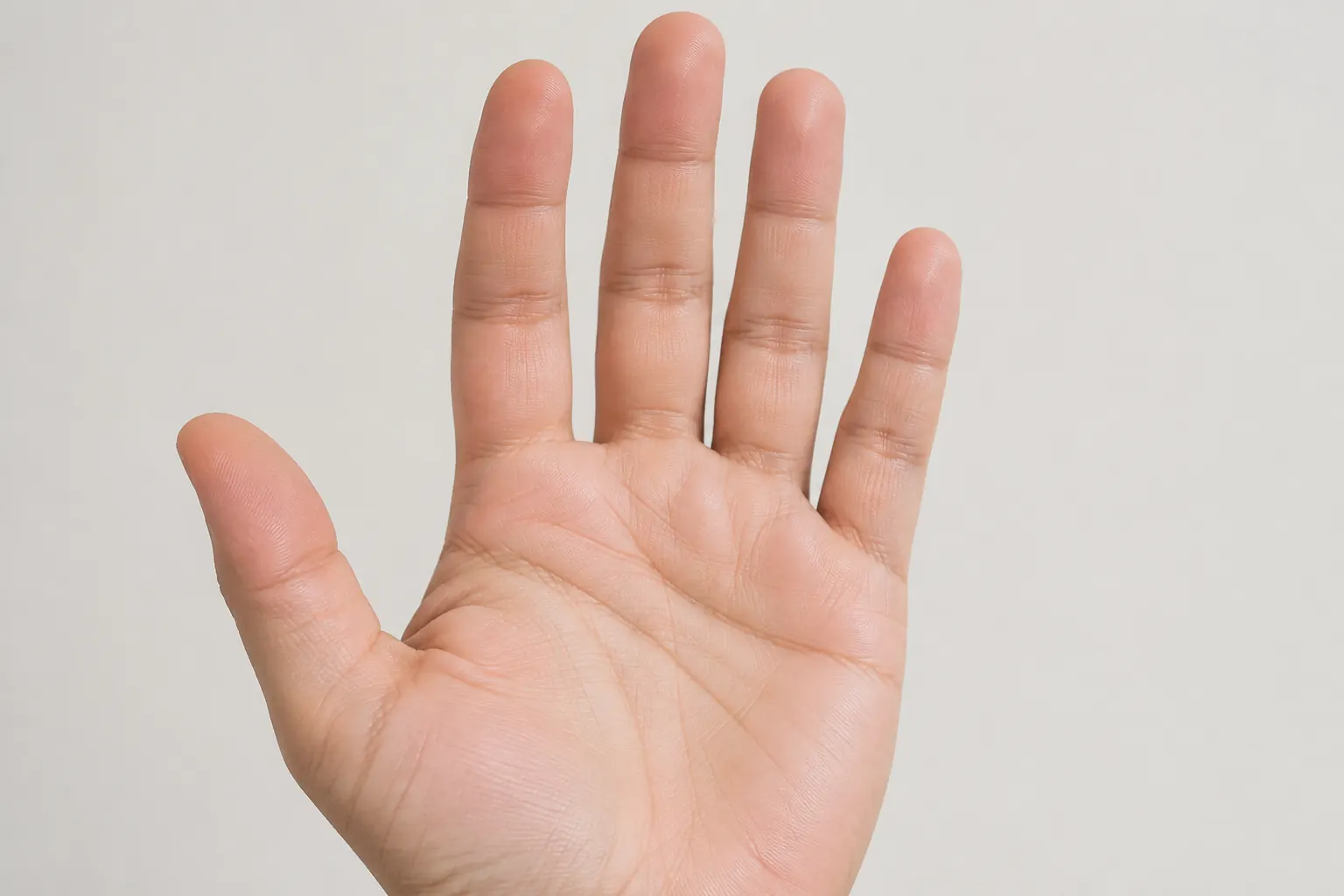
An extra crease on your pinky finger is a skin line, not an extra joint. Most little fingers have three creases on the palm side. A few have four, usually with the extra one in the bottom section. X-rays in a 1978 study found normal bones and joints under every extra crease they checked. Palmistry has no agreed meaning for it. Some modern readers treat it like a long little finger, a sign of ease with words. Others read it as a hold-up in the same area. Neither view has evidence behind it, and the crease is not a medical diagnosis.
You noticed an extra line on your little finger, or one fewer than other people have, and want to know what it is and whether palmistry reads anything into it.
What a typical little finger looks like
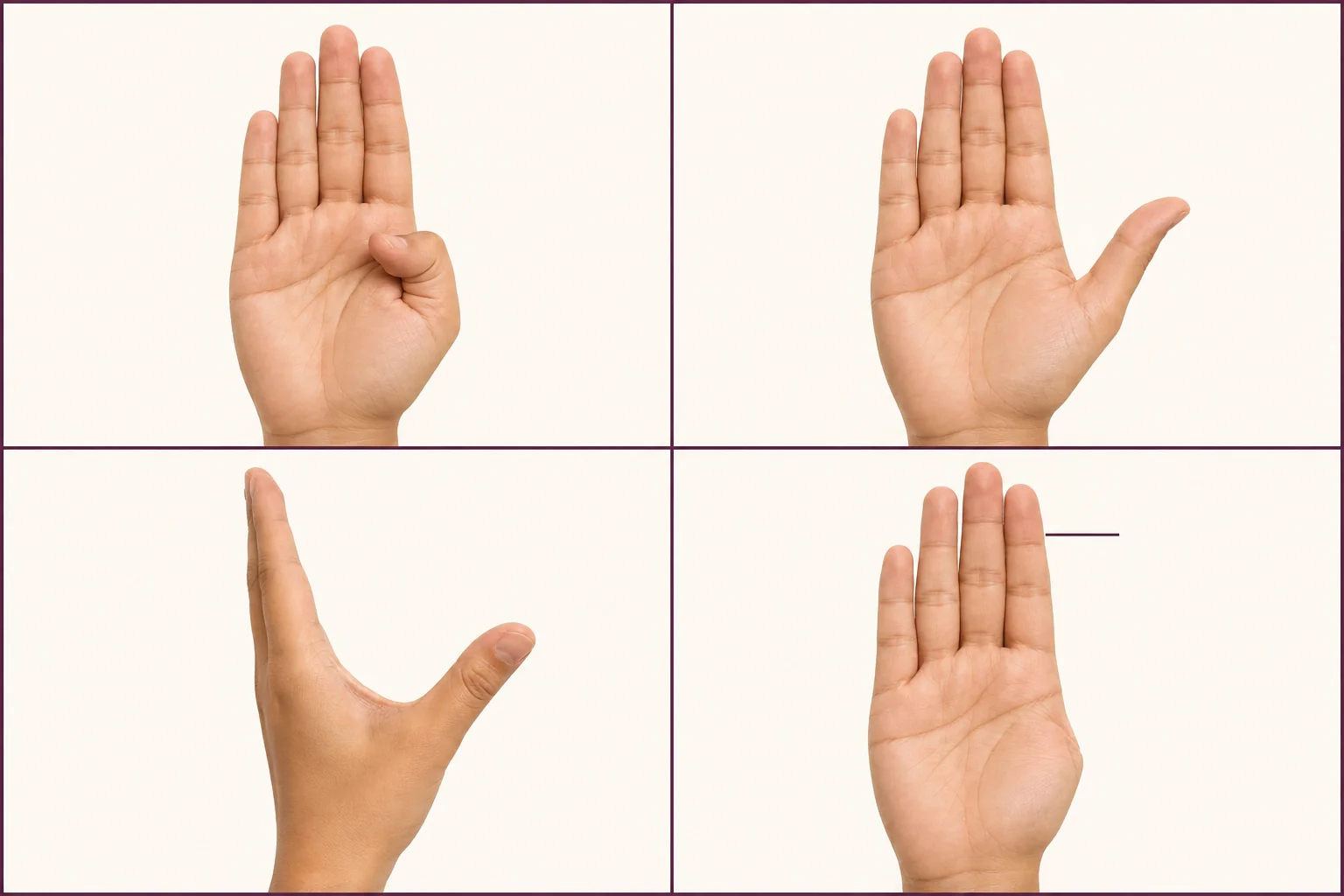
Turn your hand palm up and relax it. On most little fingers you will see three creases across the palm side.
- The base crease, where the finger meets the palm.
- The middle crease, near the middle joint.
- The top crease, near the joint below the fingertip.
Creases are folds where the skin is anchored more firmly to the tissue underneath, so it can bend without bunching. They sit close to the joints, but not exactly on them. In a 1993 X-ray study of 53 hands, the middle and top creases sat 2 to 8 mm nearer the palm than their joints. The base crease sat 14 to 20 mm further out than the knuckle joint, which is hidden under the palm. So a crease marks where the skin folds. It does not count your bones.
Check what you actually have
Look at both hands in good daylight, palm up, fingers straight but not stretched. Then match what you see to this table.
| What you see | What it usually is |
|---|---|
| A fourth line in the bottom section, between the base and middle creases | An extra crease. This is the spot the 1978 and 2017 studies describe |
| Two lines very close together at the middle joint | A doubled middle crease. Hand anatomy texts describe two creases at the middle joint as the usual pattern, so this is one crease in two parts |
| Only two creases, with one missing | A missing crease. See the section below before you search further |
| A line that runs at a slant or stops halfway | Often a fine wrinkle or a scar from an old cut, not a flexion crease |
| A dent where you wear a ring | Pressure from the ring. It may fade if you stop wearing it |
| Short lines on the outer side of the hand, under the little finger | Not a finger crease. Palmists call these marriage or relationship lines |
Palmists also read the skin sections between these creases. See finger phalanges in palmistry.
It can be on one hand or both, so check each. If you want to show it to someone, photograph the palm side of the finger straight and relaxed, without pressing it against glass. Our palm photo guide covers lighting.
How rare is an extra pinky crease?
Only a few studies have counted it, and they found different rates in different groups.
| Study | Who was checked | What they found |
|---|---|---|
| Komatz, Daijo and Yoshida, Japan, 1978 | 551 people (1,102 little fingers) | 4 people had an extra crease on the little finger, 6 fingers in all. X-rays showed no bone or joint anomaly in any of them |
| Dey and Kapoor, North India, 2017 | 307 adults aged 18 to 60 from one community in Uttar Pradesh, with no history of hand disease | 23 people (about 1 in 13) had an extra crease on at least one finger. The ring finger was the most common. By our count of the paper's table, 10 little fingers in 9 people had one |
So it is uncommon, and the rate depends on who is checked. Two studies cannot give a world figure.
What palmistry says about it
The older palmistry books we checked do not give a rule for an extra finger crease. Cheiro's Palmistry for All (1916) talks about the little finger's length, not its creases. He wrote that a little finger "passing the nail joint of the third" is "indicative of power of speech and subtlety in choice of language".
Modern readers have filled the gap in opposite ways.
- Like a long little finger. One reply on Reddit's r/palmistry said an extra crease "generally means the same as having a long little finger: talent and facility for speaking, writing, communication" (thread).
- A block in the same area. Some practitioner pages read the same line as hesitation or holding back in speech.
- Nothing at all. Some readers leave finger creases out and read only length, set and shape. Our finger meanings guide takes that approach.
When one tradition calls a mark a gift and another calls it a block, the mark is not settling the question. If you enjoy palmistry as reflection, turn it into a question for yourself. Do I find it easy to say what I mean? Then read it with the rest of the hand. Our Mount of Mercury guide covers the area under the little finger.
What if a crease is missing?
People who search for an extra crease often find the opposite: a little finger with only two creases. Medical papers list a single crease on the little finger among features seen in some genetic conditions, including Down syndrome. The same literature also reports it in people with no condition at all, such as a 2012 report of a 28-year-old man with no other unusual features and a single crease on both little fingers.
Doctors diagnose those conditions from many signs and tests, not from one crease. A palm reading cannot do it from a photo either. If you are an adult with no other concerns, a crease pattern you have had all your life is a feature of your hand. If you are worried, or you are asking about a baby or child, talk to a doctor.
Easy to mix up
- A single palm crease. One line across the palm where most people have two. MedlinePlus says it appears in about 1 in 30 people and is often normal. See our simian line page.
- A bent little finger. A pinky that curves toward the ring finger is called clinodactyly. Cleveland Clinic describes it as a bone shape that is usually harmless and affects how the finger looks, not how it works.
- Bumpy or swollen joints. These are about the joint, not the crease. Our page on knotted and smooth finger joints shows which bumps a doctor should look at.
If a finger has become painful, stiff or swollen, that belongs with a doctor, not a palm reading.
Common questions
What does an extra line on the pinky finger mean?
It is usually an extra skin crease, most often in the bottom section of the little finger. It is uncommon and has no proven link to personality or health. Some palmists read it like a long little finger, a sign of ease with words, and others read it as a block. There is no agreed meaning.
Does an extra crease mean I have an extra bone or joint?
No. Creases are skin folds. In the 1978 Japanese study, X-rays of the little fingers with an extra crease showed normal bones and joints.
Is a missing crease on the little finger a sign of a medical condition?
Not on its own. A single little-finger crease is listed among features of some genetic conditions, but it is also found in healthy people. Doctors diagnose those conditions from many signs and tests. If you are worried, ask a doctor.
Can finger creases change over time?
The main finger creases form before birth, in the first months of pregnancy, according to embryology studies. Fine wrinkles, ring marks and scars can add lines later that look like creases. If a finger changes shape, swells or hurts, see a doctor.
Sources
- Komatz Y, Daijo K, Yoshida O. Extra interphalangeal transverse creases of the little finger. Japanese Journal of Human Genetics 23 (1978): 31 to 36.
- Dey S, Kapoor AK. Relevance of extra digital flexion creases: a study in North India. Journal of Forensic Science and Criminology 5(4): 404 (2017).
- Bugbee WD, Botte MJ. Surface anatomy of the hand: the relationships between palmar skin creases and osseous anatomy. Clinical Orthopaedics and Related Research 296 (1993): 122 to 126.
- Meštrović T, Ožegić O. Single bilateral interdigital flexion crease of the fifth finger in a phenotypically normal male. International Journal of Anatomical Variations 5 (2012): 113 to 115.
- Doyle JR, Botte MJ. Surgical Anatomy of the Hand and Upper Extremity (2003), section on palmar and digital flexion creases.
- Kimura S, Kitagawa T. Embryological development of human palmar, plantar, and digital flexion creases. The Anatomical Record 216 (1986): 191 to 197.
- Cheiro, Palmistry for All (1916), full text at Project Gutenberg eBook 20480.
- MedlinePlus, Single palmar crease. Cleveland Clinic, Clinodactyly.