
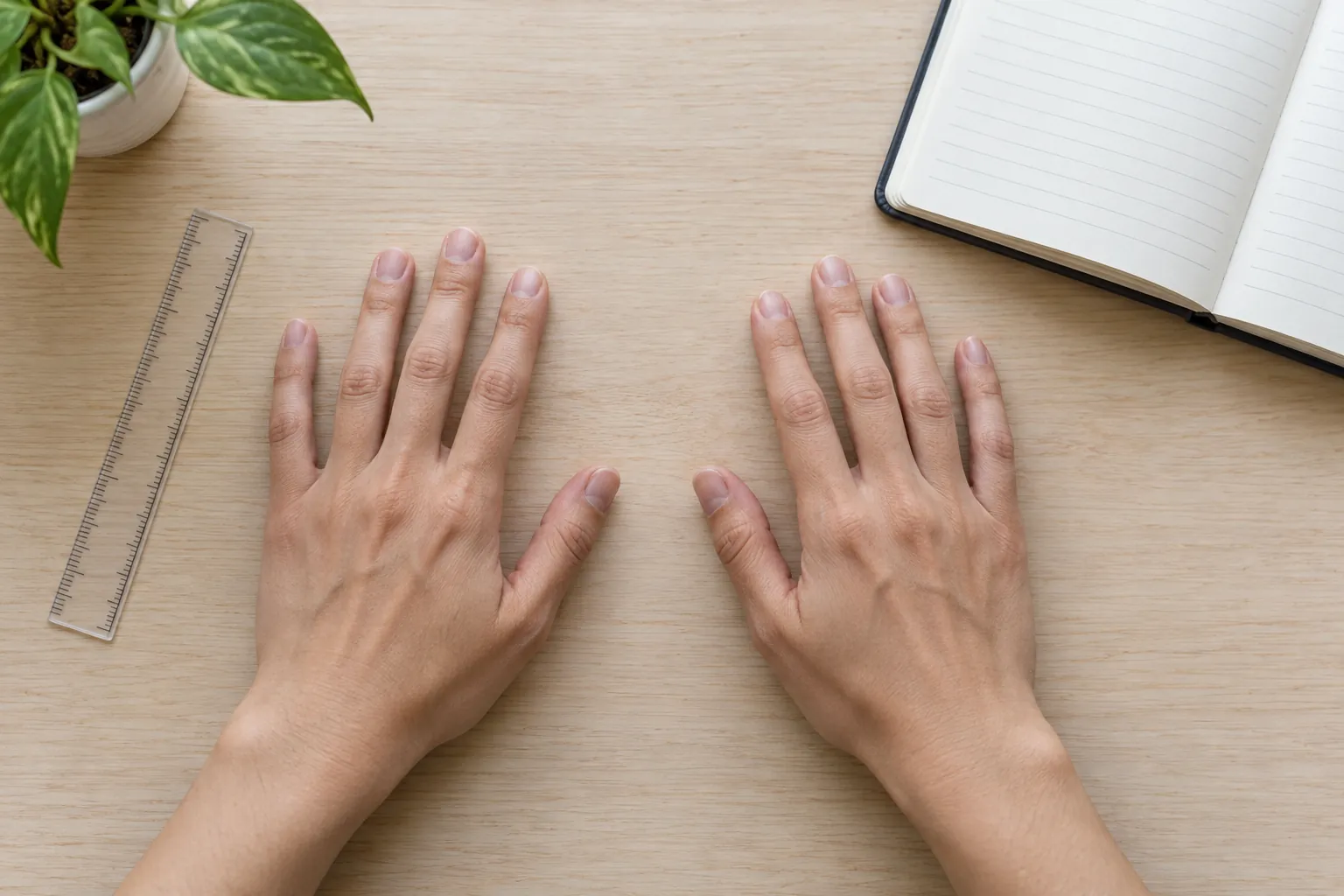
In palmistry, fingernails are read for temperament. The classic system, from the palmist Cheiro in 1897, sorts nails into long, short, broad and narrow. Long nails are said to belong to calm, artistic, impressionable people, short nails to sharp, critical ones, and nails wider than they are long to people who worry and meddle. That is tradition, not evidence. No study has shown that nail shape reveals character.
A palmistry chart told you your short nails mean a critical mind, and a friend said your white spots mean you lack calcium. You want to know which of it means anything.
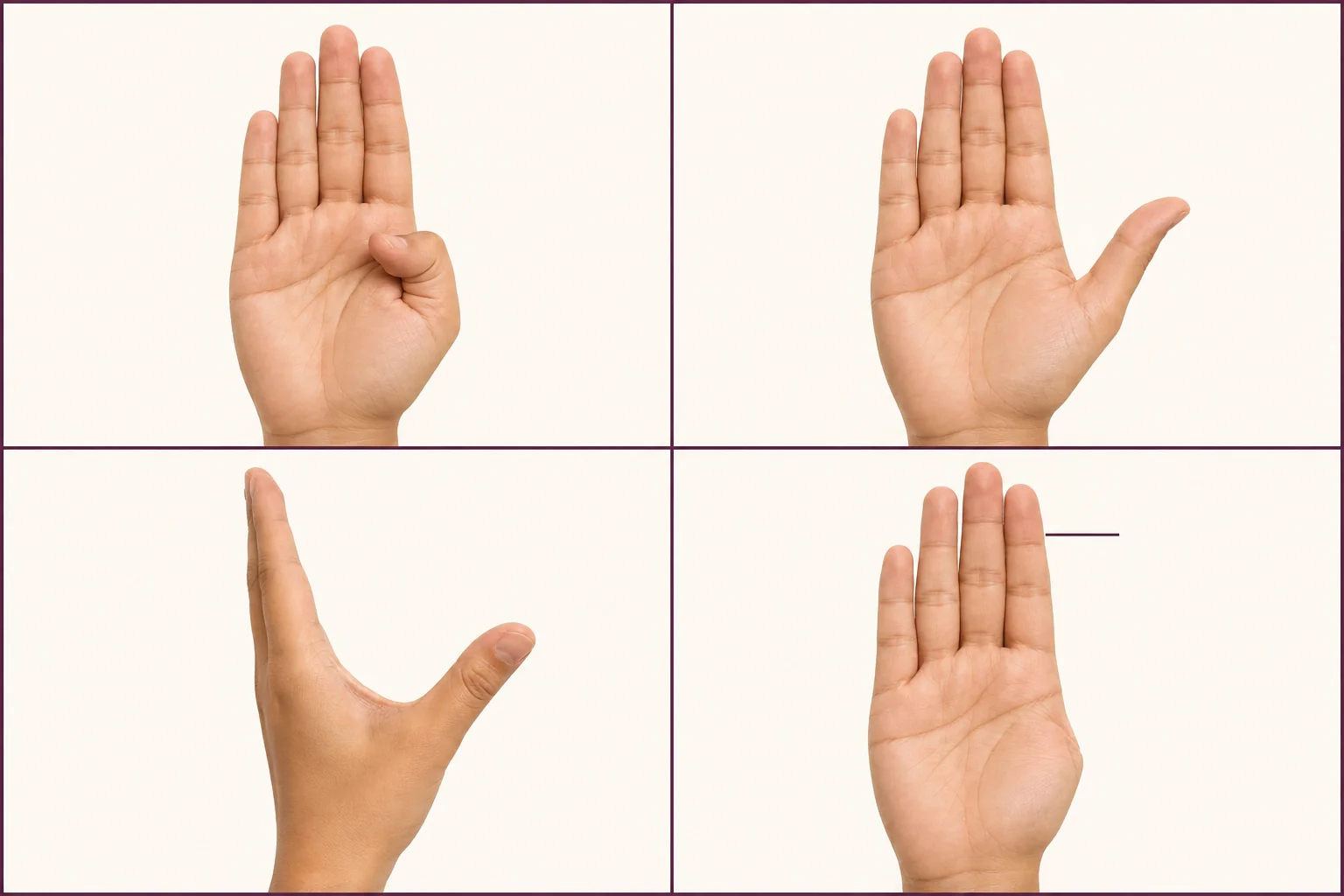
Doctors look at the same nails for different reasons, and some of what they look for matters. A few nail changes can point to illness elsewhere in the body, and a new dark streak under a nail should be checked for skin cancer. This guide puts the two readings side by side, so you can enjoy the palmistry and still know which signs belong with a doctor. It does not diagnose anything. If something in it worries you, take your hands to a GP or dermatologist.
Cheiro's four kinds of nail
Most nail lore you find online goes back, directly or by copying, to Cheiro's Language of the Hand (1897). Behind the pen name was Louis Hamon, the best-known society palmist of his day. His chapter on nails is short, and it opens with health rather than character: "Particularly as regards health, and the diseases likely to affect the subject, the nails will be found to be remarkably sure guides."
He made three rules that later charts kept.
- Four classes. "Nails are divided into four distinct classes: long, short, broad, and narrow." The square, almond, oval and fan shapes on modern charts are later additions. They are not in his chapter.
- Care does not matter. He wrote that "the care of the nails does not alter or affect their type in the slightest degree", whether they are broken by work or polished every morning. You read the shape of the nail bed and plate, not the length someone has filed them to.
- Health first, then disposition. Half the chapter is about illness, which is the part modern readers should handle with the most care.
His character readings are vivid. Long nails mean people who are "calmer in temper and more gentle", and he adds "Such nails indicate great ideality". They also show "an artistic nature", but such people are "inclined to be visionary, and shrink from looking facts in the face". Short nails mean people who are "extremely critical, even of things relating to self", and "Short-nailed individuals make the best critics". Broad nails: "When the nails are broader than they are long, they indicate a pugnacious disposition, also a tendency to worry and meddle". Bitten nails: "Nails short by the habit of biting indicate the nervous, worrying temperament."
One nail, two readers
The left column gives Cheiro's reading, quoted or closely paraphrased. The middle column gives what medical sources say about the same feature. The right column says what to do with it.
| What you see | The palmist's reading (Cheiro, 1897) | What doctors say | What to do |
|---|---|---|---|
| Long nails | Gentle, artistic, idealistic. More prone to chest and lung trouble | Doctors do not treat nail length on its own as a medical sign | Enjoy the palmistry reading |
| Short nails | Critical, logical, quick-tempered. A family tendency to heart trouble | No link between short nails and heart disease is recognised | Enjoy the palmistry reading. Ignore the heart claim |
| Broad nails (wider than long) | Combative, a worrier, a meddler | No medical meaning on its own | Palmistry only |
| Large or absent half-moons | "Large moons indicate good circulation." Little or no moons with short, thin nails: "sure signs of weak action of the heart" | The half-moon (lunula) is the visible edge of the nail matrix. Everyone has one, but it is often hidden under the cuticle and shrinks with age. Missing moons are usually no concern on their own | No action unless the colour changes or you have other symptoms |
| White spots or flecks | Spots are signs of "a highly strung nervous temperament" | Usually minor injury to the nail, such as knocks, biting or rough manicures. Spots grow out over six to nine months | Wait for it to grow out. See a doctor if spots keep appearing with no knocks |
| Ridges running lengthwise | Fluted nails make his long-nail chest warning worse | Lengthwise lines are common, increase with age and are usually nothing to worry about | No action |
| A groove running across the nail | Not described | A Beau's line. Something slowed nail growth for a while, such as a fever, injury, chemotherapy or major stress | See a doctor if you cannot think of a cause |
| Nails curving down over swollen fingertips | Very long, much-curved nails point to "chest and lung trouble" | Clubbing. It develops slowly and can be linked to lung, heart, liver or digestive disease. Sometimes it simply runs in families | See a doctor if it is new or getting worse |
| Thin nails that dip like a spoon | Not described | Koilonychia, often linked to iron deficiency | See a doctor |
| Bitten nails | "the nervous, worrying temperament" | Biting and cuticle picking are habits that can damage the nail. Doctors can help with breaking them | If you want to stop, a GP or dermatologist can help |
Two rows stand out. In one row the two readers agree. Cheiro's warning about long, "much curved" nails and lung trouble sounds a lot like a description of clubbing, which doctors do connect with lung disease. That is our reading of his text, not a claim he made, but it suggests some of his health notes came from what Victorian physicians were observing. He says as much: "Medical men in both London and Paris have lately taken up this study of the nails with great interest." In the other row they disagree. His statement that short nails with small moons are "sure signs" of heart disease has no support today, and Cleveland Clinic advises that you would not diagnose any disease from the lunulae alone.
Your nails keep a six-month diary
Here is one thing about nails that is measurable. According to the Australasian College of Dermatologists, fingernails grow about 3 mm a month and take about six months to grow from the cuticle to the tip. A review in a medical journal gives 2 to 3 mm a month. So each fingernail carries a record of roughly the last six months, with the newest part at the base.
That is why doctors can roughly date a Beau's line, the groove across the nail left when growth paused. Measure from the cuticle to the groove in millimetres, divide by three, and you get an approximate number of months since growth slowed.
An invented example, to show the arithmetic. Someone notices a faint groove across both thumbnails, about 6 mm above the cuticle. Six divided by three is two, so growth probably slowed about two months ago. They remember a high fever in late summer, which fits. The groove should grow out in about four more months. If they could not link it to anything, the sensible step would be a GP visit, not a palm reading.
Palmistry has nothing quite like this. A crease in the palm has no clock in it, and our post on whether palm lines change over time covers what does and does not shift. Nails really do record time.
A ten-minute look at your own nails
Do this in daylight, with clean hands and no polish. You need a ruler and a notebook.
- Shape. For each hand, note whether the nails on your middle fingers are longer than they are wide, about square, or wider than long. That is Cheiro's long, short or broad.
- Half-moons. Count how many fingers show a visible lunula. Most people see them clearly on the thumbs and less on the little fingers.
- Surface. Run a fingertip along each nail. Note lengthwise ridges, any groove running across, pits, or white flecks.
- Colour and edge. Note any nail that is lifting from the skin, yellow and thick, or has a dark line running from the base to the tip.
- The diamond test. Press the backs of your two index fingernails together, nail to nail. Most people see a small diamond-shaped gap between the nail beds. Doctors call this Schamroth's window. If there is no gap, that can be a sign of clubbing. It is a screening trick, not a diagnosis, and the next step is a doctor.
- Write two readings. On one side of the page write the palmistry reading from the table, for fun. On the other side write anything from steps 3 to 5 that you would mention to a doctor.
For most people the second list is empty, and the first gives you something to talk about. If you want to fit your nails into a full reading, the complete palm reading checklist shows where they sit next to hand shape, the thumb and the fingers.
Nail changes to show a doctor, not a palmist
The American Academy of Dermatology and Mayo Clinic list these as reasons to get nails examined. This is a summary of their lists, not a complete one.
- A new or changing dark streak running the length of a nail. Most are harmless, but it can be melanoma, so it needs a skin cancer check.
- A nail lifting away from the skin underneath (onycholysis).
- Redness, swelling or pain around a nail, or a nail turning green or black, which can mean infection.
- Pits that look like they were made with a pin, which can go with psoriasis and other conditions.
- Yellow, thick nails that seem to stop growing.
- A deep groove across the nail with no obvious cause.
- Spoon-shaped nails.
- Clubbing, nails curving down over rounded, swollen fingertips.
- Changes in nail colour that you cannot explain, especially with other symptoms.
None of these is a palmistry question. A palm reader who sees one should say so and suggest a doctor, and a good one will.
Three things people believe about nails
"White spots mean you lack calcium." This is the best-known nail myth. Cleveland Clinic says the most common cause is injury to the nail, and that researchers are not sure whether deficiencies play any part. A spot from a knock you have forgotten will grow out on its own.
"No half-moons means poor health." Cheiro thought so. Cleveland Clinic says everyone has lunulae, that they may be hidden under the cuticle or shrink with age, and that missing moons are usually no cause for concern when you have no other symptoms.
"Ridges mean something is wrong." Lengthwise ridges are common and become more common with age. The AAD says lines that run the length of the nail are usually nothing to worry about. Grooves running across the nail are different, as the table explains.
Where nails fit in a palm reading
In practice nails are a small part of a palm reading. Palmists who use them treat them as a supporting detail, mostly to soften or sharpen what the hand shape already suggests. A square hand with short nails reads as practical twice over. A long, narrow hand with long nails reads as dreamy twice over. Contradictions get more attention, as with a long, sensitive hand and blunt, short nails.
The honest limit is the same as for every other part of palmistry. Readings like Cheiro's are a symbolic language, useful for reflection and conversation, and they have not been shown to describe personality or predict events. Our post on whether palm reading is real has a test you can run yourself. Nails add one thing the lines do not: for health, a doctor can actually read them. Keep the two readings in separate columns and both stay useful.
Common questions
What do fingernails mean in palmistry?
In traditional palmistry, nails are read for temperament. Cheiro's 1897 system links long nails with calm, artistic, idealistic people, short nails with critical and logical ones, and broad nails with a tendency to worry and argue. These are traditional readings, not scientific findings.
What do short nails mean in palmistry?
Cheiro wrote that short-nailed people are "extremely critical, even of things relating to self", quick in judgment and fond of debate. He also linked short nails to heart trouble, which modern medicine does not support.
Do the half-moons on my nails mean anything?
The half-moon, or lunula, is the visible part of the nail matrix, where new nail grows. Cleveland Clinic says everyone has them, but they can be hidden or shrink with age, and missing ones are usually not a concern without other symptoms. Palmists have read large moons as good circulation, but that is tradition.
Do white spots on nails mean calcium deficiency?
Usually not. Cleveland Clinic says the most common cause is minor injury to the nail, and that it is unclear whether deficiencies play a part. Spots on fingernails grow out over about six to nine months.
Can nails show health problems?
Some nail changes can. Clubbing, spoon-shaped nails, grooves across the nail, pits, a lifting nail and a new dark streak are all reasons to see a doctor. Nail shape on its own, such as long or short, is not a medical sign.
How long does a fingernail take to grow out?
About six months from cuticle to tip, at roughly 3 mm a month, according to the Australasian College of Dermatologists. That means a groove 6 mm from the cuticle formed about two months ago.
Sources
- Cheiro (Louis Hamon), Cheiro's Language of the Hand (1897), Chapter XIII, "The Nails", Internet Archive scan. All Cheiro quotations are from this edition.
- American Academy of Dermatology, 12 nail changes a dermatologist should examine
- Mayo Clinic, Fingernails: Do's and don'ts for healthy nails and 7 fingernail problems not to ignore
- Cleveland Clinic, What do the half-moons on your nails mean? and White spots on nails (leukonychia)
- Australasian College of Dermatologists, A to Z of skin: Nails
- Optimal diagnosis and management of common nail disorders, review article, PMC8896184 (fingernail growth of 2 to 3 mm a month, Beau's lines)
- Wikipedia, Nail clubbing, for Schamroth's window test (described by cardiologist Leo Schamroth in 1976)