
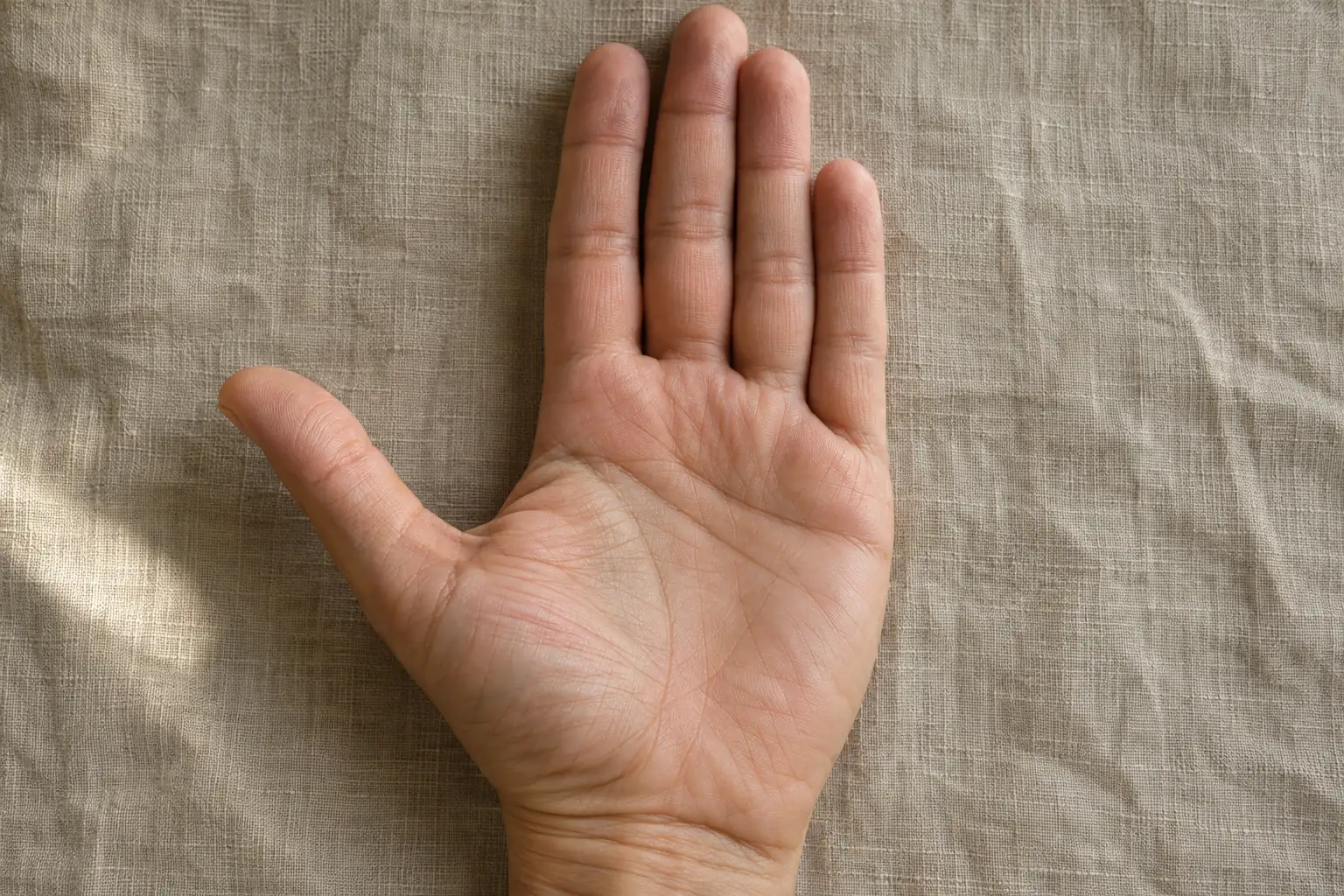
The Mount of Mars is not one mount. Most palmistry books split it into three areas: lower (or inner) Mars on the thumb side, just inside where the life line begins, upper (or outer) Mars on the opposite edge of the palm, between the heart and head lines, and the plain of Mars, the hollow in the middle. Traditionally, lower Mars is read for courage to act, upper Mars for staying power under pressure, and the plain for temper. These are old symbolic labels, not measurements of how brave or angry anyone is. The Mount of Mars is also not the same thing as the Mars line, which is a crease running inside the life line.
You read about upper Mars, lower Mars or Mars positive and cannot tell which part of your palm the writer means, or whether a full or flat area says anything about you.
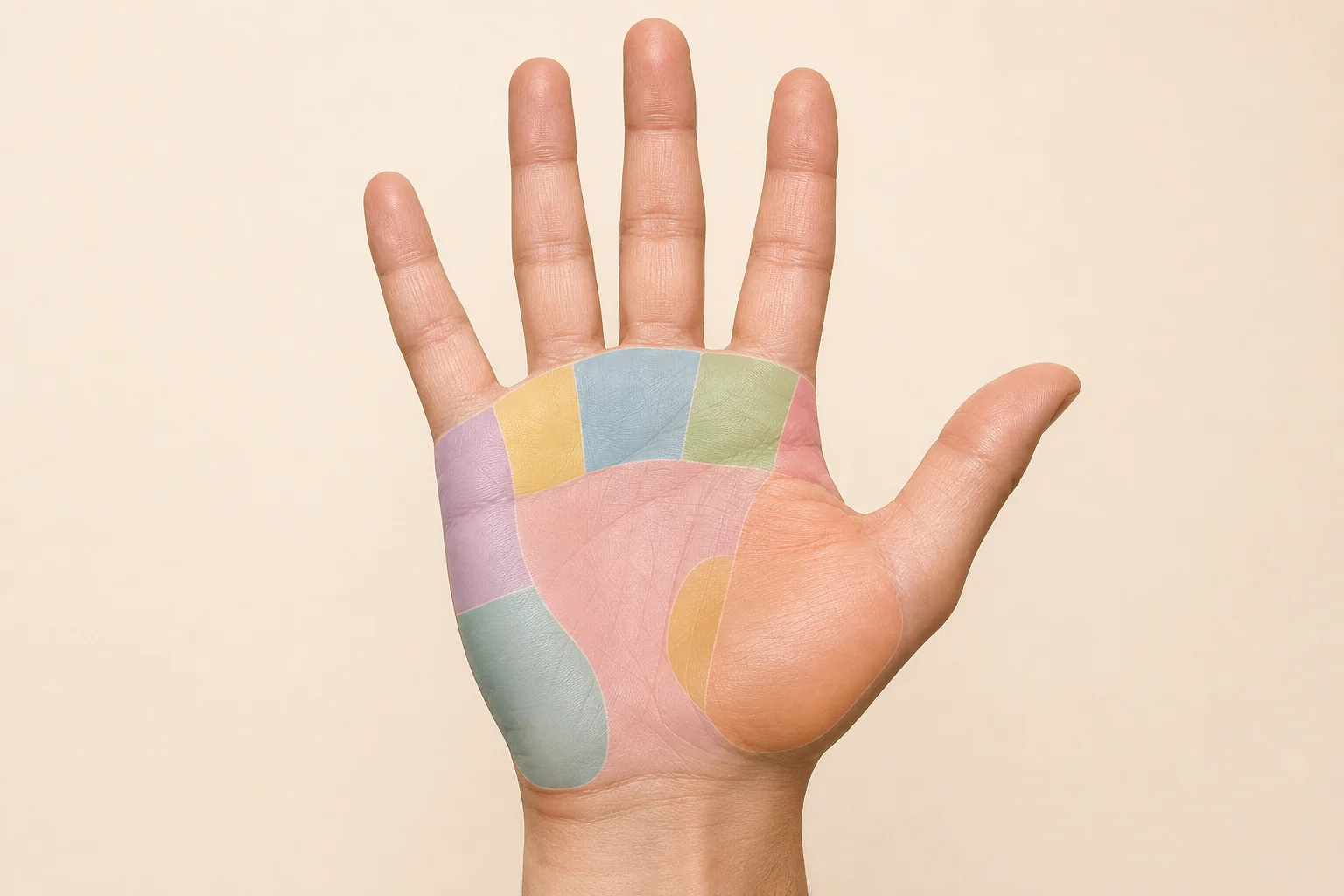
Find all three areas in two minutes
Use a relaxed hand, palm up, fingers together, in even light. Do not stretch the fingers apart, because that flattens the pads.
- Lower Mars. Find where the life line starts, between the thumb and index finger. Just inside that curve, above the thick thumb pad, is a small padded area. That is lower Mars. The big pad below it is the Mount of Venus.
- Upper Mars. Go to the outer edge of the palm, the little-finger side. Find the level between where the heart line and the head line reach that edge. The pad of the palm edge there is upper Mars.
- The plain of Mars. Cup the hand very slightly. The hollow in the centre of the palm, between the two Mars areas, is the plain. It is not raised. Palmists read it anyway.
| Area | Where to look | What lies next to it |
|---|---|---|
| Lower Mars | Thumb side, just inside the start of the life line | Jupiter above it (under the index finger), Venus below it |
| Upper Mars | Little-finger edge, between the heart and head lines | Mercury above it (under the little finger), the Moon mount below it |
| Plain of Mars | Centre of the palm | Crossed by the head line, and by the fate line if you have one |
The mounts overview shows Mars in place among the other six mounts.
One area, five names
If you have read two palmistry sites and come away confused, this is probably why. Each school names the Mars areas its own way.
| Thumb-side area | Little-finger-side area | Used by |
|---|---|---|
| Lower Mars | Upper Mars | William Benham, The Laws of Scientific Hand Reading (1900), and most Western diagrams |
| Mars under Jupiter | Mars under Mercury | Cheiro, who placed the second mount "between the Mount of Mercury and the Mount of Luna" |
| Inner Mars | Outer Mars | Many modern guides |
| Active Mars | Passive Mars | Modern guides that follow Cheiro's "active" and "passive courage" |
| Nimna Mangal (निम्न मंगल) | Uchcha Mangal (उच्च मंगल) | Hindi palmistry books and sites. The centre is Mangal ka maidan |
Then there are "Mars positive" and "Mars negative". Here the sources genuinely disagree. Some guides call the thumb side positive. In one r/palmistry thread a commenter put it the other way round: "Under the pinky is positive mars, above the thumb is negative mars." Both are in use.
The simplest fix is to ignore the label and go by location. When you read about "Mars positive", check which side of the hand the author means before you apply it to yours.
Upper Mars or Moon mount?
This is the most common mix-up. Both sit on the little-finger edge of the palm, one above the other, and on many hands the edge is a single smooth pad with no clear border.
A rule of thumb that most maps share: upper Mars sits between the heart and head lines, and the Moon mount starts below where the head line ends and runs down to the wrist. In one r/palmistry thread a reader asked whether a pad was "upper mars or lunar mount", and the replies split between "Moon" and "That's mars positive". If experienced readers disagree on a photo, treat the border as a zone, not a line. Our Mount of Moon guide has a boundary table for the lower edge.
What the tradition says each area means
The meanings below come from two books that shaped most modern palmistry, Cheiro's Language of the Hand (1890s) and Benham's 1900 textbook. They are presented as tradition, not fact.
| Area | Cheiro | Benham | A fairer question to ask yourself |
|---|---|---|---|
| Lower Mars | "active courage, the martial spirit, but when large, shows a very quarrelsome, fighting disposition" | "aggression", the person who pushes plans through | When do I push for what I want, and when do I hold back? |
| Upper Mars | "passive courage, self-control, resignation, and strength of resistance against wrong" | "resistance", someone who stays "cool, collected, calm" and "does not get discouraged" | What keeps me going when things go wrong? |
| Plain of Mars | Not treated as a mount. He reads lines that cross or start in it | "temper", especially if "much crossed by fine or red lines" | What sets off my temper, and how fast do I cool down? |
Benham's own picture is easy to remember: lower Mars starts a fight, upper Mars refuses to lose one, and the plain decides how hot it gets. Modern readers soften "aggression" to "initiative" or "drive".
The map has moved, and some old claims should go
Benham, writing in 1900, admitted that the Mars areas had been redrawn within living memory. "In the earlier history of Palmistry the Plain of Mars was considered to be the principal part of the Martian development," he wrote. Upper Mars "was afterwards located", and "in later years the Mount of Venus was subdivided" to create what he called lower Mars. Older palmists had placed aggression in the plain of Mars. Benham moved it to the thumb side.
That is worth knowing. The meanings were not handed down unchanged. They were rearranged by individual writers who disagreed with each other.
Two claims from that era should be dropped outright:
- Benham's warning about suicide. He wrote that a deficient upper Mars "is found on the hands of almost all suicides". There is no evidence for this, and a pad on the edge of the hand says nothing about anyone's risk. If you or someone you know is struggling, talk to a person. In India, Tele MANAS answers on 14416 at any hour.
- His claim of proof. Benham said his system rested on "several thousand" cases and "many thousand verifications". He did not describe a comparison group, a method of measuring a mount, or any way the cases could have failed. That is a collection of examples, not a test.
Cheiro's markings are in the same class. He wrote that a star on lower Mars meant "great distinction and celebrity" from "a martial life, or a signal battle". Read those as period colour, not predictions.
Reading Mars fairly
If you want to use the Mars areas as a conversation starter, a few habits keep it honest.
- Compare within the same hand. A "full" upper Mars only means fuller than the rest of that palm edge, not fuller than someone else's.
- Look at both hands. Readers differ on which hand to read, and differences between your hands are often about which one you use more.
- Allow for ordinary causes. Grip-heavy work, gym training, weight changes, cold hands and camera angle all change how full a pad looks. A straight-down photo flattens everything. A low side light exaggerates it.
- Read Mars with its neighbours. Benham and Cheiro both read the Mars areas next to the thumb and the life line, never alone.
- Use it as a question, not a verdict. "This area is traditionally linked with staying power. What has kept you going this year?" leaves room for a no. "You have a weak Mars, so you give up easily" does not.
A note on lumps. A firm lump, dimple or cord in the palm, especially toward the ring and little fingers, is not a mount. The NHS lists lumps or ridges on the palm as the first sign of Dupuytren's contracture, a common condition that can slowly bend the fingers. Show a doctor any new pain, swelling, numbness or a lump that changes. A palmist is the wrong person to ask.
An example, to show the shape
This example is invented. Two friends compare palms. Asha's thumb-side pad is noticeably full and her little-finger edge is flat. Ravi's is the other way round, and his palm centre is deeply hollow.
A traditional reading would call Asha quick to act and Ravi slow to start but hard to shake, with a hollow plain meaning he rarely loses his temper. Asha laughs, because she plays badminton four times a week with her right hand. Ravi points out he types all day and has never had much padding anywhere.
Neither reading is useless. Each one gives them a question to talk about. Neither is evidence. Their hands mostly show how they use them.
Common questions
Where is the Mount of Mars on the palm?
There are two Mars areas and a plain. Lower Mars is on the thumb side, just inside where the life line begins. Upper Mars is on the little-finger edge, between the heart and head lines. The plain of Mars is the hollow in the centre.
What does a prominent Mount of Mars mean?
In traditional palmistry, a full lower Mars is linked with courage to act and a full upper Mars with endurance. Older books also tie a very large lower Mars to a quarrelsome nature. These are symbolic readings. A full pad is often just muscle, work or build.
What does a flat Mount of Mars mean?
Traditionally, less of that area's theme. In practice many hands have a flat palm edge, and it says nothing reliable about courage or resilience.
Is upper Mars the same as Mars positive?
It depends on the author. Some guides call the little-finger side positive and others call the thumb side positive. Go by location, not the label.
Is the Mount of Mars the same as the Mars line?
No. The Mars line is a crease running inside the life line, near the thumb. The Mount of Mars is a set of areas of the palm. They share a name because both were linked to the planet Mars.
Sources
- William G. Benham, The Laws of Scientific Hand Reading (1900), Chapter XXIII, The Mount of Mars and Part 2, Chest of Books reprint.
- Cheiro, Cheiro's Language of the Hand, chapter "The Mounts" and "The Star on the Mount of Mars", Internet Archive scan.
- Hindi names: likhahai.com, निम्न मंगल पर्वत and मंगल मैदान.
- Reddit r/palmistry threads 18165zo and 18ca73k, public discussions of Mars naming and the upper Mars / Moon border.
- NHS, Dupuytren's contracture.
- Tele MANAS, Ministry of Health and Family Welfare, India, telemanas.mohfw.gov.in.
- The Asha and Ravi example is invented for illustration.