
The Ring of Saturn is a curved line that loops around the base of the middle finger, cutting across the pad of skin palmists call the Mount of Saturn. It is rare, and most lines people find there turn out to be the ordinary crease where the finger bends. Old palmistry books gave it a grim reputation, but they disagreed with each other, and we found no study that has ever tested it. It does not predict failure, loneliness or tragedy. Like the rest of palmistry, it is best read as tradition and a prompt for reflection.
Someone told you that a curved line under your middle finger is the worst mark in palmistry, and you want to know whether to worry.
If you came here because a reader, an app or a comment thread told you it is "the worst" mark, the short version is this: check whether you have one at all, then read what the old writers actually said. Both steps usually take the fear out of it.
Do you actually have one? A five-step check
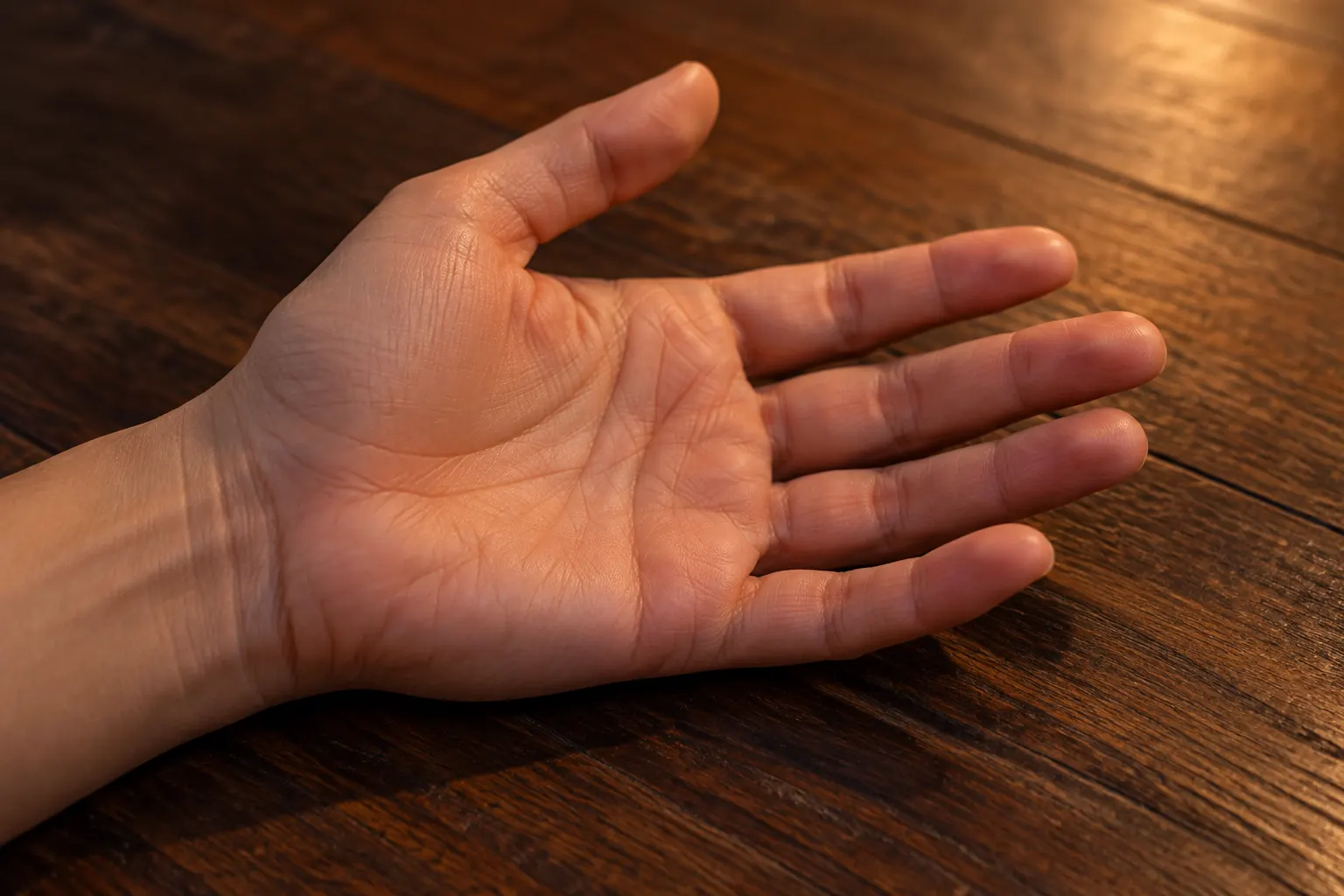
Most "rings" turn out to be something else. Look at your hand in good side light, palm up, fingers relaxed.
- Find the middle finger and the fold where it joins the palm. Every hand has at least one fold there, because that is where the finger bends. That fold is not a Ring of Saturn.
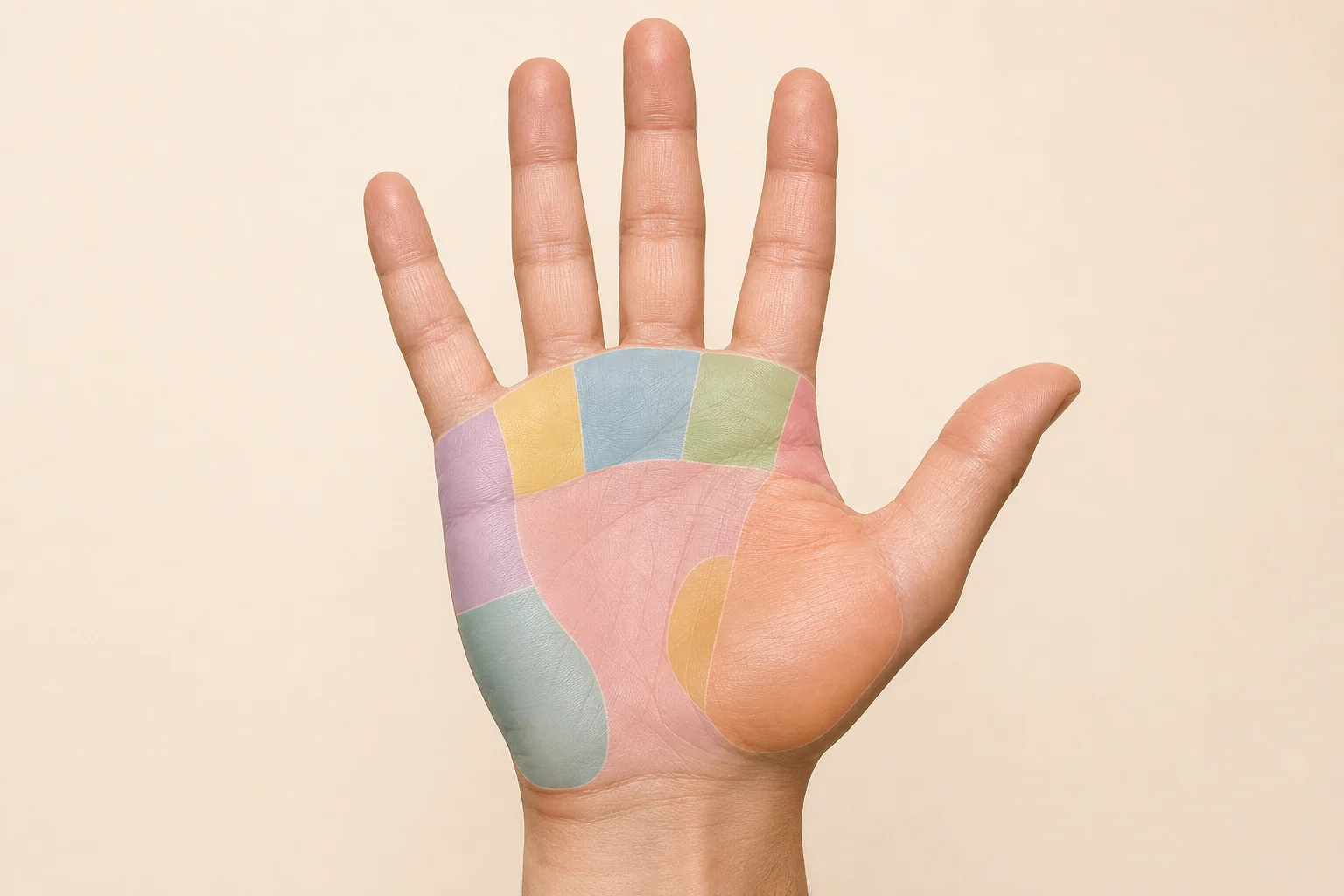
- Look just below that fold, on the small pad between it and the heart line. Our guide to locating the Mount of Saturn shows where the pad starts and stops.
- A true ring is a separate arc on that pad. In the old books it starts in the gap between the index and middle fingers, curves under the middle finger and ends in the gap between the middle and ring fingers.
- Bend the middle finger slowly. A finger crease deepens as the finger folds. A separate arc lower down on the pad moves far less.
- Take a photo and compare both hands. If the arc only shows up in one light, or you have to join several tiny lines to make it, treat it as "not clear" rather than "yes".
If you still see a clean, separate arc under the middle finger, you have what palmists would call a Ring of Saturn, or a partial one. Read on with that in mind. If not, you are in the large group of people who were told about a mark they do not have.
What else it could be
Several lines sit close to the middle finger. This table shows the six most often confused with a ring.
| Line or mark | Where it sits | How to tell it apart |
|---|---|---|
| Finger-base crease | Exactly where the middle finger meets the palm | Present on every hand and deepens when you bend the finger |
| Ring of Saturn | A separate arc on the pad below the middle finger only | Starts and ends in the gaps either side of the middle finger |
| Girdle of Venus | A longer arc above the heart line, usually under the middle and ring fingers together | Spans two fingers, often in broken pieces. See how to find the Girdle of Venus |
| Ring of Solomon | Under the index finger, on the Jupiter pad | Wrong finger. See where the Ring of Solomon sits |
| Heart line ending under Saturn | The end of the heart line itself | Joined to the long line that runs across the palm. See heart line ending under Saturn |
| Fate line ending on the mount | A long line running up the palm toward the middle finger | Runs up and down the palm, not around the finger. See the fate line ending under Saturn |
| Short bars or crosses on the mount | Small marks on the same pad | Short and straight, not a curve around the finger |
What the old books actually said
The Ring of Saturn appears by name in a handful of popular English-language palmistry books from the 1890s to 1916. We read the passages in scanned copies of the original books rather than in later summaries. Here is what each author wrote.
| Book | What it says about the ring | Worth knowing |
|---|---|---|
| Cheiro, Cheiro's Language of the Hand (first published in the 1890s) | "a mark very seldom found, and is not a good sign to have on the hand". He linked it to people "full of big ideas and plans, but with such want of continuity of purpose that they always give up half-way" | He put much of it down to temperament, in his own words |
| Comte de Saint-Germain, The Practice of Palmistry for Professional Purposes (1897) | A ring "just encircling the base of the Finger" means "Extraordinary Magic (or Occult) Powers" | The opposite of a warning |
| William G. Benham, The Laws of Scientific Hand Reading (1900) | "a disposition to jump from one occupation to another". He adds that the line "per se, does not make failure in life a necessity" | A broken ring, he says, "is not as unfavorable" as a complete one |
| Cheiro, Palmistry for All (1916) | People with it are "gloomy, morbid, and Saturnine in character". He ends: "It is the most unfortunate mark ever to find" | The same author, about twenty years on, much harsher |
Put side by side, the books do not agree on what the mark means. One author calls it magic power. Another calls it restlessness and says plainly that it does not make failure necessary. The best-known author softened nothing and got gloomier over time, without describing any new evidence. When the founding texts disagree this much, no single meaning can claim to be "the" traditional one.
Where the frightening meaning comes from
The scariest lines online trace back to two sources. One is Cheiro's 1916 paragraph, which says he had never met anyone with the mark who succeeded in life. The other is Benham, who wrote that he had seen the ring on the hands of prisoners and of people who had died by suicide.
Both are personal impressions. Neither author counted how many people with the mark did well, or how many people without it struggled. Nobody wrote down how often the mark appeared in a comparison group. A palmist who already believes a mark is unlucky will remember the hands that fit and forget the ones that did not. That habit is ordinary and human, and it is exactly why a claim like this needs a count before anyone repeats it.
We searched for a modern study of the Ring of Saturn and found none. The studies that have looked at palm lines, such as the 2019 life line study, are summarised in our page on what research has checked about palm reading. None of them supports reading fate from a single crease.
If you read those old lines about prisons and suicide and they landed hard, please take this seriously: a line on your hand does not decide anything about your life. If you are having thoughts of ending your life, call Tele MANAS on 14416 in India or 988 in the US, any time.
What it can fairly mean in a reading today
Many modern palmists read the ring calmly, as a theme to think about, not a verdict. The theme most books share, under all the gloom, is follow-through: starting many things and finishing few. That is a useful question for almost anyone, ring or no ring.
| Old claim | What a fair reading does with it |
|---|---|
| "Never succeeds" (Cheiro, both books) | Asks which plan you have left half done, and what finishing one small part would look like |
| "Jumps from one occupation to another" (Benham) | Asks whether the changes were choices you are glad of, or exits you wish you had not taken |
| "Isolated and alone" (Cheiro 1916) | Asks who you actually talk to when things feel heavy. Nothing more |
| "Unhappy marriage" (Cheiro 1916) | Drops it. One crease says nothing about a relationship |
| Prisons and suicide (Benham) | Drops it. These were unsupported anecdotes |
| "Occult powers" (Saint-Germain) | Enjoys it as folklore. There is no evidence for this either |
The Mount of Saturn itself is linked in palmistry with patience, seriousness and long work. If you want the wider picture of that pad, see how palmists read the Saturn mount's markings.
Broken rings, half rings and one hand only
Most rings people do find are partial: a short curve that never closes, or two short lines that cross on the pad. Benham, who was the hardest on the full ring, still wrote that a broken one is milder. Read a half ring as a half idea, if you read it at all.
Palmists also compare the two hands. A mark on one hand only is usually read as a passing pattern rather than a fixed trait. Our guide on which hand palmists read explains the usual conventions, and they differ between schools.
Fine creases can look lighter, deeper or more broken over the years as skin, work and age change. If you want to track yours, our page on whether palm lines change has a simple photo routine.
If a reader said it is a bad sign
Readings sometimes land badly. If someone pointed at your middle finger and told you the news was grim, a few steps help.
- Ask what exactly they saw. A good reader can point to the line and explain which book or system they are using.
- Do the five-step check above with your own photo. Many "rings" are finger creases.
- Remember the table of old books. Even the classic authors could not agree.
- Notice how you feel after a day or two. A reading is meant to give you something to think about. It should not leave you afraid.
Be careful with anyone who offers to fix the ring. Gemstone rings, special prayers, "removal" rituals and charms sold against a palm mark are a known pattern. Warning signs include a price that appears only after the fear, pressure to pay today, and a promise that the problem will get worse if you wait. Our guide for anyone told they are cursed shows how these pitches usually sound and what to do next. A palm mark cannot be removed, and nothing needs to be.
Three questions to sit with
If you do have a ring, or simply recognise the "many plans, few finished" theme, these three questions turn an old warning into something you can use.
- Which project have I started more than once?
- What is the smallest finished version of it I could reach this month?
- Who would I tell when it is done?
Here is an invented example. Ravi, a reader we made up for this page, has a half ring on his right hand and three half-written course outlines on his laptop. His answers might be: "the Python course", "one finished lesson, recorded", and "my cousin, who asked about it in June". None of this depends on the line being meaningful. The line just started the conversation.
If you want to know where these old ideas came from in the first place, our short history of palmistry covers the nineteenth-century writers behind most of them.
Common questions
Is the Ring of Saturn bad luck?
No, not in any proven sense. Some old palmistry books read it as a warning, one read it as a sign of occult power, and no study has tested any of these claims. At most it is a prompt to think about follow-through.
How rare is the Ring of Saturn?
Cheiro called it a mark very seldom found, and modern palmists agree it is uncommon. We found no survey that has counted it, so any percentage you see online is a guess.
Is the crease under my middle finger a Ring of Saturn?
Probably not. Every hand has a crease where the middle finger meets the palm. A Ring of Saturn is a separate arc lower on the pad, running from the gap on one side of the middle finger to the gap on the other.
Should I wear a gemstone or do a ritual to cancel it?
No. A palm line cannot be cancelled, and nothing about it needs fixing. Treat anyone who sells a remedy for a palm mark, especially with a deadline or a threat attached, as a warning sign.
Does a broken Ring of Saturn mean anything different?
In the old books, a broken or partial ring was read as milder than a complete one. Even Benham, who was the harshest on the full ring, said so. Most rings people find are partial.
Sources
- Cheiro, Cheiro's Language of the Hand, chapter "The Girdle of Venus, the Ring of Saturn, and the Three Bracelets", text read in an 1898 printing, archive.org scan.
- Comte C. de Saint-Germain, The Practice of Palmistry for Professional Purposes (1897), index and dictionary entry "Saturn, The Ring of", archive.org scan.
- William G. Benham, The Laws of Scientific Hand Reading (1900), chapter "The Minor Lines", section "The Ring of Saturn", archive.org scan.
- Cheiro, Palmistry for All (1916), chapter "The Girdle of Venus, the Ring of Saturn, and the Bracelets", Project Gutenberg ebook 20480.
- Tele MANAS, telemanas.mohfw.gov.in, 14416. US 988 Suicide and Crisis Lifeline, 988lifeline.org.
- The Ravi example is invented for illustration.