
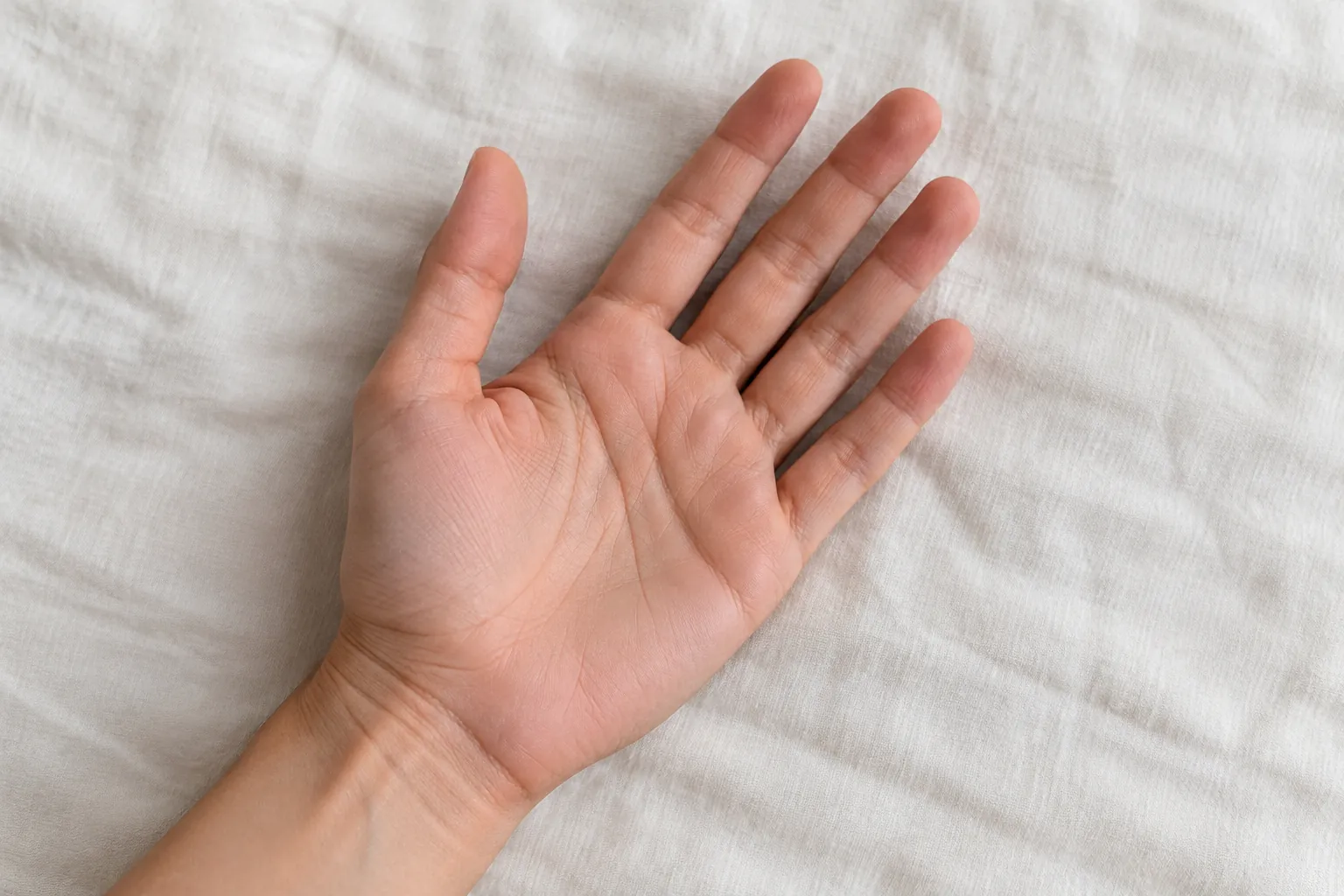
A Sydney line is a head line that runs right across the palm to the outer edge, below the little finger, while the heart line above it stays separate. Researchers at a children's hospital in Sydney, Australia, named it in 1968. It is a normal variation that many healthy people have, and on its own it does not diagnose anything. Palmists read a head line this long as a sign of deep, single-track focus. That reading is tradition, best treated as reflection and entertainment, not science.
You have just noticed that your head line runs all the way across your palm, or someone online told you that means something worrying.
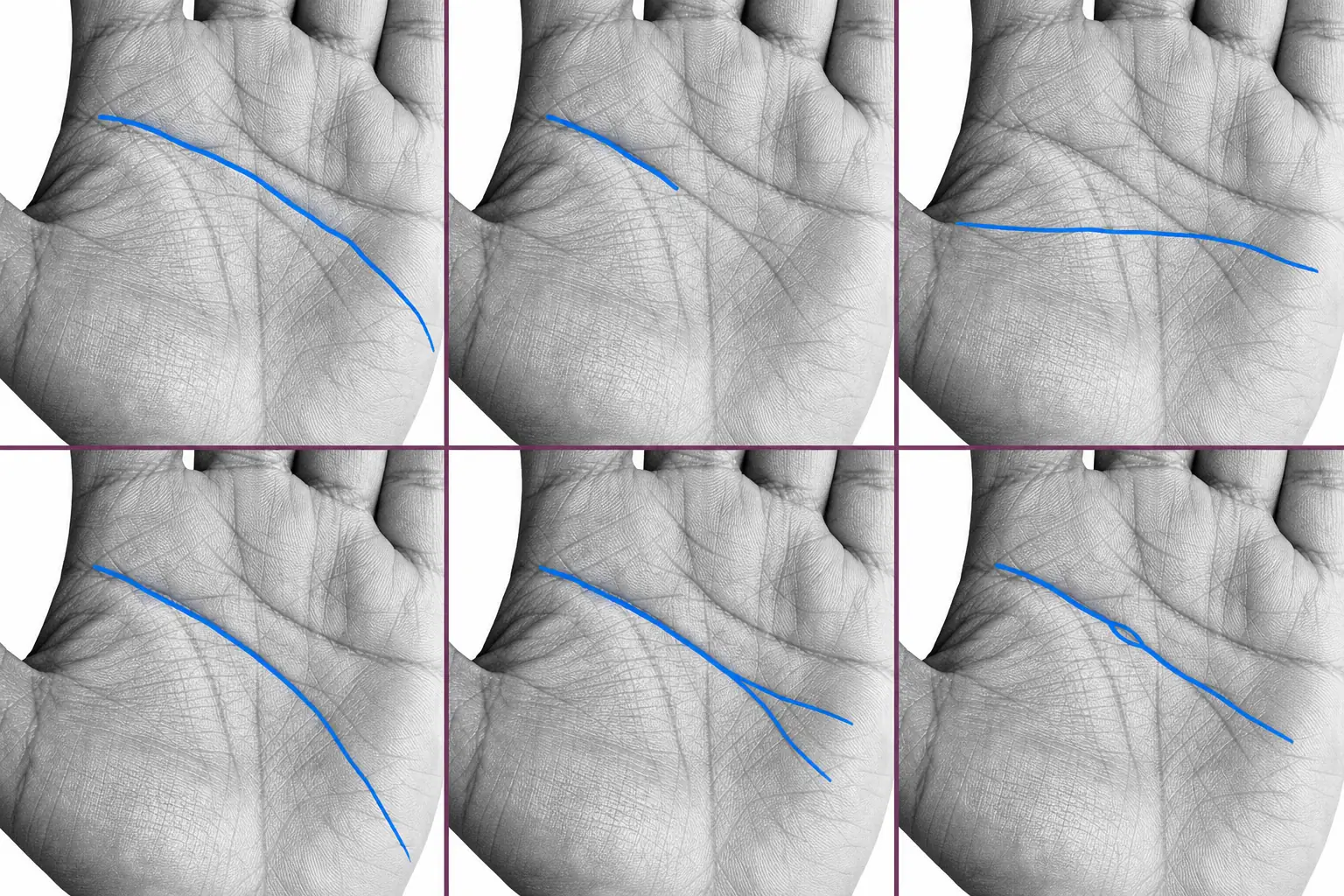
How do I know if I have a Sydney line?
Open your hand and relax it. Find the head line, the lower of the two long creases that run across the palm. It starts near the gap between your thumb and index finger. Now follow it outward.
- Most head lines fade out somewhere under the ring finger or the gap after it.
- A Sydney line keeps going until it reaches the outer edge of the palm, the side below the little finger. The medical definition says it goes past an imaginary line drawn straight down from the middle of the little finger.
- Check that the heart line, the crease above, is still a separate line. If the two have merged into one, you are looking at a different pattern (see the table below).
- Look at both hands. Researchers count each hand on its own, because the line can appear on one hand and not the other.
Take a photo in daylight with the fingers relaxed. A palm bent forward makes creases look longer than they are.
Sydney line, simian line and the lookalikes
| Pattern | What you see | Heart line | Head line |
|---|---|---|---|
| Usual palm | Two separate creases across the palm | Separate | Ends somewhere under the ring finger |
| Long head line (a palmistry term) | Head line runs well into the outer half | Separate | Long, but stops short of the edge |
| Sydney line | Head line reaches the outer edge | Separate | Runs all the way across |
| Simian line | One crease takes the place of both | Merged with the head line | Merged with the heart line |
| Suwon crease | Head and heart lines meet, with an extra separate crease alongside | Joined | Joined |
The long head line and the Sydney line are close cousins. Our guide to the long head line covers the palmistry reading of a line that goes most of the way. The simian line is the single-crease pattern people most often confuse it with. The Suwon crease was named in 2010 after Suwon, South Korea, where a team studying the palms of 3,216 Korean people first described it.
Where does the name come from?
The name comes from a hospital, not from a palmistry book. In 1968 Stuart Purvis-Smith and Margaret Menser of the Royal Alexandra Hospital for Children in Sydney published a study in The Lancet. They had compared the hand prints of adults born with congenital rubella after the 1940 Australian epidemic with a hundred healthy controls. They reported "a previously undescribed, atypical palmar crease (the 'Sydney line')", seen more often in the women with rubella.
In 1972 Purvis-Smith gave the formal definition still quoted today: the lower crease "extends beyond the midline axis of the fifth finger towards the ulnar border of the palm". In plain words, the head line goes past the middle of the little finger and on toward the edge of the hand.
What did the medical studies find?
The research is about groups of people, not individuals. Several studies found the line more often in some conditions than in controls. Others found it in plenty of healthy people too.
| Year | Study | What it found | What to keep in mind |
|---|---|---|---|
| 1968 | The Lancet, adults born with congenital rubella | The line was seen more often in the women with rubella | First description, small groups |
| 1969 | JAMA, 100 children with congenital rubella | 27 of the 100 had a Sydney line | Children born in New South Wales |
| 1969 | The Lancet, 25 children with leukaemia | 5 of 25 had one, against 7 of 100 controls | The authors called it "a suggestion" |
| 1970 | Journal of Medical Genetics, people with leukaemia | No significant difference from the general population | Excluded people with Down syndrome |
| 1972 | Australian study of 105 people with Down syndrome | Significantly more Sydney and simian lines than controls | An association, not a test |
| 1982 | Japanese study, 694 healthy controls | Fewer Sydney lines than in Australian and North American controls | How common it is depends on the population |
| 2019 | Ethiopian study, 318 healthy students | Unusual creases, Sydney lines among them, in 13.8% of palms | The authors said these may not point to disease |
| 2022 | Ethiopian study, students at the University of Gondar | Sydney creases in 1.92%, the least common pattern, against 90.8% usual creases | Rates differ a lot between groups |
Two things stand out. First, in the 1969 leukaemia study 7 of 100 children without leukaemia had a Sydney line. Second, the 2019 authors found unusual creases in healthy students and concluded they may not indicate known disease at those rates.
So a doctor cannot tell anything about your health from this crease alone. Doctors who note palm creases do it as one small sign alongside many others, usually in a newborn. If you have a health worry, see a doctor about the worry itself. The crease is not a reason to book one.
Twin studies add one more piece. A 1976 study found that parents with a Sydney line had more children with one, but its twin comparison did not suggest strong genetic involvement. See do identical twins have the same palm lines?
What does a Sydney line mean in palmistry?
Palmistry is older than the medical name, and it reads line length rather than crease types. Cheiro, writing in Palmistry for All (1916), described a head line that goes "very far across the hand" as the mark of "an extremely strong-willed determined person who has the power to hide his sensitiveness and nervousness". He was describing a straight head line joined to the life line, but his words are often applied to the Sydney line today.
Modern palm readers usually read it along these lines:
- Deep focus once you start on something
- Thoroughness, a wish to follow an idea to the end
- Trouble switching off, or letting a problem go at night
Online forums often go much further and attach anxiety, obsession or other labels to the line. No study supports those claims. The medical research above was about congenital conditions, not personality, and the research on palm lines has not found that lines predict character or events. If a reading has used your Sydney line to tell you something frightening, it has mixed up 1960s hospital research with fortune-telling.
Reading your own Sydney line calmly
If you enjoy palmistry, treat the line as a question about yourself rather than a verdict.
- Where in your life do you go deep, and where would a lighter touch help?
- Do you find it hard to put a problem down at the end of the day?
- Is the line on your dominant hand, the other one, or both? Palmists treat the two hands differently, as this page on choosing a hand sets out.
Answers to questions like these are yours to weigh. The crease does not decide them. For the background on where these ideas came from, see the history of palmistry.
Common questions
Is the Sydney line rare?
It depends on the group. In a 1969 Sydney study, 7 of 100 children without leukaemia had one. A 2022 study of Ethiopian students found Sydney creases in under 2%, and a 1982 study found fewer in Japanese controls than in Australian and North American ones.
Is a Sydney line the same as a simian line?
No. A simian line is one crease that replaces both the head and heart lines. With a Sydney line the head line runs all the way across, but the heart line is still a separate crease above it.
Does a Sydney line mean something is wrong with me?
No. Studies found it more often in some congenital conditions, but many healthy people have it. A crease on its own diagnoses nothing. If you have a health concern, talk to a doctor about that concern.
Can you have a Sydney line on one hand only?
Yes. Researchers record each hand separately, because the line can appear on one hand and not the other.
What does a Sydney line mean in palmistry?
Palmists usually read a head line that crosses the whole palm as deep focus and thoroughness, sometimes with trouble switching off. This is tradition and personal reflection, not something research supports.
Sources
- S. G. Purvis-Smith and M. A. Menser, Dermatoglyphics in adults with congenital rubella, The Lancet, 1968.
- S. G. Purvis-Smith, Dermatoglyphic defects and rubella teratogenesis, JAMA, 1969.
- M. A. Menser and S. G. Purvis-Smith, Dermatoglyphic defects in children with leukaemia, The Lancet, 1969.
- J. L. Verbov, Dermatoglyphs in leukaemia, Journal of Medical Genetics, 1970.
- S. G. Purvis-Smith, The Sydney line: a significant sign in Down's syndrome, Australian Paediatric Journal, 1972.
- H. Shiono and J. Azumi, The Sydney line and the simian line: the incidence in Down's syndrome, patients with mental retardation and Japanese controls, 1982.
- J. S. Park and colleagues, Improved analysis of palm creases, Anatomy and Cell Biology, 2010.
- M. Afework, Prevalence of the different types of palmar creases among medical and dental students in Addis Ababa, Ethiopia, Ethiopian Journal of Health Sciences, 2019.
- D. G. Belay and colleagues, Prevalence of palmar crease patterns and associated factors among students at University of Gondar, Northwest Ethiopia, Anatomy and Cell Biology, 2022.
- Cheiro, Palmistry for All (1916), Project Gutenberg.