
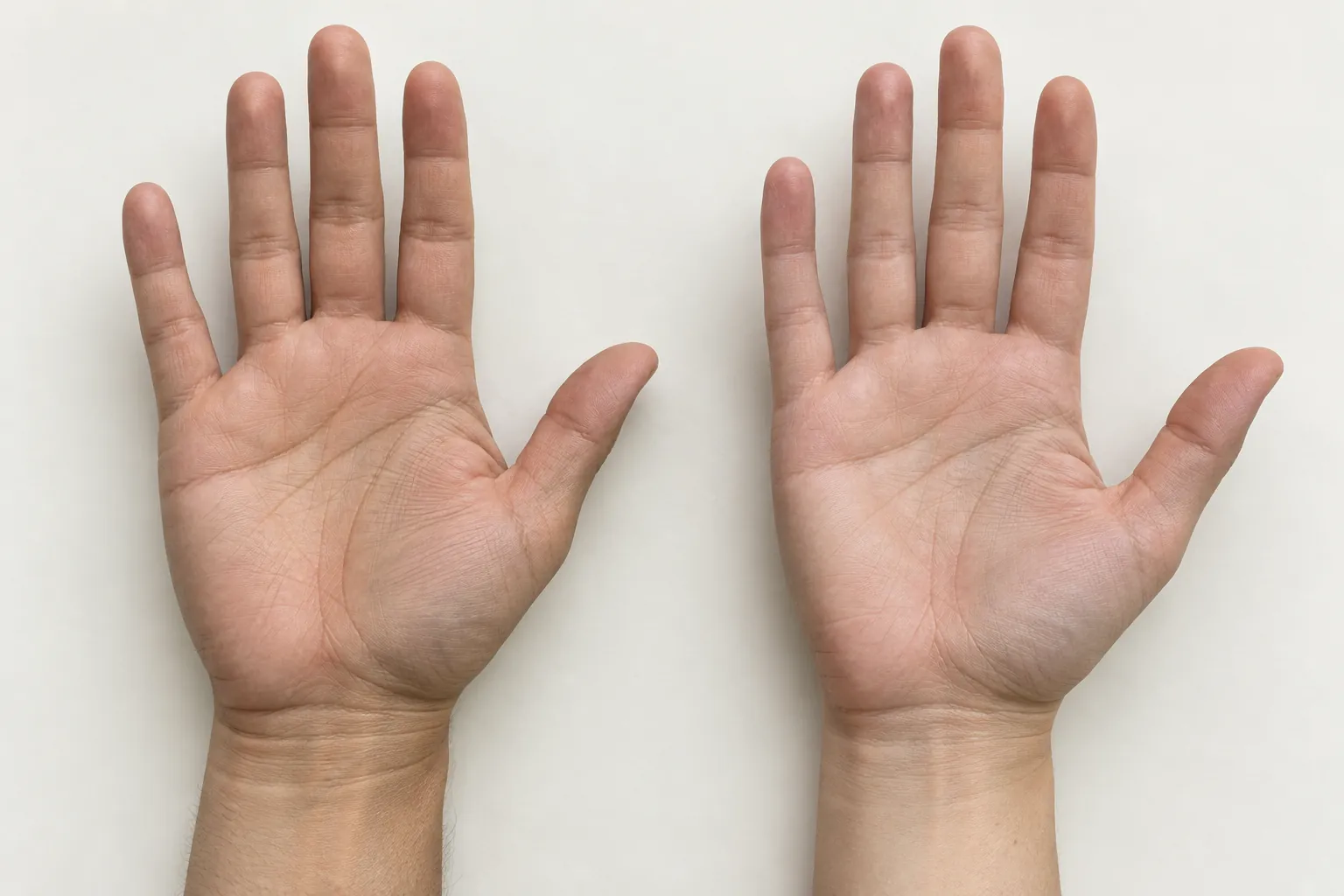
No. Identical twins have palm lines that are more alike than two strangers' lines, but they are not the same. In the largest study we found, researchers photographed the palms of 53 pairs of identical twins. They found that the three main lines are partly shaped by genes, yet their software could still tell every pair apart. Your own left and right hands turn out to be similar in the same way. And similar lines tell you nothing about whether two people will have similar lives.
You are a twin, or you know some, and you want to know if your palms really match and what that would mean.
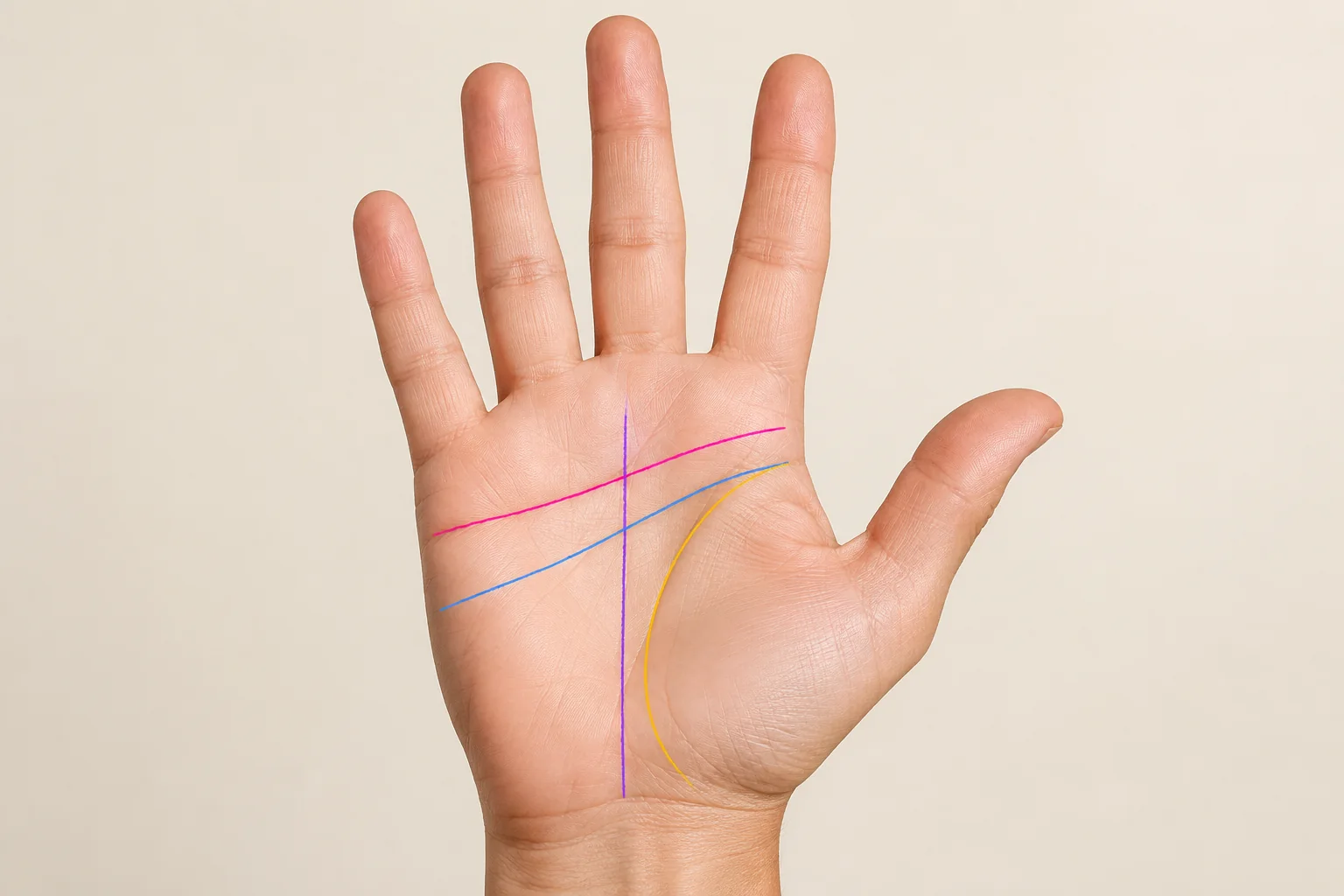
If you are a twin, or you know some, this page explains what is shared, what is not, and how to compare two palms yourself.
What the twin palm study found
The study is Kong, Zhang and Lu, "A study of identical twins' palmprints for personal verification", published in Pattern Recognition in 2006. The team collected 1,028 palm images from 53 pairs of identical twins, aged 6 to 45. They used a palmprint recognition system, the kind built for security checks, and asked it to match each twin's palm against their co-twin's.
They found three things.
- The three main lines are partly genetic. When the researchers removed the strongest features from the images, the extra similarity between genetically matched palms shrank. Those strongest features sat on the heart, head and life lines. Some fainter lines were shared too, which is why the similarity never vanished completely.
- Twins are still distinguishable. Looking at one twin pair by eye, the authors wrote that three of the four palms looked similar but were "still distinguishable", and the fourth was "relatively different".
- The numbers. At a setting where the system accepted 97 percent of true matches, it wrongly matched two strangers 0.000044 percent of the time and wrongly matched identical twins 0.02 percent of the time.
That last result is easy to misread, so here is the arithmetic. Twins were mistaken for each other about 450 times more often than strangers were. That still works out to roughly 1 wrong match in 5,000 tries. Similar, then, and still far from identical.
Ridges, creases and lines are three different things
People use "palm lines" for several features. They behave differently in twins.
| Feature | What it is | When it forms | In identical twins |
|---|---|---|---|
| Fingerprints and palm ridges | The fine raised skin patterns used for identification | Roughly weeks 10 to 16 of pregnancy | Often the same broad pattern type, but the fine details differ. A 2002 study of 94 twin pairs found software could still tell them apart |
| Major creases | The heart, head and life lines, plus the fate line when present | The first half of pregnancy | Partly genetic, more alike than strangers, not identical |
| Fine lines | Small creases and wrinkles across the palm | Throughout life | Shaped by age, skin, work and use, so they drift apart over time |
A 1986 study of 160 fetuses aged 6 to 20 weeks found something many people do not expect. Most of the creases it tracked appear at the same time as the small fetal pads on the hand, and with some exceptions they seem to develop independently of the hand's folding movements. So the main lines are not simply drawn by how you clench your fist. Our page on fingerprints in palmistry covers ridges in more depth, and do palm lines change over time? covers the fine lines.
Which palm features run in families?
A 1976 study by Plato, Wertelecki and Schwartz compared identical twins, fraternal twins and ordinary siblings. Two common variations in the normal crease pattern clustered in families, and identical twins matched each other on them more often than fraternal twins or siblings did. That points to genes.
The single crease and the Sydney line told a different story. Parents with these creases had more children with them. But the twin comparison did not suggest strong genetic involvement for either one. Our guides to the simian line and the Sydney line explain how to recognise them.
Identical twins can also differ in ways that genes cannot explain. In a 2000 twin study of psychosis, researchers found identical pairs where only one twin had an unusual crease or ridge pattern. They concluded that something early in pregnancy, beyond genes, made the difference. This is group research. An unusual crease on your own hand is not a diagnosis of anything.
Your two hands are a kind of twin too
The 2006 study had a clever second test. Your left and right hands grow from the same DNA, just as identical twins do. So the researchers flipped each left palm image and matched it against the same person's right palm. They called this a "virtual twin" match. The two hands were correlated in the same way twins were, and still told apart.
That explains something many beginners notice. Your two palms look like siblings, not copies. A head line might curve more on one hand or a fate line might be fainter. Palmists have built whole systems on those differences, and our guide on which hand to read shows how they compare the two.
What palmistry has said about twins
Cheiro, the most famous palmist of the 1890s, used twins as proof of his method. In Cheiro's Language of the Hand (1897 edition) he wrote that "the markings of no two hands have ever been found alike", adding that this is "particularly noticeable in the case of twins". He claimed the lines "will be widely different if the natures are different".
Half of that holds up. No two hands are alike, and that includes twins. The other half, that line differences match personality differences, has never been tested in the studies we found. No one, as far as we can tell, has measured twins' creases and their temperaments side by side. So treat that part as tradition. Our history of palmistry tells the story of Cheiro's era.
Fraternal twins, mirror twins and other questions
Fraternal twins grow from two separate eggs. Genetically they are ordinary siblings who happen to share a birthday, so you should expect family resemblance in the palm and no more.
Identical twins come from one fertilised egg that splits. The 2006 paper puts them at about 0.4 percent of births across populations.
Mirror twins are identical twins who seem to be mirror images, for example one right-handed and one left-handed. You will see claims that their palm lines mirror each other too. We found no study that has measured this, so it stays a claim.
Try it: compare two palms
You need two people (twins, siblings, or just your own two hands), a phone and some paper.
- Photograph each right palm the same way: same light, same distance, fingers relaxed. Our palm photo guide has the set-up.
- Print the photos at the same size, or lay tracing paper over the screen.
- Trace only the three main lines on each.
- For each line, note where it starts, where it ends, and how much it curves.
- Then do the blind version. Mix up four photos, two from each person, and ask a friend to pair them. Our palm swap test works the same way.
Here is an invented example, to show what a filled-in sheet might look like.
| Line | Twin A | Twin B | Same or different? |
|---|---|---|---|
| Life line | Wide curve, starts halfway between thumb and index finger | Wide curve, same start | Same |
| Head line | Joined to the life line at the start, slopes down | Joined, slopes slightly less | Close |
| Heart line | Ends under the middle finger | Ends between index and middle finger | Different |
Most pairs end up with a sheet like this: a few lines that match, a few that are close and at least one that differs.
What similar hands do not mean
Even if two people's lines looked identical, that would not mean they share a future. Palm creases are folds of skin. The best-known claim in palmistry, that a longer life line promises a longer life, was tested on 60 cadavers in a 2019 study and no link was found. Our page on what studies have checked has the details.
So if twins compare hands and find their heart lines end in different places, that is a fun thing to talk about. It does not show that one twin will be luckier in love.
Common questions
Do identical twins have the same fingerprints?
No. Identical twins often share the same broad fingerprint pattern, such as a loop or a whorl, but the fine details differ. A 2002 study of 94 twin pairs found that fingerprint software could still tell twins apart.
Can a palm reader tell identical twins apart?
Usually, yes, if they look closely at both hands. Twins' main lines are more alike than strangers' lines, but differences in curves, endings and fine lines are normally visible. Software built for security checks can tell them apart too.
Do fraternal twins have similar palm lines?
About as similar as any two siblings. Fraternal twins come from two separate eggs, so some features may run in the family, but there is no special match.
Why do my two hands have different lines?
Your hands grow from the same DNA but not in exactly the same conditions, and you use them differently over the years. The 2006 twin study found that a person's left and right palms are related in much the same way identical twins' palms are.
Do twins' palm lines change differently over time?
The main creases stay fairly stable through life. Fine lines change with age, skin and hand use, so twins with different jobs, hobbies or health can see their fine lines drift apart.
Sources
- Adams Wai-Kin Kong, David Zhang and Guangming Lu, "A study of identical twins' palmprints for personal verification", Pattern Recognition 39 (2006), pages 2149 to 2156, doi 10.1016/j.patcog.2006.04.035. Author manuscript read in full from Nanyang Technological University.
- Anil K. Jain, Salil Prabhakar and Sharath Pankanti, "On the similarity of identical twin fingerprints", Pattern Recognition 35 (2002), pages 2653 to 2663, doi 10.1016/S0031-3203(01)00218-7. Abstract via IBM Research. The 94-pair figure is as summarised in PLOS One 2012, doi 10.1371/journal.pone.0035704.
- S. Kimura and T. Kitagawa, "Embryological development of human palmar, plantar, and digital flexion creases", Anatomical Record 216 (1986), pages 191 to 197, PubMed 3777451.
- C. C. Plato, W. Wertelecki and J. T. Schwartz, "Normal and aberrant palmar creases in twins and siblings", Acta Geneticae Medicae et Gemellologiae 25 (1976), pages 174 to 176, PubMed 1036358.
- A. Rosa and colleagues, "Congenital dermatoglyphic malformations and psychosis: a twin study", American Journal of Psychiatry 157 (2000), pages 1511 to 1513, PubMed 10964873.
- E. Bou Farah and colleagues, "Dermatoglyphics and schizophrenia: a comprehensive review of neurodevelopmental biomarkers", World Journal of Psychiatry (2025), PubMed 41281513, for the weeks 10 to 16 ridge-formation window.
- Cheiro, Cheiro's Language of the Hand (copyright 1897), read from the Internet Archive scan.
- The twin comparison sheet is invented for illustration.