
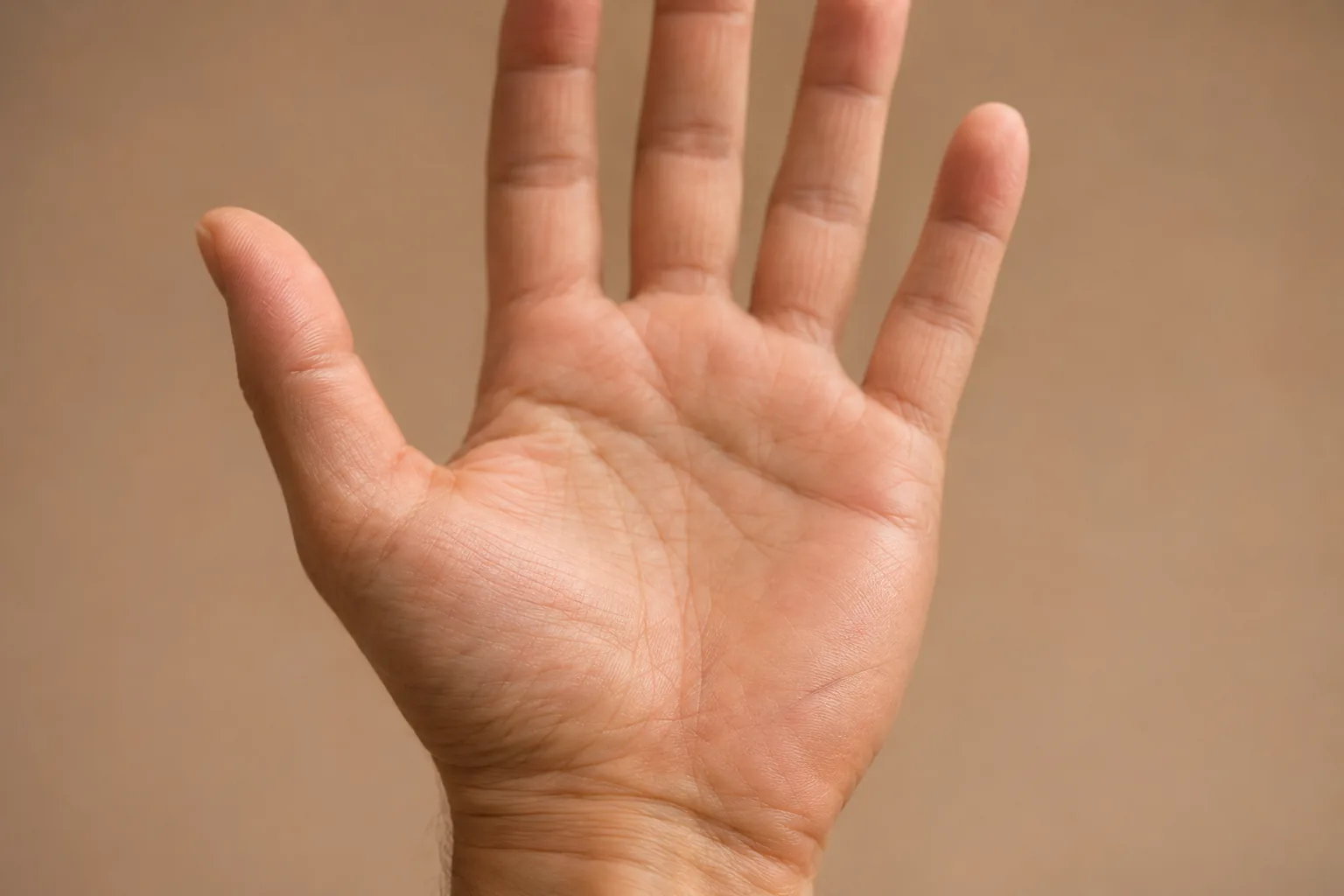
The Via Lasciva is a rare minor line that old palmistry books place low on the outer side of the palm, on the Mount of the Moon. The name is Latin for "the wanton way", and the books tied it to sexual appetite, heavy drinking, drugs and even an early death. Those claims were never tested, and we found no study linking this or any other palm crease to sex, addiction or lifespan. The three classic authors who describe it do not even agree on where it is. If you think you have one, the most likely answer is an ordinary crease in the outer palm. This page shows how to tell which crease it is, where each book put the line, and which old readings to set aside.
You found a line low on the outer edge of your palm, or a reading named the Via Lasciva, and the meanings you looked up worried you.
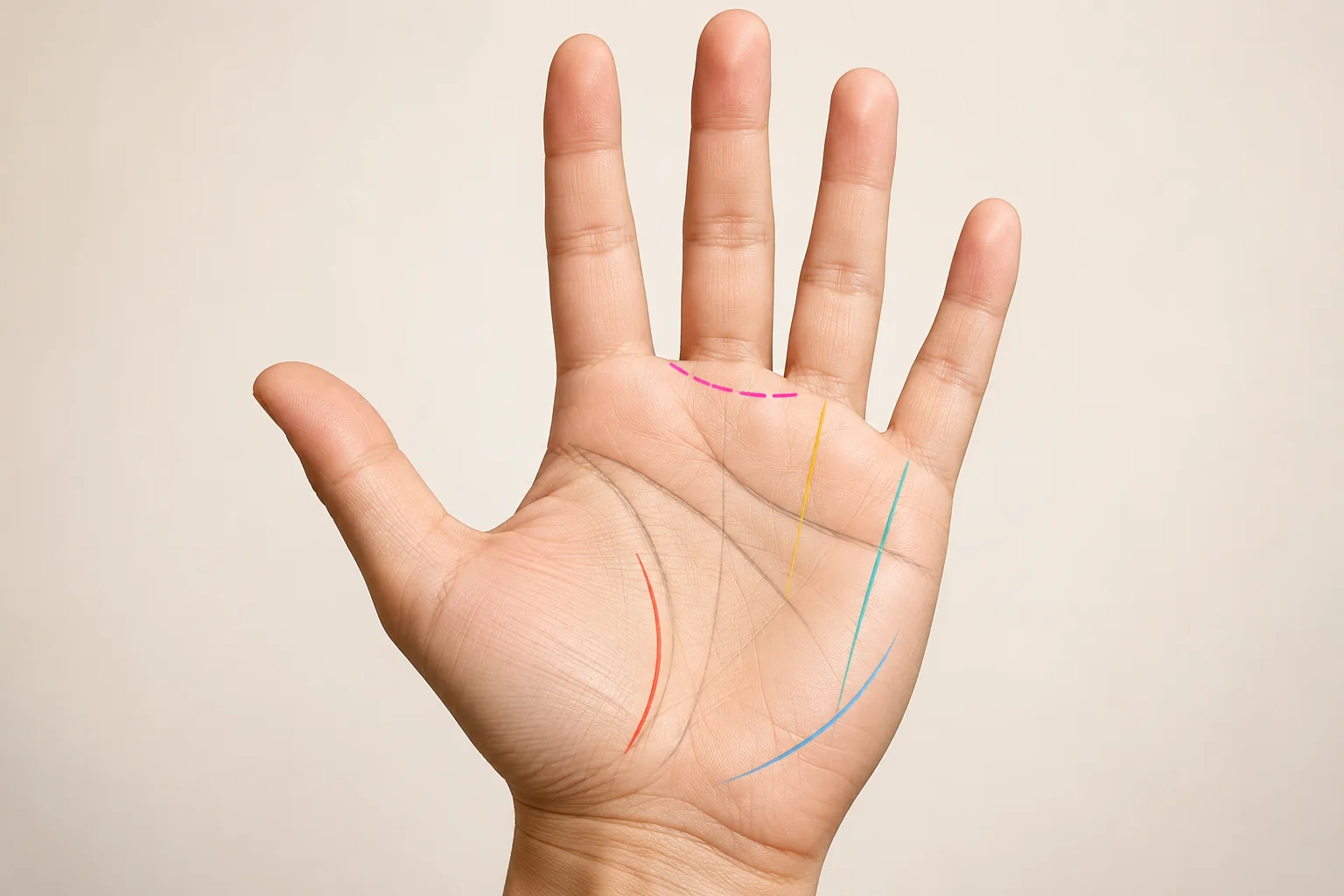
Is the line on your palm the Via Lasciva?
Look at your palm flat, in daylight coming from one side. Find the Mercury line first if you have one: the line that climbs toward the little finger, covered in our Mercury line guide. Then work through this list from the top and stop at the first match.
- It climbs toward the little finger. That is the Mercury line itself, or a branch of it.
- It is short and enters from the outer edge of the palm, roughly flat. Most palmists call that a travel line. See travel lines on the Mount of Moon.
- It curves like a crescent from under the little finger down toward the Moon mount. That is the shape usually called the intuition line, covered in our intuition signs guide.
- It is low on the palm and slants from the inner base of the Moon mount up toward the outer edge, running beside the Mercury line and outside it. That matches Benham's 1900 description of the Via Lasciva.
- It arcs from the Moon mount across toward the ball of the thumb, sometimes crossing the life line. That matches the first form in Cheiro's 1916 description.
- It runs off the bottom of the palm into the wrist. Both of Cheiro's books allow this form too.
- It is one of many fine criss-cross lines. That is a busy palm, not a named line. Our page on why some palms have so many lines explains what the skin is doing.
One more test. Bring your little finger slowly toward your thumb, as if cupping water. Creases in the outer lower palm often deepen as the skin folds. A line that changes with the fold is behaving like what it is, a crease where the hand bends.
The line that would not stay put: 1897 to now
The Via Lasciva is a good example of how palmistry's map was assembled. Here is where it sits in the three books most later writers copied from.
- 1897, Cheiro, Cheiro's Language of the Hand (the edition we read is copyright 1897). Cheiro calls it "the sister health-line", says it "is not often found, and is generally confounded with the hepatica" (the older name for the health or Mercury line), and says it "should by right run off the palm into the wrist". If it runs into the Mount of Venus instead, he writes, "it shortens the natural length of life by its excesses."
- 1900, William G. Benham, The Laws of Scientific Hand Reading. Benham spells it Via Lascivia. In his overview of the lines he is blunt: "I do not consider it as any more than a chance line, and consequently not entitled to be given a fixed place among the Minor lines." Later in the same book he describes it anyway, as a slanting line "rising from the inside of the base of the Mount of Moon and terminating on the lower part of the upper Mount of Moon near the percussion" (the percussion is the outer edge of the hand), and he attaches a long list of warnings to it.
- 1916, Cheiro, Palmistry for All. Nineteen years after his first description, Cheiro gives it a new shape: a semicircle that "connects the Mount of the Moon with that of Venus", or a line that runs "from the lower part of the Mount of Luna into the wrist". The warnings get darker too, with opium and morphine, drinking fits, and death "where it cuts through the Line of Life".
- Today. Some modern hand readers and forum writers use "allergy line" or "poison line" for a fine line in the same area, and they argue among themselves about whether it is the same mark as the Via Lasciva. We found no study behind the allergy name either.
So the same author moved the line between two of his own books, and the most careful author of the period said it did not deserve a fixed place at all. That is worth knowing before you take any meaning attached to it seriously.
Why is it called the "wanton way"?
Via is Latin for a road or way. Lascivus first meant playful or frisky, and later wanton or lustful, which is where the English word "lascivious" comes from.
Benham gives the reasoning behind the name, and it is mostly geography. A strong Mercury line was read as a sign of good health, so a second line running beside it was taken as health to spare, and the old writers assumed that spare energy would be spent "in lascivious practices". He adds that because the line slants and "does not rise to the top of the hand", it was taken to point at "the lower world" at the base of the palm. Then he pushes back on his own sources: unless the hand looked sensual, a person "would be much more likely to expend his surplus energy in the sphere of activity in which the type of his hands placed him." In other words, even in 1900 the name was a guess built on a guess.
Three old readings to set aside
"It shows a strong sexual appetite." The books start from the name and work backwards. No one counted lines and compared them with anyone's behaviour. A crease cannot tell you about a person's private life, and reading one that way about someone else is a judgement, not an observation.
"It shows a tendency to drink or drugs." Cheiro's 1916 claim about opium and morphine is stated with no cases, numbers or records behind it. Addiction has well-studied causes, and palm creases are not among them.
"If it crosses the life line, it means an early death." Both Cheiro and Benham link the crossing to illness or a shortened life. Our life line guide explains why no line on the palm measures lifespan, and a short crease meeting it does not change that.
What can stay, if you enjoy palmistry as a reflective practice, is the general idea some readers keep: a mark on the Moon mount as a prompt to think about restlessness, appetite for experience or the need for rest. That is a conversation starter, not a finding.
If the worry underneath is about drinking, drugs or health
Sometimes people look up this line because a reading named it and the worry stuck, or because they are already concerned about their own habits or someone else's. A line cannot confirm or rule out either. If drinking or drug use is worrying you, a real conversation will help more than any palm.
- India: the National Toll-Free Helpline for Drug De-addiction, 14446, and Tele MANAS, 14416, for mental health support.
- United States: the SAMHSA National Helpline, 1-800-662-4357, free and confidential, all day, every day.
- Anywhere: your doctor, or a local de-addiction or counselling service.
If your palms are itchy, very dry or covered in fine lines, that is a question for a doctor or dermatologist, not a palmist.
Common questions
Is the Via Lasciva rare?
The old books say so. Cheiro called it "not often found" and Benham "seldom seen". Nobody has counted it in a real population, and because the books place it differently, any count would depend on whose definition you used.
Is the Via Lasciva the same as the allergy line?
Some modern readers use the two names for the same mark and others insist they are different lines. There is no agreed definition and no study behind either name.
Which hand should I look at?
Palmists differ on which hand to read, and our guide to which hand to read covers the usual conventions. For this line, a crease on one hand only is common and means nothing on its own.
Is it bad to have a Via Lasciva?
No. It is a crease. The frightening meanings in the old books were never tested, and the most careful writer of the period thought it was a chance line.
Can the line fade or appear later?
Fine creases in the outer palm can look deeper or fainter with skin dryness, swelling and how you hold your hand when you look. For what is known about lines changing over the years, see do palm lines change over time?
Sources
- Cheiro, Cheiro's Language of the Hand, chapter "The Via Lasciva and the Line of Intuition" and the list of lesser lines, read in a copyright 1897 edition, Internet Archive scan.
- William G. Benham, The Laws of Scientific Hand Reading (1900), the introduction to the minor lines and the section "The Via Lascivia", Internet Archive scan.
- Cheiro, Palmistry for All (1916), chapter "The Line of Intuition and the Via Lasciva", Project Gutenberg ebook 20480.
- Modern Palmistry forum, "A household of Via Lascivia palmar lines", for the modern allergy line naming debate.
- Wiktionary, lascivus, for the Latin word.
- Ministry of Social Justice and Empowerment, Government of India, National Toll-Free Helpline for Drug De-addiction (14446), Tele MANAS (14416), and SAMHSA's National Helpline.