
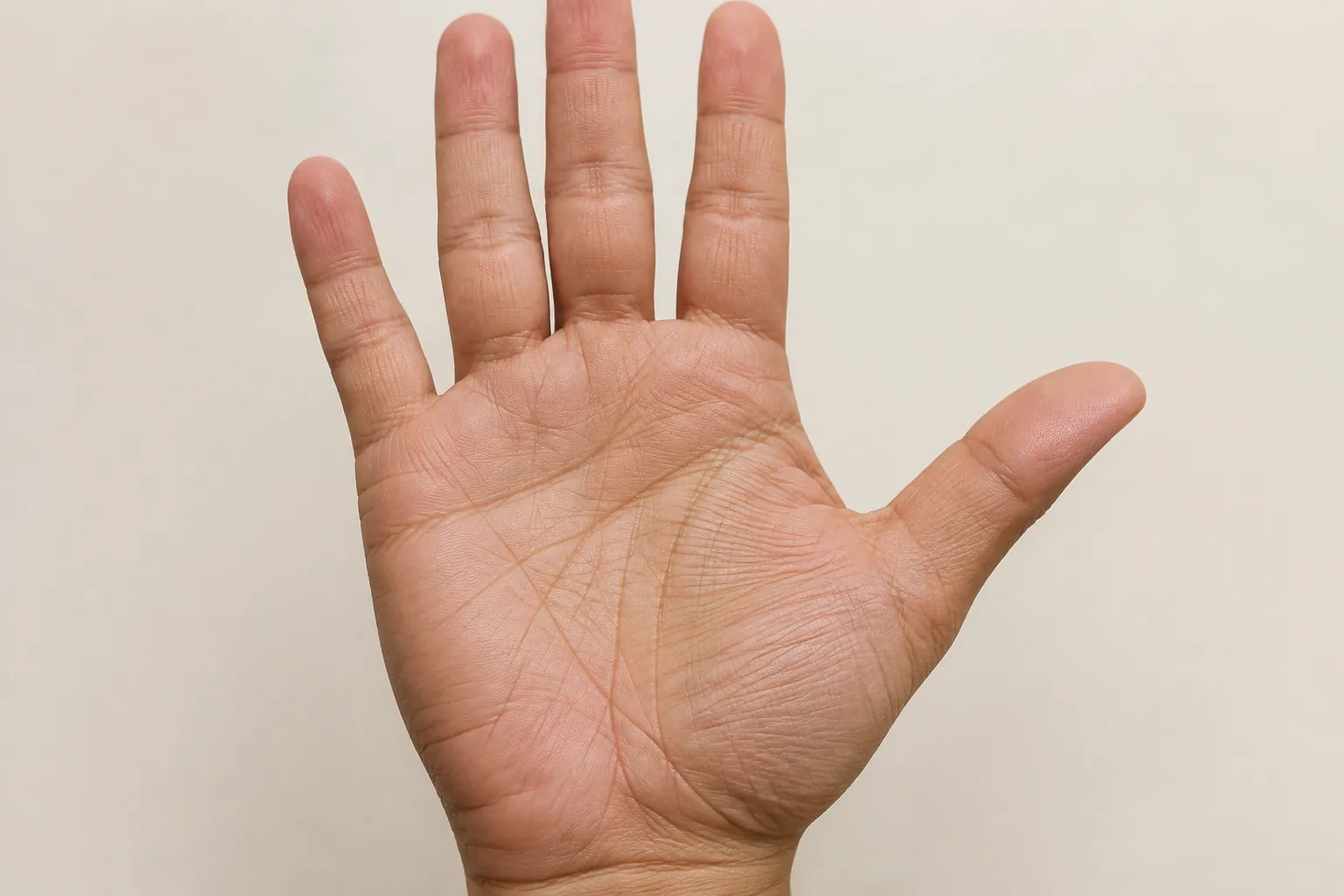
A palm crowded with lines is common, and on its own it says nothing bad about your health, your luck or your mind. Your main creases formed before you were born. The extra fine lines are mostly a matter of skin type, and in some people they come with an inherited tendency to dry skin. In palmistry, a hand like this is called a "full hand". The tradition reads it as a sensitive, busy temperament, but no study we could find has tested that idea.
You have noticed your palm has far more lines than other people's, and someone told you it means worry or a hard life.
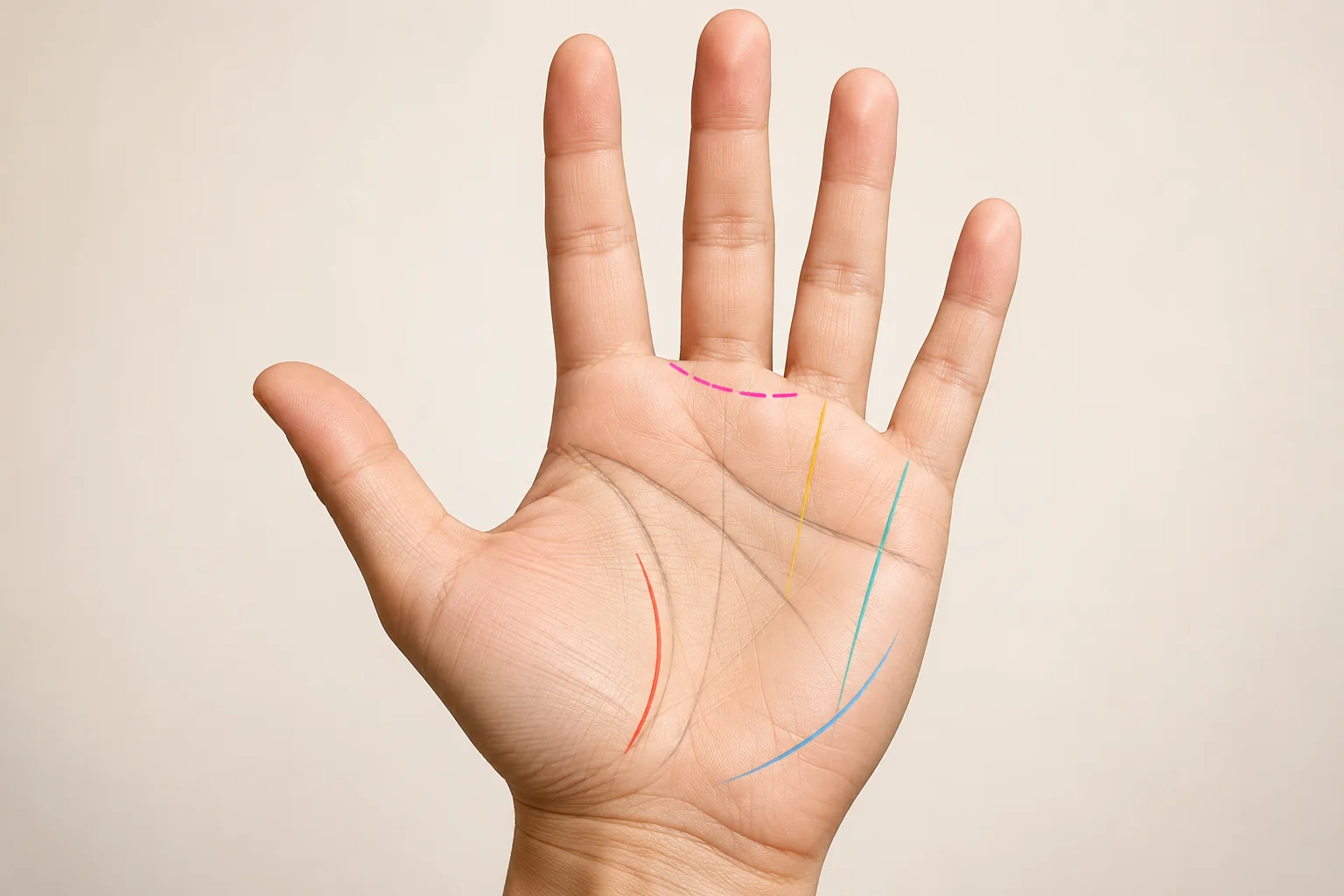
If someone online told you your lines mean anxiety, depression or a hard life, this page is for you. It covers what the tradition says, what dermatologists have found, and a simple photo check you can do tonight.
What palmists call a full hand
Modern hand readers sort palms by how crowded they look.
| Hand type | What it looks like | How the tradition reads it |
|---|---|---|
| Full hand | Many fine lines crossing the palm, often with small grilles and crossbars | A responsive, easily stimulated temperament with many interests at once |
| Average hand | The main lines plus a few minor ones | No special reading |
| Empty hand | Mostly the three main lines, clear and few | A steady, focused temperament |
Neither end is "better" in the tradition. One modern palmist, Lawrence Rook, wrote in October 2026 that clients with full hands often remember having those lines since childhood and that "moisturiser won't reduce them". He reads line density as a sign of how a person's nervous system is wired.
That is an interpretation, not a finding. We searched for studies that counted palm lines and measured personality or anxiety in the same people and found none. So treat the full-hand reading as a reflection prompt: does "busy and responsive" describe you, or not?
What strangers on Reddit tell people
"Why do I have so many lines on my palm?" is a regular post on r/palmistry. The replies follow a pattern. One commenter called a crowded palm the sign of "a natural worrier" who is "prone to a wide range of physical illness". Another said people with many lines are "prone to depression anxiety and other poor mental health issues". A third answered a different user with one word: "That's worry."
The original posters often add the same detail. One wrote: "I've had all the lines since I was kid. My mother has lots of lines and so does my son."
That detail matters more than the readings. Lines that run in a family from early childhood point to skin and genes. A crease count cannot tell anyone whether you are anxious or unwell. If you are worried about your mood, talk to a doctor or a counsellor, not a palm reader.
What your skin is actually doing
Palm lines come in layers, and each layer has a different cause.
The main creases form early. A 1986 study of 160 fetal hands found that the major palm creases appear around the time the small pads of the developing hand form, in the first half of pregnancy, and with some exceptions independently of the hand's folding movements. Our page on whether palm lines change covers what happens to them later in life.
Fine lines can be a skin trait. Dermatologists use the term "hyperlinear palms" for palms with more and deeper fine lines than usual. In a 1981 study of 178 people with atopic eczema, 28 percent had increased palm markings. Most of those also had ichthyosis vulgaris, an inherited dry-skin condition. People with eczema alone almost always had ordinary palms.
It is linked to one gene, loosely. Ichthyosis vulgaris is caused by changes in the filaggrin gene, which helps build the skin's outer barrier. A 2021 analysis of 3,656 children with eczema or at high risk of it found that 37 percent had hyperlinear palms. A busy palm was not a reliable sign of the gene change, but a palm without it made the change unlikely. All the children in that study were of white European ancestry, so the numbers may differ elsewhere.
What this means for you: a palm full of fine lines from childhood, especially if a parent's palm looks the same, is most often just how your skin is built. If your skin is also dry, rough, flaky or itchy, a doctor or dermatologist can tell you whether a barrier condition is involved and what helps.
Telling the lines apart
Before you count, sort what you see. Our minor lines guide shows how palmists separate a true line from a crease.
| What you see | What it is | Palmistry reading | What is known |
|---|---|---|---|
| Three or four long, deep lines | Major flexion creases | Life, head, heart and fate lines | Form before birth and stay fairly stable |
| Shorter clear lines under the fingers | Minor lines | Sun, Mercury and other named lines | Vary a lot between people |
| A web of fine criss-cross lines | Fine skin lines | Full hand, worry or stress lines | Linked to skin type and, in some people, inherited dry skin |
| Small lattices on a mount | Grilles | Scattered energy in that area | Part of the same fine-line pattern |
The grille guide has more on how density changes a traditional reading, and deep or faint lines covers line quality.
Try it: the two-photo check
This takes ten minutes and tells you which lines are deep creases and which are surface lines.
- Photo one, dry. Wash your hands, dry them, wait five minutes, and take a daylight photo of your dominant palm, held open and loose. For lighting and distance, follow the steps in how to take a clear palm photo.
- Moisturise. Rub in a plain, unscented moisturiser and wait 20 minutes.
- Photo two, moisturised. Same light, same distance, same hand position.
- Compare. Put the photos side by side and note which lines stay sharp and which soften.
- Optional, ask a parent. Photograph a parent's or sibling's palm the same way and compare the overall busyness.
Here is an invented example of what a filled-in comparison might look like.
| Feature | Dry photo | Moisturised photo | Likely type |
|---|---|---|---|
| Life, head and heart lines | Deep and clear | Deep and clear | Major creases |
| Line under the ring finger | Clear | Clear | Minor line |
| Criss-cross lines on the lower palm | Many, sharp | Softer, fewer visible | Fine skin lines |
| Short bars on the outer edge | Sharp | Faint | Fine skin lines |
In this invented example, the deep creases did not move and much of the "crowd" softened. That is what you would expect if many of the extra lines are surface skin lines. If almost nothing changes, your lines are simply deep, which is also normal.
What a full hand does not mean
- It does not mean you will have a hard life. No study links line count to life events.
- It does not mean you are anxious. Some people with full hands are calm, and some with empty hands worry a lot.
- It does not mean you are older than your age. Children can have full hands too, as the 2021 study shows.
- It does not mean something is wrong with your health. Look at the skin itself, not the line count. Dryness, cracking, itching or a sudden change are reasons to see a doctor.
Our palm swap test summarises what studies have checked about palm lines in general, and the twins and palm lines page covers which crease patterns run in families.
If you want to read your full hand anyway
Palmistry can still be an interesting way to think about yourself, as long as you hold it lightly. With a busy palm, start with the main lines and ignore the web of fine lines at first. Then ask whether the traditional full-hand description fits you. If it does not, drop it. Our beginner's guide walks through a whole hand in order.
Common questions
Is it rare to have a lot of lines on your palm?
No. Busy palms are common, and in studies of children with eczema more than a third had them. There is no good figure for the general population, but palmists describe full hands as a familiar type.
Do a lot of palm lines mean anxiety or stress?
Some palmists read them that way, but no study we found has linked line count to anxiety. Many fine lines are a skin trait that can run in families and show up in early childhood.
Can moisturiser get rid of palm lines?
It will not remove the main creases. It may make some fine surface lines look softer for a while, and a before-and-after photo is the simplest way to see whether that happens on your hand.
What is an empty hand in palmistry?
An empty hand shows mostly the three main lines, with few minor ones. The tradition reads it as a steady, focused temperament. Like the full hand, that reading has not been tested.
When should I see a doctor about my palm lines?
Not because of the lines themselves. See a doctor if the skin on your palms is very dry, cracked, scaly or itchy, or if you notice a sudden change in how your hands look or feel.
Sources
- M. Uehara and S. Hayashi, "Hyperlinear palms: association with ichthyosis and atopic dermatitis", Archives of Dermatology 117 (1981), pages 490 to 491, PubMed 7259244.
- Bradshaw and colleagues, "Clinical examination for hyperlinear palms to determine filaggrin genotype: a diagnostic test accuracy study", Clinical and Experimental Allergy (2021), PubMed 34608691, full text.
- S. Kimura and T. Kitagawa, "Embryological development of human palmar, plantar, and digital flexion creases", Anatomical Record 216 (1986), pages 191 to 197, PubMed 3777451.
- Lawrence Rook, Why do I have so many lines on my hand?, October 4, 2026, for a modern palmist's view of the full hand.
- Reddit r/palmistry threads: why do I have so many lines? (August 2024) and why do I have so many lines on my palm? (February 2025).
- The two-photo comparison table is invented for illustration.