
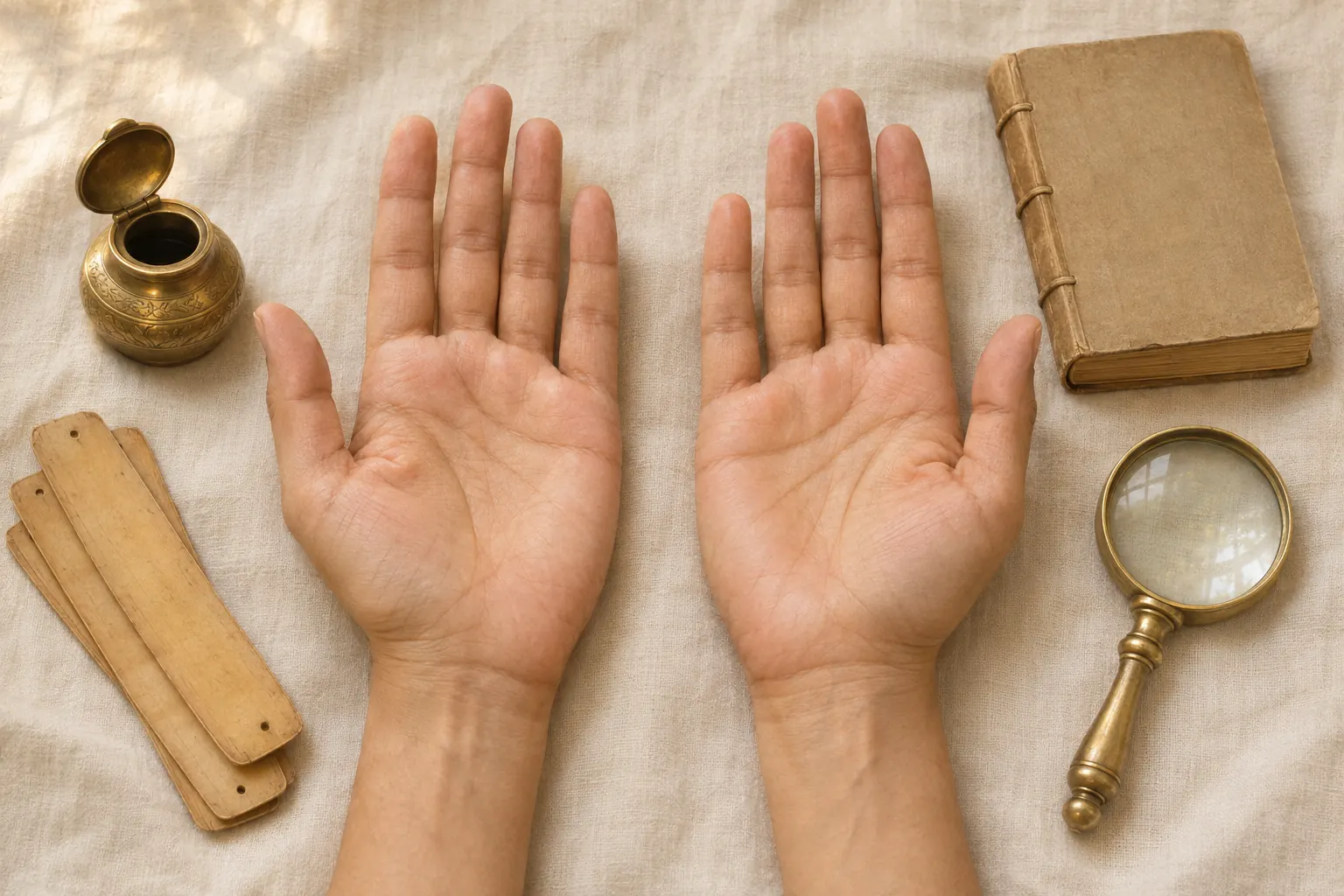
Indian and Western palmistry look at the same hand, but they are not two translations of one book. In practice, most "Indian" palm reading today uses the Western map of lines and mounts with Hindi names attached, and adds a layer of karma and planets. The old Sanskrit marks tradition is different again. It reads the palm mostly by shapes, such as a fish, a conch or a lotus, and attaches predictions about wealth and rank to them. Knowing which of the three you are looking at explains most of the arguments you will see about what a line "really" means. None of the three has been shown to predict anything, and this page treats them as traditions to compare, not facts about your hand.
You have seen palm charts that call the same line by a Hindi and an English name and give different meanings, and want to know which tradition is which and what is actually old.
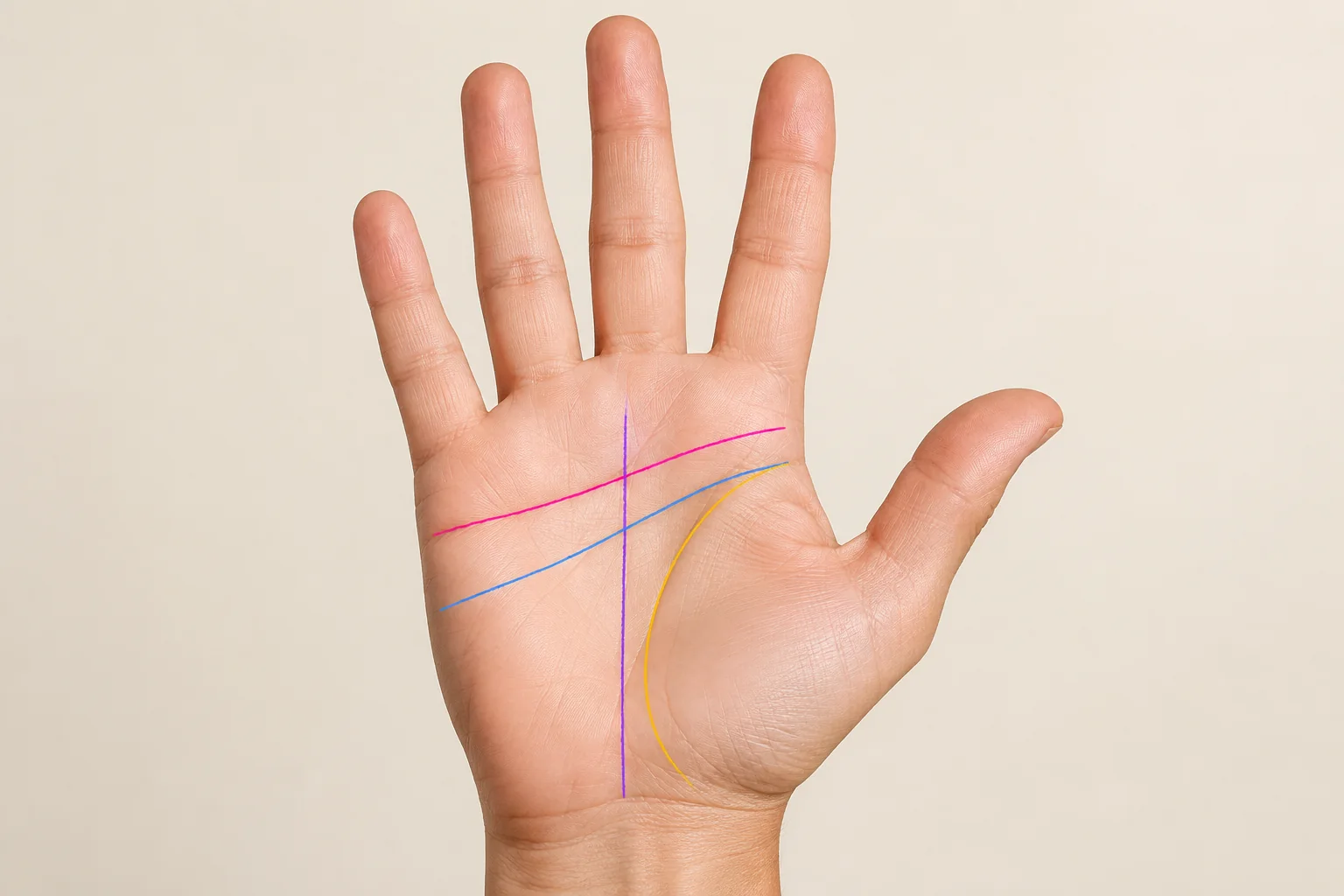
Which book are you holding?
When a chart says "Indian palmistry" or "Western palmistry," it is usually one of three layers that got blended together.
| Layer | Where it comes from | What it reads | Typical kind of claim |
|---|---|---|---|
| Classical Sanskrit marks tradition (Hasta Samudrika) | Texts such as the Brihat Samhita (6th century) and the Samudrika-tilaka (about 1160 to 1175) | Shapes and omens on the palm, among marks all over the body | Wealth, rank, generosity, as omens |
| Western chiromancy and chirology | Medieval manuals, then the 1800s and early 1900s: d'Arpentigny (1839), Heron-Allen (1883), Cheiro, Benham (1900) | Four named lines, mounts, hand shape | Character, temperament, life direction |
| Modern Indian practice | Hindi line names and graha-named mounts layered on the Western map, read with Jyotish and karma ideas | The same lines and mounts, read against planets and karma | Karmic and planetary explanations |
Our history of palmistry covers how these threads grew. This page is about what changes when you move between them.
The Hindi names are a translation key
If you have seen Jeevan Rekha, Mastishk Rekha or Hridaya Rekha, you have met modern Hindi names for the Western lines. Palmistry Path, a beginner site that cites its sources, says plainly that these names "map the Western scheme onto Indian vocabulary rather than descending from it." They are really used, and they are handy to know when you read Hindi or Indian-English material.
| Western name | Hindi name in modern use | Our page |
|---|---|---|
| Life line | Jeevan Rekha | Life line |
| Head line | Mastishk Rekha | Head line |
| Heart line | Hridaya (or Hriday) Rekha | Heart line |
| Fate line | Bhagya Rekha | Fate line |
| Sun line | Surya Rekha | Sun line |
| Marriage line | Vivah Rekha | Marriage line |
The point of the table is practical. A Hindi name does not tell you that a classical Indian meaning sits behind it. Palmistry Path puts the warning this way: "frequently the underlying interpretation being taught is the Western one wearing Indian terminology."
What the oldest text actually reads
The Brihat Samhita of Varahamihira is a 6th-century encyclopedia that includes a chapter on the features of men. In N. Chidambaram Iyer's 1884 English translation, its palm verses do not describe a life line or a heart line. They read glossy or dry lines, and shapes. Three examples:
- Verse 43: "If the lines in the palm of the hand be glossy and deep, the man will be rich," and the same verse says the opposite of lines that are not.
- Verse 44: "If the three lines issuing from the wrist reach the middle of the palm, the person will be a king, and if there be two marks of the shape of the fish in the middle of the palm, the person will daily feed many people."
- Verse 45 (one of several shapes it lists): "if of the shape of a conch shell, an umbrella, a palanquin, an elephant, a horse or a lotus, the person will be a king."
That is an omen literature, and it is openly predictive: wealth, kingship, feeding others. Palmistry Path describes it the same way, and notes that it is not Vedic scripture, as popular accounts sometimes say. It cites Zysk for the earliest surviving collection on bodily marks, around the 1st century CE in the Gargiyajyotisha, with systematic treatments like the Brihat Samhita following. Our page on the fish sign covers one of these old shapes as it is read today.
Two things follow. First, if someone tells you a particular reading of the heart line is "ancient Indian," ask which text. The classical verses above do not contain it. Second, the old verses make claims about kings and wealth that nobody has shown a palm can support, so they are best read as history.
Same mount name, different meaning
The mounts are where the two traditions look most alike. Both name them for planets: Jupiter (Guru Parvat), Saturn (Shani Parvat), the Sun (Surya Parvat), Mercury (Budh Parvat), Venus (Shukra Parvat), the Moon (Chandra Parvat), and Mars (Mangal Parvat) at two spots. Palmistry Path warns that shared names do not mean shared meanings, and that how much is shared inheritance and how much is later convergence cannot be settled. It also notes the possible influence of the Western mount scheme on modern Indian practice. Our mounts overview walks through the Western layout.
The usual difference is in the frame. A Western guide reads a full Mount of Jupiter as ambition, leadership or confidence. A Jyotish-minded Indian reader may read it against Jupiter's place in the birth chart, a frame Palmistry Path describes as rooted in Indian astrology. Same pad of flesh, two different questions. Neither has been shown to match outcomes.
Reading a chart in Hindi or Indian English
If your chart or app is in Hindi, three checks save a lot of confusion.
- Spelling varies. Hridaya and Hriday, Mastishk and Mastishka, Budh and Budha all refer to the same line or mount. A search for one spelling will miss pages that use the other.
- A name is not a method. A "Bhagya Rekha" label tells you which line the author means. It does not tell you whether the author is reading it as Western career direction, as karma phala, or as a classical omen. Look at the sentence after the label.
- Count the mounts. Some Indian charts show Mars twice, as an upper and a lower Mangal Parvat, and some add a plain of Mars in the centre. Western charts do the same, but the labels differ, so compare positions, not names. Our mounts overview shows the usual layout.
Which hand to read
Both traditions have a hand rule, and both vary. The Western convention that most guides give is dominant hand for the life you are shaping and the other for what you started with. Some Indian teachers say the right hand for men and the left for women. Palmistry Path says it has no source it would cite for any single Indian rule and that conventions vary by school. Our which hand to read page covers the options and why comparing both palms is the sturdier habit, so there is no need to repeat it here.
A test you can run: three captions for one line
This takes about fifteen minutes and shows how much of a reading is the frame. Pick one feature on your own palm that you can see clearly. Write three captions for it, one per layer, then ask of each caption what would count as it being wrong.
- Western caption. What would a modern chirology guide say about the line's character or direction?
- Modern Indian caption. What would a Jyotish-linked guide say about karma or the planet?
- Classical caption. Does the line or mark match a shape in the old verses, such as a fish, a conch or a lotus? If not, write "no match."
- For each caption, write one event or observation that could, in principle, show it wrong.
An invented example: Rohan, 29, has a faint, broken fate line. His Western caption was that career direction may be flexible or change in stages. His modern Indian caption was that the karmic fruits of his work show up less clearly. His classical caption was "no match," because the verses name no line like it. For the fourth step he could not name one event that would show either of the first two captions wrong. That is the finding. A caption that no event can contradict is a story, which is fine for reflection and not fine as a forecast.
Using both without mixing them up
- Name the layer. Ask whether a claim comes from a classical text, a Western author or a modern teacher.
- Keep the vocabulary separate from the meaning. A Hindi name does not make a reading classical.
- Do not crown one tradition as more accurate. Age is not evidence of accuracy, and neither has been shown to predict anything.
- Skip any reading that gives a verdict about health, a lifespan, a marriage or a child. These are old omen claims, not information about you.
- Treat the hand as a prompt for reflection. If a line makes you think about your work or relationships, think about that.
Common questions
What is the difference between Indian and Western palmistry?
Three things mix together under those names. The classical Sanskrit marks tradition reads palm shapes as omens. Western chirology names four main lines and the mounts and reads character. Modern Indian practice usually puts Hindi names and karma and planet ideas on the Western map. They share vocabulary, not a single rulebook.
Are Jeevan, Hridaya, Mastishk and Bhagya Rekha ancient names?
According to Palmistry Path, they are modern Hindi terms that map the Western four-line scheme onto Indian vocabulary. The oldest text discussed here, the Brihat Samhita, does not name a life line or heart line.
What does Hasta Samudrika Shastra mean?
Hasta means hand and shastra means a body of classical knowledge. Samudrika is the branch concerned with bodily marks. Wikipedia glosses Samudrika Shastra as roughly "knowledge of body features," and hand reading is one part of it, alongside reading the face and the rest of the body.
Is Bhagya Rekha the same as the fate line?
In modern practice it is the counterpart of the Western fate line, though bhagya means destiny, fortune or luck and is usually read through karma. As with the Western line, it is not always present, and its absence is not a defect.
Is Indian palmistry more accurate than Western palmistry?
Neither has been shown to predict events. Palmistry Path puts it plainly: age is not evidence of accuracy. Treat both as traditions for reflection. Our page on whether palm reading is real shows how to test the claims yourself.
Sources
- Varahamihira, Brihat Samhita, chapter 68 "On the features of Men," English translation by N. Chidambaram Iyer (1884), at WisdomLib, verses 43 to 49. Sanskrit of verses 44 and 45 at siva.sh.
- Palmistry Path, Indian Palmistry: A Beginner Guide to Hasta Samudrika Shastra (May 27, 2026), for the modern status of the Hindi line names, the mounts caution, the which-hand caution and the dating of the marks literature. It cites Kenneth G. Zysk, The Indian System of Human Marks (Brill, 2016).
- Wikipedia, Samudrika Shastra, for the meaning of the term, the Samudrika-tilaka (about 1160 to 1175) and the manuscript tradition, and Palmistry, for the nineteenth-century Western figures.
- Likhahai, Palmistry: lines, mounts, signs and hand shapes, for the Hindi names of lines and mounts as used in current Indian-language material.
- PalmVision, Indian vs Western Palmistry (March 11, 2026), for the stated right-hand-for-men, left-hand-for-women convention. It is a commercial site, so the rule is attributed, not asserted.
- The Rohan example is invented for illustration.